
牟合方盖面面观
几何画板及绘图内容加载中,请稍等……
所属专题
intersection: surface-surface, curve-curve
surface 3D /3D-Oberflächen 1
surface 3D /3D-Oberflächen 1
intersection: surface-surface, curve-curve
intersection: surface-surface, curve-curve
intersection: surface-surface, curve-curve
Volumes and Surface Areas of Pyramids, Cones and Spheres
Volumes in Ancient Chinese Mathematics 中国古算中的体积
Volumes of Pyramid and Sphere in Ancient Chinese Mathematics
Volume of Spheres in Ancient Chinese Mathematics
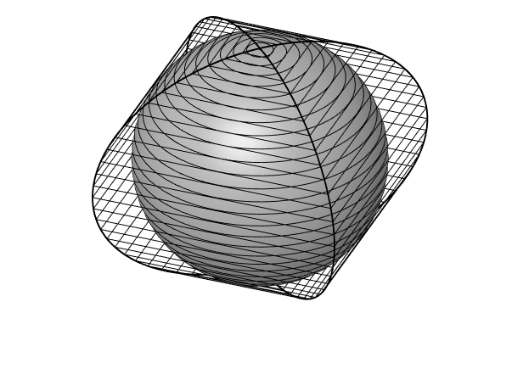
这个范例演示了牟合方盖的几何构造。牟合方盖是古代中国数学家刘徽提出的一个几何体,用于计算球体体积。该范例涉及球体、体积和函数等核心数学概念。通过使用Surface、Sphere、CurveCartesian和Sequence等GeoGebra命令,可以动态展示牟合方盖的形成过程。适合高中数学教学和研究。
GeoGebra 命令及参数
Surface(sqrt(1 - t^(2)), (s * sqrt(1 - t^(2))), t + 1, s, -1, 1, t, -1, 1) → bSphere((0, 0, 1), r) → aSurface((s * sqrt(1 - t^(2))), sqrt(1 - t^(2)), t + 1, s, -1, 1, t, -1, 1) → cSurface((-sqrt(1 - t^(2))), (s * sqrt(1 - t^(2))), t + 1, s, -1, 1, t, -1, 1) → dSurface((s * sqrt(1 - t^(2))), (-sqrt(1 - t^(2))), t + 1, s, -1, 1, t, -1, 1) → eCurveCartesian(sqrt(1 - t^(2)), sqrt(1 - t^(2)), t + 1, t, -1, 1) → fCurveCartesian((-sqrt(1 - t^(2))), sqrt(1 - t^(2)), t + 1, t, -1, 1) → gCurveCartesian((-sqrt(1 - t^(2))), (-sqrt(1 - t^(2))), t + 1, t, -1, 1) → hCurveCartesian(sqrt(1 - t^(2)), (-sqrt(1 - t^(2))), t + 1, t, -1, 1) → iSequence(Circle[(0, 0, 1 - (r * cos(θ))), (r * sin(θ)), zAxis], θ, 0, π, π / n) → list3Sequence(Polygon[((-sin(θ)), (-sin(θ)), 1 - cos(θ)), (sin(θ), (-sin(θ)), 1 - cos(θ)), (sin(θ), sin(θ), 1 - cos(θ)), ((-sin(θ)), sin(θ), 1 - cos(θ))], θ, 0, π, π / n) → list4
AI 绘图提示语参考
绘制一个名为“牟合方盖”的立体几何图形。先构造一个单位球体,球心位于z轴上方某点。然后,用四个曲面围成该立体,每个曲面由参数方程定义,形状类似圆柱面的一部分,它们相互垂直交叉,共同围成一个类似两个方盖扣合的空间。再画出四条空间曲线,作为这些曲面的交线,形成方盖的棱边。最后,添加一系列水平圆环和正方形截面,从球顶到球底均匀分布,展示该立体与球体的关系,以及体积计算中的截面变化。整体呈现半透明的三维效果,便于观察内部结构。
以上提示语为根据原始绘图命令整理而来,仅供参考。