
判断函数是否可逆及求函数值
几何画板及绘图内容加载中,请稍等……
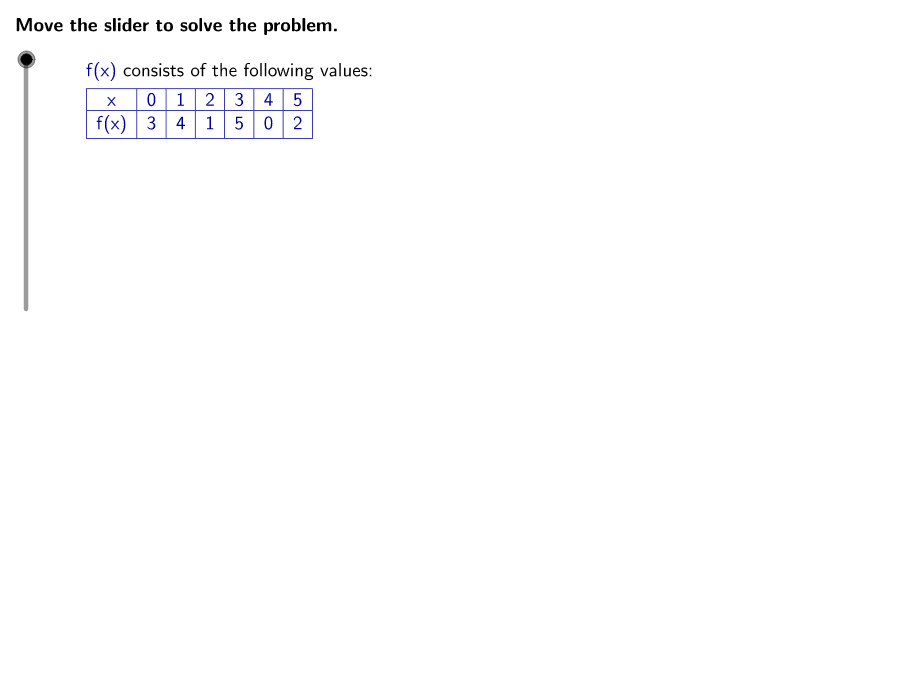
本范例演示如何通过表格判断函数是否可逆,并利用表格求特定函数值。涉及的核心数学概念为函数可逆性及其判定条件。作图要点包括使用 GeoGebra 的 Element、IndexOf、LaTeX、Corner、TableText、If 等命令和对象来创建和操作表格、函数表示及条件判断。适合高中阶段学生学习函数性质及 GeoGebra 应用。
GeoGebra 命令及参数
Element(common, 3) → v3IndexOf(v3, functionvalues) → p3Element(common, 2) → v2IndexOf(v2, xvalues) → p2Element(common, 1) → v1IndexOf(v1, xvalues) → p1LaTeX(steps) → counterLaTeX("\text{Use the buttons below to return to the original problem or}\cr\text{randomly generate a similar practice problem.}") → RandomizationTextCorner(1) → ACorner(3) → BTableText({Append["x", xvalues], Append["f(x)", functionvalues]}, "c|_") → dataLaTeX("\text{Determine whether the inverse function }\textcolor{#000099}{f^{–1}(x)}\text{ exists.}") → text1LaTeX("\text{To determine whether a function is invertible, check to see if any }\textcolor{#000099}{x}\text{- or }\textcolor{#000099}{y}\text{-values}\cr\text{have been used more than once.}") → text2LaTeX("\text{The function represented in the table repeats an }\textcolor{#000099}{x}\text{- value, so the function is not}\cr\text{“one-to-one” and is not invertible. The inverse }\textcolor{#000099}{f^{-1}(x)}\text{ does not exist.}") → text3bIf(Length[xvalues] ≟ Length[Unique[xvalues]], "y", "n") → xuniqueLaTeX("\text{The function represented in the table repeats a }\textcolor{#000099}{y}\text{- value, so the function is not}\cr\text{“one-to-one” and is not invertible. The inverse }\textcolor{#000099}{f^{-1}(x)}\text{ does not exist.}") → text3cLaTeX("\text{The function represented in the table repeats an }\textcolor{#000099}{x}\text{- and a }\textcolor{#000099}{y}\text{-value, so the}\cr\text{function is not “one-to-one” and is not invertible. The inverse }\textcolor{#000099}{f^{-1}(x)}\text{ does not}\cr\text{exist.}") → text3dIf(Length[functionvalues] ≟ Length[Unique[functionvalues]], "y", "n") → inverseuniqueLaTeX("\text{The function represented in the table does not repeat any }\textcolor{#000099}{x}\text{-values or any }\cr\textcolor{#000099}{y}\text{-values, so the function is “one-to-one” and is invertible. The inverse }\textcolor{#000099}{f^{–1}(x)}\cr\text{exists.}") → text3aIf(xunique ≟ "y", If[inverseunique ≟ "y", LaTeX[text3a], LaTeX[text3c]], If[inverseunique ≟ "y", LaTeX[text3b], LaTeX[text3d]]) → text3Element(common, 4) → v4Element(functionvalues, p1) → m1LaTeX((("\text{Find the function value }\textcolor{#000099}{f(" * v1) * ")}.")) → text4Element(xvalues, p3) → m3Element(functionvalues, p2) → m2LaTeX((("\text{Find the function value }\textcolor{#000099}{f(" * v2) * ")}.")) → text7LaTeX((((((((((((((("\text{To find the value of }\textcolor{#000099}{f(x)}\text{ at }\textcolor{#000099}{x=" * v1) * "}\text{, locate the value }\textcolor{#000099}{") * v1) * "}\text{ in the }\textcolor{#000099}{x}\text{ row of the table.}\cr\text{The value }\textcolor{#000099}{") * m1) * "}\text{ directly below }\textcolor{#000099}{x = ") * v1) * "}\text{ is the value of }\textcolor{#000099}{f(x)}\text{ at }\textcolor{#000099}{x = ") * v1) * "}\text{. That is, }\textcolor{#000099}{f(") * v1) * ") = ") * m1) * "}.")) → text5LaTeX((((((((((((((("\text{To find the value of }\textcolor{#000099}{f(x)}\text{ at }\textcolor{#000099}{x=" * v2) * "}\text{, locate the value }\textcolor{#000099}{") * v2) * "}\text{ in the }\textcolor{#000099}{x}\text{ row of the table.}\cr\text{The value }\textcolor{#000099}{") * m2) * "}\text{ directly below }\textcolor{#000099}{x = ") * v2) * "}\text{ is the value of }\textcolor{#000099}{f(x)}\text{ at }\textcolor{#000099}{x = ") * v2) * "}\text{. That is, }\textcolor{#000099}{f(") * v2) * ") = ") * m2) * "}.")) → text8LaTeX((("\text{Find the inverse function value }\textcolor{#000099}{f^{-1}(" * v3) * ")}.")) → text10IndexOf(v4, functionvalues) → p4Element(xvalues, p4) → m4TableText({Join[{{LaTeX["\textcolor{#000099}{x}"]}, Sequence[LaTeX[(("\textcolor{#000099}{" * Element[xvalues, i]) * "}")], i, 1, p1 - 1], {LaTeX[(("\textcolor{#CC0000}{" * Element[xvalues, p1]) * "}")]}, Sequence[LaTeX[(("\textcolor{#000099}{" * Element[xvalues, i]) * "}")], i, p1 + 1, 6]}], Join[{{LaTeX["\textcolor{#000099}{f(x)}"]}, Sequence[LaTeX[(("\textcolor{#000099}{" * Element[functionvalues, i]) * "}")], i, 1, p1 - 1], {LaTeX[(("\textcolor{#CC0000}{" * Element[functionvalues, p1]) * "}")]}, Sequence[LaTeX[(("\textcolor{#000099}{" * Element[functionvalues, i]) * "}")], i, p1 + 1, 6]}]}, "c|_") → text6TableText({Join[{{LaTeX["\textcolor{#000099}{x}"]}, Sequence[LaTeX[(("\textcolor{#000099}{" * Element[xvalues, i]) * "}")], i, 1, p2 - 1], {LaTeX[(("\textcolor{#CC0000}{" * Element[xvalues, p2]) * "}")]}, Sequence[LaTeX[(("\textcolor{#000099}{" * Element[xvalues, i]) * "}")], i, p2 + 1, 6]}], Join[{{LaTeX["\textcolor{#000099}{f(x)}"]}, Sequence[LaTeX[(("\textcolor{#000099}{" * Element[functionvalues, i]) * "}")], i, 1, p2 - 1], {LaTeX[(("\textcolor{#CC0000}{" * Element[functionvalues, p2]) * "}")]}, Sequence[LaTeX[(("\textcolor{#000099}{" * Element[functionvalues, i]) * "}")], i, p2 + 1, 6]}]}, "c|_") → text9TableText({Join[{{LaTeX["\textcolor{#000099}{x}"]}, Sequence[LaTeX[(("\textcolor{#000099}{" * Element[xvalues, i]) * "}")], i, 1, p3 - 1], {LaTeX[(("\textcolor{#CC0000}{" * Element[xvalues, p3]) * "}")]}, Sequence[LaTeX[(("\textcolor{#000099}{" * Element[xvalues, i]) * "}")], i, p3 + 1, 6]}], Join[{{LaTeX["\textcolor{#000099}{f(x)}"]}, Sequence[LaTeX[(("\textcolor{#000099}{" * Element[functionvalues, i]) * "}")], i, 1, p3 - 1], {LaTeX[(("\textcolor{#CC0000}{" * Element[functionvalues, p3]) * "}")]}, Sequence[LaTeX[(("\textcolor{#000099}{" * Element[functionvalues, i]) * "}")], i, p3 + 1, 6]}]}, "c|_") → text12LaTeX((("\text{Find the inverse function value }\textcolor{#000099}{f^{-1}(" * v4) * ")}.")) → text13TableText({Join[{{LaTeX["\textcolor{#000099}{x}"]}, Sequence[LaTeX[(("\textcolor{#000099}{" * Element[xvalues, i]) * "}")], i, 1, p4 - 1], {LaTeX[(("\textcolor{#CC0000}{" * Element[xvalues, p4]) * "}")]}, Sequence[LaTeX[(("\textcolor{#000099}{" * Element[xvalues, i]) * "}")], i, p4 + 1, 6]}], Join[{{LaTeX["\textcolor{#000099}{f(x)}"]}, Sequence[LaTeX[(("\textcolor{#000099}{" * Element[functionvalues, i]) * "}")], i, 1, p4 - 1], {LaTeX[(("\textcolor{#CC0000}{" * Element[functionvalues, p4]) * "}")]}, Sequence[LaTeX[(("\textcolor{#000099}{" * Element[functionvalues, i]) * "}")], i, p4 + 1, 6]}]}, "c|_") → text15LaTeX((((((((((((((("\text{To find the value of }\textcolor{#000099}{f^{-1}(" * v4) * ")}\text{, locate the value }\textcolor{#000099}{") * v4) * "}\text{ in the }\textcolor{#000099}{f(x)}\text{ row of the table.}\cr\text{The value }\textcolor{#000099}{") * m4) * "}\text{ directly above }\textcolor{#000099}{f(x) = ") * v4) * "}\text{ is the value of }\textcolor{#000099}{f^{-1}(") * v4) * ")}\text{. That is, }\textcolor{#000099}{f^{-1}(") * v4) * ") = ") * m4) * "}.")) → text14LaTeX("\text{Summarize your findings.}") → text16LaTeX((((((((((((((((("\text{As found using the table for }\textcolor{#000099}{f(x)}\text{, }\textcolor{#000099}{f(" * v1) * ")= ") * m1) * "}\text{, }\textcolor{#000099}{f(") * v2) * ") = ") * m2) * "}\text{, }\textcolor{#000099}{f^{–1}(") * v3) * ") = ") * m3) * "}\text{, and }\textcolor{#000099}{f^{–1}(") * v4) * ") = ") * m4) * "}.")) → text17If(inverseunique ≟ "y" ∧ xunique ≟ "y", stepMax, 4) → triggerLaTeX("\text{Move the slider to solve the problem.}") → text0LaTeX((("\textcolor{#000099}{f(x)}\text{ consists of the following values:}\cr\textcolor{#000099}{" * data) * "}")) → ProblemLaTeX((((((((((((((("\text{There are multiple ways to find an inverse function value. One way is to use the existing table.}\cr\text{To find the value of }\textcolor{#000099}{f^{-1}(" * v3) * ")}\text{, locate the value }\textcolor{#000099}{") * v3) * "}\text{ in the }\textcolor{#000099}{f(x)}\text{ row of the table.}\cr\text{The value }\textcolor{#000099}{") * m3) * "}\text{ directly above }\textcolor{#000099}{f(x) = ") * v3) * "}\text{ is the value of }\textcolor{#000099}{f^{-1}(") * v3) * ")}\text{. That is, }\textcolor{#000099}{f^{-1}(") * v3) * ") = ") * m3) * "}.")) → text11
AI 绘图提示语参考
画一个函数表,包含 x 值和对应的 f(x) 值,并用不同颜色突出显示一个特定的 x 和 f(x) 值。在表上方添加文本说明函数是否可逆,并解释原因,例如是否重复了 x 或 y 值。接着,添加文本说明如何找到特定 x 值对应的 f(x) 值,以及如何找到 f(x) 值对应的逆函数值。最后,总结找到的函数值和逆函数值。
以上提示语为根据原始绘图命令整理而来,仅供参考。