
达兰贝尔球与抛物线
几何画板及绘图内容加载中,请稍等……
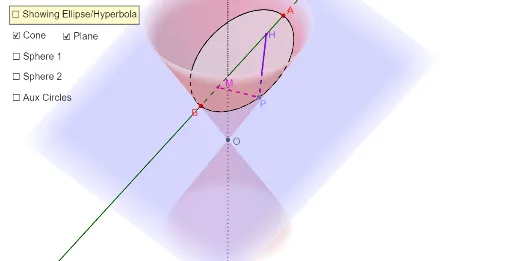
①本范例演示达兰贝尔球如何解释抛物线、椭圆和双曲线为何是圆锥曲线;②涉及核心概念:圆锥曲线、达兰贝尔球、几何定义、圆锥截面;③作图要点:使用 GeoGebra 命令如 InfiniteCone(无限圆锥)、Rotate(旋转)、IntersectPath(路径相交)、Circle(圆)、Sphere(球)等构建几何模型;④适合高中及以上学生及需要深入理解圆锥曲线几何本质的教育者。
GeoGebra 命令及参数
InfiniteCone((0, 0, 0), zAxis, α) → aAxes(a) → d, e, fRotate(f, (-α), yAxis) → lineOAPoint(lineOA) → ARotate(f, α, yAxis) → f'Point(f') → BPlane(A, B_1, B) → bIntersectPath(b, a) → EllipseHyperbolaAxes(EllipseHyperbola) → i, jAngularBisector(f', i) → b2, b1Center(a) → OVector(O, B) → vOBAngle(Vector[A, B], Vector[A, O]) → βVector(O, A) → vOARotate(vOA, β / 2, A, k) → vOA'Angle(Vector[B, A], Vector[O, B]) → α1Rotate(vOB, α1 / 2, B, k) → vOB'Ray(B, B') → gIntersect(f, b1) → CenterSphere1OrthogonalLine(CenterSphere1, i, k) → hIntersect(i, h) → HCircle(CenterSphere1, H, k) → pSphere(CenterSphere1, H) → lRay(A, A') → mIntersect(f, b2) → CenterSphere2OrthogonalLine(CenterSphere2, i, k) → nIntersect(i, n) → MCircle(CenterSphere2, M, k) → sPoint(EllipseHyperbola) → PLine(O, P) → a_1Segment(M, P) → b_1Segment(P, H) → e_1Sphere(CenterSphere2, M) → l'OrthogonalLine(CenterSphere2, lineOA, k) → qOrthogonalLine(CenterSphere1, lineOA, k) → rIntersect(lineOA, r) → CIntersect(q, lineOA) → DCircle(f, C) → tangentCircle1Circle(f, D) → tangentCircle2Line(O, P) → lineOPIntersect(lineOP, tangentCircle2) → TangencyP2,Intersect(lineOP, tangentCircle1) → TangencyP1,Segment(P, TangencyP1) → PtoTangent1Segment(TangencyP2, P) → PtoTangent2Segment(O, TangencyP2) → coneEdgeTangent(A, EllipseHyperbola) → t,Plane(t, lineOA) → tangentToConePlanePlane(B, tangentToConePlane) → planeForParabolaIntersectPath(planeForParabola, a) → ParabolaIntersect(f, Parabola) → E,Intersect(f, planeForParabola) → F_1Line(B, F_1) → cAngularBisector(f', c) → f_1, g_1Intersect(g_1, f) → C_{SphereForParabola}OrthogonalLine(C_{SphereForParabola}, c, space) → h_1Intersect(h_1, c) → FSphere(C_{SphereForParabola}, F) → oPoint(Parabola) → GSegment(F, G) → i_1Intersect(f', o) → I, JCircle(f, I) → c_1Sphere(B, F) → uIntersect(c, u) → K, LOrthogonalPlane(K, c) → p_1IntersectPath(p_1, planeForParabola) → directrixOrthogonalLine(G, p_1) → k_1Intersect(directrix, Parabola) → N, TIntersect(directrix, k_1) → QSegment(G, O) → l_1Intersect(l_1, c_1, 1) → RPlane(c_1) → tangentCirclePlaneForParabolaOrthogonalLine(G, tangentCirclePlaneForParabola) → m_1Intersect(m_1, tangentCirclePlaneForParabola) → SAngle(S, G, R) → γAngle(Q, G, S) → δSegment(G, R) → j_1Segment(Q, G) → n_1Segment(Q, S) → q_1Segment(S, R) → r_1Angle(G, S, Q) → εAngle(R, S, G) → ζIf(checkBoxEllHyp, checkBoxParabola + (0 * z) = false) → p_2If(checkBoxEllHyp, checkBoxParabola + (0 * z) = false) → q_2If(checkBoxEllHyp, checkBoxParabola + (0 * z) = false) → r_2If(checkBoxEllHyp, checkBoxParabola + (0 * z) = false) → p_3If(checkBoxEllHyp, checkBoxParabola + (0 * z) = false) → q_3If(checkBoxEllHyp, checkBoxParabola + (0 * z) = false) → r_3If(checkBoxEllHyp, checkBoxParabola + (0 * z) = false) → p_4If(checkBoxEllHyp, checkBoxParabola + (0 * z) = false) → q_4If(checkBoxEllHyp, checkBoxParabola + (0 * z) = false) → r_4If(checkBoxEllHyp, checkBoxParabola + (0 * z) = false) → p_5If(checkBoxEllHyp, checkBoxParabola + (0 * z) = false) → q_5Angle(G, Q, K) → η
AI 绘图提示语参考
画一个圆锥,在其上生成一条旋转线,形成截面曲线。展示两个Dandelin球,一个与截面曲线相切于两个点,另一个与截面曲线相切于一个点。标出圆锥的顶点、截面曲线上的点、切点以及Dandelin球的中心,并画出与截面曲线相切的球面。最后,连接顶点与截面曲线上的点,形成一条直线。
以上提示语为根据原始绘图命令整理而来,仅供参考。