
统计学V1的副本
几何画板及绘图内容加载中,请稍等……
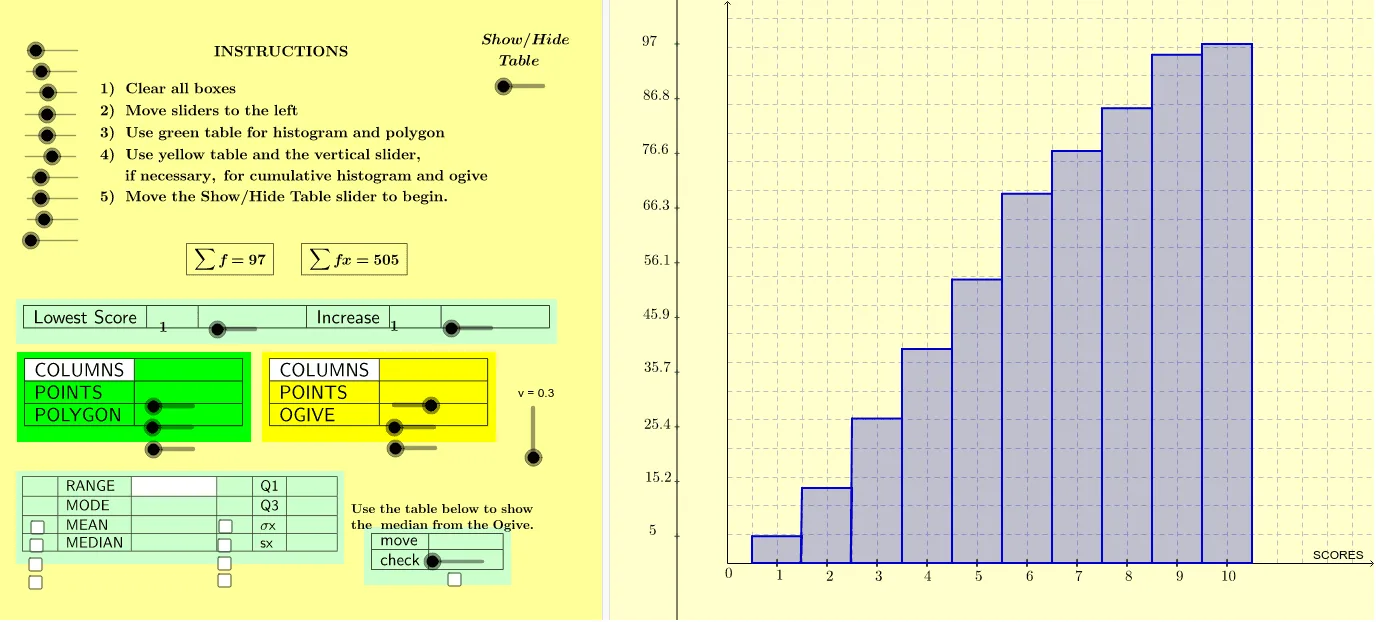
这个范例演示了统计学V1中的数据处理过程。核心数学概念包括中位数、众数、均值、四分位数、标准差等。通过使用GeoGebra命令如Sum、Median、Mean、Q1、Q3、SD等,可以直观地展示数据的分布特征。适合高中及以上学生或教师使用。
GeoGebra 命令及参数
Sum(B2:B11) → B13Sum(C2:C11) → C13Polygon(O, P_1, Q_1, P) → poly5, o_2, p_1, q_1, pPolygon(P, R_1, S_1, Q) → poly6, p_2, r_1, s_1, qPolygon(Q, T_1, U_1, S) → poly7, q_2, t_1, u_1, sPolygon(S, V_1, W_1, R) → poly8, s_2, v_1, w_1, rPolygon(R, Z_1, A_2, T) → poly9, r_2, z_1, a_2, tPolygon(T, B_2, C_2, U) → poly10, t_2, b_2, c_2, uPolygon(S_2, G_3, H_3, T_2) → poly12, s_3, g_3, h_3, t_3Polygon(T_2, I_3, J_3, U_2) → poly13, t_4, i_3, j_3, u_2Polygon(U_2, K_3, L_3, V_2) → poly14, u_3, k_3, l_3, v_2Polygon(V_2, M_3, N_3, W_2) → poly15, v_3, m_3, n_3, w_2Polygon(W_2, O_3, P_3, Z_2) → poly16, w_3, o_3, p_3, z_2Polygon(Z_2, Q_3, R_3, A_3) → poly17, z_3, q_3, r_3, a_3Polygon(A_3, S_3, T_3, B_3) → poly18, a_4, s_4, t_5, b_3Polygon(B_3, U_3, V_3, C_3) → poly19, b_4, u_4, v_4, c_3Polygon(C_3, W_3, Z_3, D_3) → poly20, c_4, w_4, z_4, d_3Polygon(D_3, B_4, A_4, E_3) → poly21, d_1, b_5, a_5, e_3IterationList(f, A2, f_1 - 1) → list2IterationList(g, A3, f_2 - 1) → list3IterationList(h, A4, f_3 - 1) → list4IterationList(i, A5, f_4 - 1) → list5IterationList(j, A6, f_5 - 1) → list6IterationList(k, A7, f_6 - 1) → list7IterationList(l, A8, f_7 - 1) → list8IterationList(m, A9, f_8 - 1) → list9IterationList(n, A10, f_9 - 1) → list10IterationList(o, A11, f_10 - 1) → list11Join({list2, list3, list4, list5, list6, list7, list8, list9, list10, list11}) → list12Median(list12) → MEDIANPolygon(U_2, L_1, M_1, V_2) → poly3, u_6, l_1, m_1, v_5Polygon(V_2, N_1, O_1, W_2) → poly4, v_6, n_1, o_1, w_5Distance(M, E) → MEMode(list12) → MODEDistance(M, O) → MOMean(list12) → MEANDistance(R, A) → RAQ1(list12) → LQQ3(list12) → UQDistance(I_4, Q) → IQSD(list12) → SDOrthogonalLine(MOVE, yAxis) → p_4Distance(S, T) → STIntersect(e_1, yAxis) → F_3Polygon(T_2, L, K_1, U_2) → poly2, t_6, l_5, k_1, u_5Polygon(S_2, H_1, I, T_2) → poly22, s_5, h_1, i_1, t_7Segment(D_2, B_1) → cSegment(B_1, C_1) → dSegment(C_1, D_1) → a_1Segment(D_1, E_1) → b_1Segment(E_1, F_1) → c_1Segment(F_1, G_1) → g_1Segment(G_1, E_2) → j_1Segment(E_2, F_2) → d_2Segment(F_2, G_2) → e_2Segment(G_2, H_2) → g_2Segment(H_2, A_1) → g_5Segment(K, H) → eSegment(H, J_3) → h_2Segment(J_3, L_3) → i_2Segment(L_3, N_3) → k_2Segment(N_3, P_3) → l_2Segment(P_3, R_3) → m_2Segment(R_3, T_3) → n_2Segment(T_3, V_3) → d_4Segment(V_3, Z_3) → e_4Segment(Z_3, A_4) → g_4Stretch(S_2, xAxis, 2) → I_1Stretch(H_1, xAxis, 2) → J_1Stretch(I, xAxis, 2) → I'Stretch(T_2, xAxis, 2) → E_4Stretch(S_2, xAxis, v) → F_4Stretch(H_1, xAxis, v) → G_4Stretch(I, xAxis, v) → I'_1Stretch(T_2, xAxis, v) → H_4Stretch(T_2, xAxis, v) → J_4Stretch(L, xAxis, v) → L'Stretch(K_1, xAxis, v) → K_4Stretch(U_2, xAxis, v) → L_4Stretch(S_2, xAxis, v) → M_4Stretch(G_3, xAxis, v) → N_4Stretch(H_3, xAxis, v) → O_4Stretch(T_2, xAxis, v) → P_4Polygon(M_4, N_4, O_4, P_4) → poly12', m_5, n_5, o_4, p_5Stretch(T_2, xAxis, v) → Q_4Stretch(I_3, xAxis, v) → R_4Stretch(J_3, xAxis, v) → S_4Stretch(U_2, xAxis, v) → T_4Polygon(Q_4, R_4, S_4, T_4) → poly13', q_4, r_5, s_6, t_8Stretch(U_2, xAxis, v) → U_4Stretch(K_3, xAxis, v) → V_4Stretch(L_3, xAxis, v) → W_4Stretch(V_2, xAxis, v) → Z_4Polygon(U_4, V_4, W_4, Z_4) → poly14', u_7, v_7, w_6, z_6Stretch(V_2, xAxis, v) → A_5Stretch(M_3, xAxis, v) → B_5Stretch(N_3, xAxis, v) → C_5Stretch(W_2, xAxis, v) → D_5Polygon(A_5, B_5, C_5, D_5) → poly15', a_6, b_6, c_6, d_6Stretch(W_2, xAxis, v) → E_5Stretch(O_3, xAxis, v) → F_5Stretch(P_3, xAxis, v) → G_5Stretch(Z_2, xAxis, v) → H_5Polygon(E_5, F_5, G_5, H_5) → poly16', e_6, f_{10}, g_6, h_5Stretch(S_2, xAxis, v) → I_5Stretch(G_3, xAxis, v) → J_5Stretch(H_3, xAxis, v) → K_5Stretch(T_2, xAxis, v) → L_5Stretch(Z_2, xAxis, v) → M_5Stretch(Q_3, xAxis, v) → N_5Stretch(R_3, xAxis, v) → O_5Stretch(A_3, xAxis, v) → P_5Polygon(M_5, N_5, O_5, P_5) → poly17', m_6, n_6, o_5, p_6Stretch(A_3, xAxis, v) → Q_5Stretch(S_3, xAxis, v) → R_5Stretch(T_3, xAxis, v) → S_5Stretch(B_3, xAxis, v) → T_5Polygon(Q_5, R_5, S_5, T_5) → poly18', q_5, r_6, s_7, t_9Stretch(B_3, xAxis, v) → U_5Stretch(U_3, xAxis, v) → V_5Stretch(V_3, xAxis, v) → W_5Stretch(C_3, xAxis, v) → Z_5Polygon(U_5, V_5, W_5, Z_5) → poly19', u_8, v_8, w_7, z_7Stretch(C_3, xAxis, v) → A_6Stretch(W_3, xAxis, v) → B_6Stretch(Z_3, xAxis, v) → C_6Stretch(D_3, xAxis, v) → D_6Polygon(A_6, B_6, C_6, D_6) → poly20', a_7, b_7, c_7, d_7Stretch(D_3, xAxis, v) → E_6Stretch(B_4, xAxis, v) → F_6Stretch(A_4, xAxis, v) → G_6Stretch(E_3, xAxis, v) → H_6Polygon(E_6, F_6, G_6, H_6) → poly21', e_7, f_{11}, g_7, h_6Stretch(C_3, xAxis, v) → I_6Stretch(W_3, xAxis, v) → J_6Stretch(Z_3, xAxis, v) → K_6Stretch(D_3, xAxis, v) → L_6Polygon(I_6, J_6, K_6, L_6) → poly20'_1, i_6, j_6, k_6, l_7Stretch(H, xAxis, v) → H'Segment(K, H') → h_4Segment(H', S_4) → i_5Segment(S_4, W_4) → j_5Segment(W_4, C_5) → k_5Segment(C_5, G_5) → l_6Segment(G_5, O_5) → q_6Segment(O_5, S_5) → h_7Segment(S_5, W_5) → i_7Segment(W_5, K_6) → j_7Segment(K_6, G_6) → k_7OrthogonalLine(H', yAxis) → m_7OrthogonalLine(S_4, yAxis) → n_7OrthogonalLine(W_4, yAxis) → p_7OrthogonalLine(C_5, yAxis) → q_7OrthogonalLine(G_5, yAxis) → r_7OrthogonalLine(O_5, yAxis) → a_8OrthogonalLine(S_5, yAxis) → b_8OrthogonalLine(W_5, yAxis) → c_8OrthogonalLine(K_6, yAxis) → d_8OrthogonalLine(G_6, yAxis) → e_8Stretch(C_4, xAxis, v) → W_6Stretch(MOVE, xAxis, v) → MOVE'Vector(MOVE', W_6) → wOrthogonalLine(B_1, yAxis) → d_5OrthogonalLine(C_1, yAxis) → g_8OrthogonalLine(D_1, yAxis) → h_8OrthogonalLine(E_1, yAxis) → i_8OrthogonalLine(F_1, yAxis) → j_8OrthogonalLine(G_1, yAxis) → k_8OrthogonalLine(E_2, yAxis) → l_8OrthogonalLine(F_2, yAxis) → m_8OrthogonalLine(G_2, yAxis) → n_8OrthogonalLine(H_2, yAxis) → p_8TableText({{B15, C15}, {B16, C16}, {B17, C17}}, "|_") → text45TableText({{B19, C19, D19, E19, F19, G19}, {B20, C20, D20, E20, F20, G20}, {B21, C21, D21, E21, F21, G21}, {B22, C22, D22, E22, F22, G22}}, "|_") → text48OrthogonalLine(W_6, xAxis) → q_8Intersect(q_8, xAxis) → K_7Point(q_8) → L_7Vector(L_7, K_7) → zTableText({{A25, B25, C25, D25, E25, F25}}, "|_") → text47TableText({{C12}}, "|_") → text51Sequence(Cell[j, 1], j, 1, Fx) → list30Sequence(Cell[j, 2], j, 1, Fx) → list31Sequence(Cell[j, 3], j, 1, Fx) → list32Sequence(Cell[j, 4], j, 1, Fx) → list33Sequence(Cell[j, 5], j, 1, Fx) → list34Sequence(Cell[j, 6], j, 1, Fx) → list35Sequence(Cell[j, 7], j, 1, Fx) → list36Sequence(Cell[j, 8], j, 1, Fx) → list37Sequence(Cell[j, 9], j, 1, Fx) → list38Sequence(Cell[j, 10], j, 1, Fx) → list39Sequence(Cell[j, 11], j, 1, Fx) → list40TableText({list30, list31, list32, list33, list34, list35, list36, list37, list38, list39, list40}, "c_|") → text52TableText({{B12}}, "|_") → text50TableText({{A27, B27}, {A28, B28}}, "|_") → text54TableText({{D15, E15}, {D16, E16}, {D17, E17}}, "|_") → text24SampleSD(list12) → samplesd
AI 绘图提示语参考
绘制一组数据的统计图形,包括中位数、众数、均值、四分位数和标准差。首先绘制数据点,然后计算并标记中位数、众数、均值、四分位数和标准差的位置,最后用多边形连接这些点,展示数据分布特征。
以上提示语为根据原始绘图命令整理而来,仅供参考。