
二项分布演示 by shanlee
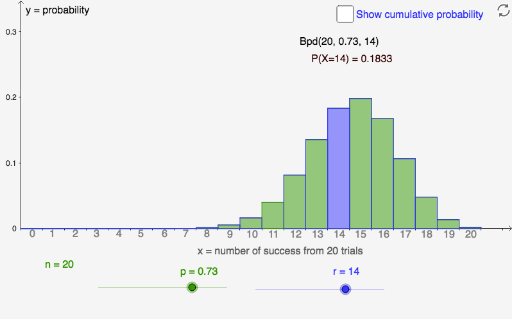
几何画板及绘图内容加载中,请稍等……
①本范例演示二项分布的概率计算与图形表示;②涉及核心数学概念包括概率统计、组合数学、几何图形绘制;③作图要点:使用 Point, Segment, Intersect, Polygon, If 命令,涉及 n, comb, p, prob, r 等对象;④适合高中及以上学生及数学爱好者学习概率分布与几何结合的应用。
GeoGebra 命令及参数
Point(Circle[A, 1]) → VSegment(A, V) → aPoint(xAxis) → WIntersect(xAxis, yAxis) → ZPolygon(A, V, W, Z) → poly01, a_1, v, w, zPoint(Circle[B, 1]) → A_1Segment(B, A_1) → bPoint(xAxis) → B_1Intersect(w, v) → C_1Polygon(B, A_1, B_1, C_1) → poly02, b_1, a_2, b_2, c_1Point(xAxis) → E_1Point(Circle[C, 1]) → D_1Segment(C, D_1) → cPoint(Circle[D, 1]) → F_1Segment(D, F_1) → dPoint(Circle[E, 1]) → G_1Segment(E, G_1) → ePoint(Circle[G, 1]) → H_1Segment(G, H_1) → fPoint(Circle[H, 1]) → I_1Segment(H, I_1) → gPoint(Circle[I, 1]) → J_1Segment(I, J_1) → hPoint(Circle[J, 1]) → K_1Segment(J, K_1) → iPoint(Circle[F, 1]) → L_1Segment(F, L_1) → jPoint(Circle[K, 1]) → M_1Segment(K, M_1) → kPoint(Circle[L, 1]) → N_1Segment(L, N_1) → lPoint(Circle[M, 1]) → O_1Segment(M, O_1) → mPoint(Circle[N, 1]) → P_1Segment(N, P_1) → qPoint(Circle[O, 1]) → Q_1Segment(O, Q_1) → r_5Point(Circle[P, 1]) → R_1Segment(P, R_1) → sPoint(Circle[Q, 1]) → S_1Segment(Q, S_1) → tPoint(Circle[R, 1]) → T_1Segment(R, T_1) → d_1Point(Circle[S, 1]) → U_1Segment(S, U_1) → e_1Point(Circle[T, 1]) → V_1Segment(T, V_1) → f_1Point(Circle[U, 1]) → W_1Segment(U, W_1) → g_1Polygon(C, D_1, E_1, B_1) → poly03, c_2, d_2, e_2, b_3Point(xAxis) → Z_1Polygon(D, F_1, Z_1, E_1) → poly04, d_3, f_2, z_1, e_3Point(xAxis) → A_2Polygon(E, G_1, A_2, Z_1) → poly05, e_4, g_2, a_3, z_2Point(xAxis) → B_2Polygon(F, L_1, B_2, A_2) → poly06, f_3, l_1, b_4, a_4Point(xAxis) → C_2Polygon(G, H_1, C_2, B_2) → poly07, g_3, h_1, c_3, b_5Point(xAxis) → D_2Polygon(H, I_1, D_2, C_2) → poly08, h_2, i_1, d_4, c_4Point(xAxis) → E_2Polygon(I, J_1, E_2, D_2) → poly09, i_2, j_1, e_5, d_5Point(xAxis) → F_2Polygon(J, K_1, F_2, E_2) → poly10, j_2, k_1, f_4, e_6Point(xAxis) → G_2Polygon(K, M_1, G_2, F_2) → poly11, k_2, m_1, g_4, f_5Point(xAxis) → H_2Polygon(L, N_1, H_2, G_2) → poly12, l_2, n_1, h_3, g_5Point(xAxis) → I_2Polygon(M, O_1, I_2, H_2) → poly13, m_2, o_1, i_3, h_4Point(xAxis) → J_2Polygon(N, P_1, J_2, I_2) → poly14, n_2, p_{22}, j_3, i_4Point(xAxis) → K_2Polygon(O, Q_1, K_2, J_2) → poly15, o, q_1, k_3, j_4Point(xAxis) → L_2Polygon(P, R_1, L_2, K_2) → poly16, p_{24}, r_1, l_3, k_4Point(xAxis) → M_2Polygon(Q, S_1, M_2, L_2) → poly17, q_2, s_1, m_3, l_4Point(xAxis) → N_2Polygon(R, T_1, N_2, M_2) → poly18, r_2, t_1, n_3, m_4Point(xAxis) → O_2Polygon(S, U_1, O_2, N_2) → poly19, s_2, u_1, o_2, n_4Point(xAxis) → P_2Polygon(T, V_1, P_2, O_2) → poly20, t_2, v_1, p_{23}, o_3Point(xAxis) → Q_2Polygon(U, W_1, Q_2, P_2) → poly21, u, w_1, q_3, p_{21}Polygon(K, M_1, G_2, F_2) → poly11a, k_5, m_5, g_6, f_6Polygon(L, N_1, H_2, G_2) → poly12a, l_5, n_5, h_5, g_7Polygon(M, O_1, I_2, H_2) → poly13a, m_6, o_4, i_5, h_6Polygon(N, P_1, J_2, I_2) → poly14a, n_6, p_{25}, j_5, i_6Polygon(O, Q_1, K_2, J_2) → poly15a, o_5, q_4, k_6, j_6Polygon(P, R_1, L_2, K_2) → poly16a, p_{26}, r_3, l_6, k_7Polygon(Q, S_1, M_2, L_2) → poly17a, q_5, s_3, m_7, l_7Polygon(R, T_1, N_2, M_2) → poly18a, r_4, t_3, n_7, m_8Polygon(S, U_1, O_2, N_2) → poly19a, s_4, u_2, o_6, n_8Polygon(T, V_1, P_2, O_2) → poly20a, t_4, v_2, p_{27}, o_7Polygon(U, W_1, Q_2, P_2) → poly21a, u_3, w_2, q_6, p_{28}Polygon(I, J_1, E_2, D_2) → poly09a, i_7, j_7, e_7, d_6Polygon(H, I_1, D_2, C_2) → poly08a, h_7, i_8, d_7, c_5Polygon(J, K_1, F_2, E_2) → poly10a, j_8, k_8, f_7, e_8Polygon(G, H_1, C_2, B_2) → poly07a, g_8, h_8, c_6, b_6Polygon(F, L_1, B_2, A_2) → poly06a, f_8, l_8, b_7, a_5Polygon(E, G_1, A_2, Z_1) → poly05a, e_9, g_9, a_6, z_3Polygon(D, F_1, Z_1, E_1) → poly04a, d_8, f_9, z_4, e_{10}Polygon(C, D_1, E_1, B_1) → poly03a, c_7, d_9, e_{11}, b_8Polygon(B, A_1, B_1, C_1) → poly02a, b_9, a_7, b_{10}, c_8Polygon(A, V, W, Z) → poly01a, a_8, v_3, w_3, z_5Segment(mupointhi, mupoint) → mulineIf(prob(r) < 0.2, prob(r) + 0.02, 0.2) → ptextheight