
复合立体的分割与体积分配(含随机选择)
几何画板及绘图内容加载中,请稍等……
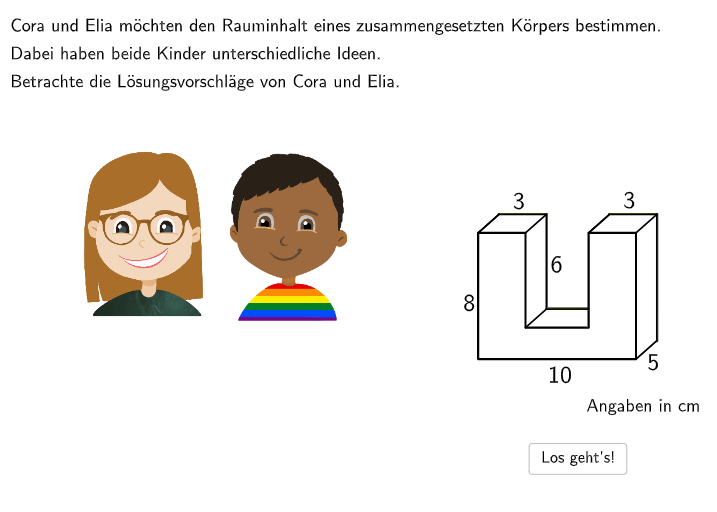
该范例演示将复合立体(如由多个长方体/正交体组合而成的“整体”)进行几何分割,并让学生通过体积关系理解如何把总体积拆成若干部分。核心数学概念包括:立体几何、体积(Volumen)与幂函数/面积-体积的幂次关系、切线(Tangente)所对应的局部几何直观(用于支撑函数与曲线的理解)、以及概率/随机变量(Zufallsvariablen或Zufallsgrößen)用于随机抽取分割方案或练习顺序。作图与交互要点:从“构造摘要”可见使用了 Textfield 构建输入框,Sum 用于体积/分块量的求和,Shuffle 与 Element 实现从候选项中随机选择并取出对应参数,U、LaTeX 用于单位/排版与公式展示;Segment、PolyLine、Translate、Dilate 用于搭建并变换各分块的几何轮廓;If 用于根据学生选择判断步骤;同时借助列表步骤 listSteps、attemptCountInputBox*、questionCount、correctCount 等对象实现分步练习与校验,最终通过 validate、showanswer、showsolution、btnValidate/btnTryAgain/btnNew 展示答案或解析。适合中学后期到大学基础阶段的立体几何与数学建模入门,用于体积拆分、函数-几何联想与基于随机练习的自测。
GeoGebra 命令及参数
Textfield(input1) → InputBox1Textfield(input2) → InputBox2Sum({attemptCountInputBox1, attemptCountInputBox2, attemptCountInputBox3, attemptCountInputBox4, attemptCountInputBox5}) → attemptCountShuffle(Sequence[Random[0, 10], i, 1, 100]) → randomNosForX, {7, 3, 10, 7, 4, 4, 6, 8, 5, 5, 2, 3, 3, 3, 4, 4, 9, 1, 0, 8, 6, 4, 8, 6, 7, 0, 7, 9, 1, 5, 8, 8, 3, 4, 7, 2, 0, 9, 4, 1, 9, 0, 10, 0, 6, 3, 6, 0, 0, 8, 10, 0, 4, 8, 5, 9, 6, 10, 2, 0, 3, 1, 1, 0, 2, 2, 4, 9, 5, 0, 7, 2, 3, 1, 7, 4, 0, 2, 2, 3, 2, 5, 9, 6, 5, 8, 6, 9, 0, 1, 10, 0, 5, 10, 4, 6, 5, 5, 10, 8}Element(randomNosForX, Mod[questionCount, 100] + 1) → numXU(A, pointVec) → l1, l2, C, D, E, F, G, H, l0BG1, l4Kontur, l2Mantel, l4lines, l4linesManual, l5FG1, l5FG2, BLaTeX(step, true, true) → Text1Segment(pointOption1, F) → segmentOption1Segment(F, pointOption2) → segmentOption2Segment(E, pointOption3) → segmentOption3Segment(E, pointOption4) → segmentOption4Translate(C, pointVec) → C'Translate(pointOption4, pointVec) → pointOption4'Translate(F, pointVec) → F'Translate(G, pointVec) → G'Translate(H, pointVec) → H'If(option1, A, pointOption1) → pointObject11If(option1, pointOption2, F) → pointObject12Translate(D, pointVec) → D'Segment(pointOption4, pointOption4') → segmentOption41Translate(B, pointVec) → B'If(¬option4, pointOption4', B') → pointObject31If(¬option4, pointOption4, B) → pointObject32If(¬option4, E, pointOption3) → pointObject33If(option2 ∧ option4, 1, option1 ∧ option4, 2, option1 ∧ option3, 3, 4) → typSegment(G', D') → segmentFilled1Segment(G, D) → segmentFilled2Segment(pointOption1, F) → segmentCutted1Segment(E, pointOption4) → segmentCutted2Segment(pointOption4, pointOption4') → segmentCutted3Segment(B', C') → fSegment(C', D') → gSegment(D', D) → hSegment(E', F') → iSegment(F', G') → jSegment(G', H') → kSegment(H', H) → lIf(step ∈ {4, 5}, (-23.75, 32.5), (-23.75, 35)) → speechbubble12If(step ∈ {4, 5}, (0, 32.5), (3.75, 35)) → speechbubble13If(step ∈ {4, 5}, (0, 40.3), (3.75, 39.5)) → speechbubble14If(step ∈ {4, 5}, (-23.75, 40.3), (-23.75, 39.5)) → speechbubble15Textfield(input3) → InputBox3Textfield(input4) → InputBox4Textfield(input71) → InputBox71Textfield(input72) → InputBox72Textfield(input73) → InputBox73Textfield(input74) → InputBox74Textfield(input75) → InputBox75If((¬option1) ∧ (¬option2), input72 ≟ ((3 * 5) * 2), true) → correct72If((¬option3) ∧ (¬option4), input74 ≟ ((3 * 5) * 2), true) → correct74Dilate(Translate[l5FG2, (-10, 0)], step6Scalefactor, CenterOfDilation) → l3Dilate(Translate[listObject1, translationVector], step6Scalefactor, CenterOfDilation) → listObject1'Dilate(Translate[listObjectFilledLeftBottom, translationVector], step6Scalefactor, CenterOfDilation) → listObjectFilledLeftBottom'Dilate(Translate[listObjectFilledRightBottom, translationVector], step6Scalefactor, CenterOfDilation) → listObjectFilledRightBottom'Dilate(Segment[Translate[F, translationVector], Translate[pointOption2, translationVector]], step6Scalefactor, CenterOfDilation) → segmentOption2'Dilate(Segment[Translate[E, translationVector], Translate[pointOption3, translationVector]], step6Scalefactor, CenterOfDilation) → segmentOption3'Dilate(Segment[Translate[pointOption1, translationVector], Translate[F, translationVector]], step6Scalefactor, CenterOfDilation) → segmentOption1'Dilate(Translate[listObject3, translationVector], step6Scalefactor, CenterOfDilation) → listObject3'Dilate(Translate[listObject2, translationVector], step6Scalefactor, CenterOfDilation) → listObject2'Dilate(Translate[l0BG1, translationVector], step6Scalefactor, CenterOfDilation) → step6l0BG1'Dilate(Translate[l2Mantel, translationVector], step6Scalefactor, CenterOfDilation) → step6l2Mantel'Dilate(Translate[l4Kontur, translationVector], step6Scalefactor, CenterOfDilation) → step6l4Kontur'Dilate(Translate[l4linesManual, translationVector], step6Scalefactor, CenterOfDilation) → step6l4linesManual'Dilate(Translate[l5FG1, translationVector], step6Scalefactor, CenterOfDilation) → step6l5FG1'Dilate(Translate[l5FG2, translationVector], step6Scalefactor, CenterOfDilation) → step6l5FG2'Dilate(Segment[Translate[pointOption4, translationVector], Translate[pointOption4', translationVector]], step6Scalefactor, CenterOfDilation) → segmentOption41'Dilate(Translate[listObjectFilledRightBottom, translationVector], step6Scalefactor, CenterOfDilation) → listObjectFilledRightBottomBG'PolyLine(Dilate[B, step6Scalefactor, CenterOfDilation], Dilate[B', step6Scalefactor, CenterOfDilation], Dilate[A, step6Scalefactor, CenterOfDilation], Dilate[C', step6Scalefactor, CenterOfDilation], Dilate[D', step6Scalefactor, CenterOfDilation], Dilate[D, step6Scalefactor, CenterOfDilation], Dilate[E', step6Scalefactor, CenterOfDilation], Dilate[F', step6Scalefactor, CenterOfDilation], Dilate[G', step6Scalefactor, CenterOfDilation], Dilate[H', step6Scalefactor, CenterOfDilation], Dilate[H, step6Scalefactor, CenterOfDilation]) → mPolyLine(Translate[E, translationVector], Translate[pointOption4, translationVector], Translate[I', translationVector]) → nDilate(PolyLine[Translate[E, translationVector], Translate[pointOption4, translationVector], Translate[I', translationVector]], step6Scalefactor, CenterOfDilation) → segmentOption4'Translate(cora, (7, 0)) → cora'Textfield(input31) → InputBox31Textfield(input32) → InputBox32Translate(elia, (30.434007263501044, -17.511741828561323)) → elia'Translate(Mirror[speechbubble2, x = -18], (0.5, -20)) → speechbubble3Textfield(input2a) → InputBox2aTextfield(input3a) → InputBox3aTextfield(input1a) → InputBox1aTextfield(input1b) → InputBox1b
AI 绘图提示语参考
绘制一个由多个正交长方体组合而成的复合立体,将其分割为若干子部分,并显示各部分的体积分配。图形包含多个可交互的输入框,用于输入数值;用线段和折线勾勒出立体各面的轮廓,并通过平移和缩放操作展示分割后的子块。界面中设有随机选择机制,用于从候选参数中随机选取数值,同时显示步骤提示、答案验证按钮和尝试次数统计。整体布局包含多个文本框、按钮和计数器,用于引导用户逐步完成体积分割与分配的计算练习。
以上提示语为根据原始绘图命令整理而来,仅供参考。