
椭圆上的台球反弹轨迹(一)
几何画板及绘图内容加载中,请稍等……
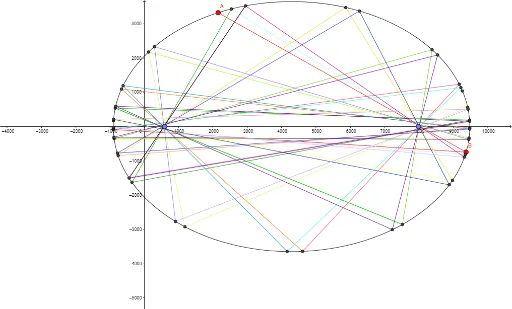
本范例演示了在椭圆边界内,台球(质点)沿直线运动并在椭圆上发生镜面反射的连续轨迹。核心数学概念是椭圆的光学性质:从椭圆一个焦点发出的光线经椭圆反射后必经过另一个焦点,因此台球轨迹会形成闭合或准周期的路径。作图要点:使用GeoGebra的Point、Ellipse、Line、Tangent、Mirror、Segment、Intersect等命令,依次构造椭圆c、初始点A、入射直线f、切点B、切线g、反射线h,并通过Mirror命令实现反射,再通过Intersect求交点,反复迭代生成多段反射线段(如i、j、k、l、m、n、p、q、r、s、t等),最终形成完整的反弹路径。适合高中及以上学生探究椭圆几何性质、反射定律与动态几何作图,也可用于大学解析几何或物理光学中的反射轨迹模拟。
GeoGebra 命令及参数
Point(xAxis) → A_1Point(xAxis) → B_1Ellipse(A_1, B_1, A) → cPoint(c) → BLine(A, B) → fTangent(B, c) → g,Mirror(f, g) → f'Segment(A, B) → hIntersect(c, f', 2) → CSegment(B, C) → iTangent(C, c) → j,Mirror(f', j) → f''Intersect(c, f'', 2) → ESegment(C, E) → kTangent(E, c) → l,Mirror(f'', l) → f'''Intersect(c, f''', 2) → FSegment(E, F) → mTangent(F, c) → n,Mirror(f''', n) → pIntersect(c, p, 2) → GSegment(G, F) → qTangent(G, c) → r,Mirror(p, r) → p'Intersect(c, p', 2) → HTangent(H, c) → s,Mirror(p', s) → p''Segment(G, H) → tIntersect(c, p'', 2) → ITangent(I, c) → a,Mirror(p'', a) → p'''Segment(I, H) → bIntersect(c, p''', 2) → JTangent(J, c) → d,Mirror(p''', d) → eIntersect(c, e, 2) → KSegment(K, J) → f_1Tangent(K, c) → g_1,Mirror(e, g_1) → e'Intersect(c, e', 2) → LSegment(L, K) → h_1Tangent(L, c) → i_1,Mirror(e', i_1) → e''Intersect(c, e'', 2) → MSegment(M, L) → j_1Tangent(M, c) → k_1,Mirror(e'', k_1) → e'''Intersect(c, e''', 2) → NSegment(N, M) → l_1Tangent(N, c) → m_1,Mirror(e''', m_1) → n_1Intersect(c, n_1, 2) → OSegment(I, J) → p_1Line(M, N) → q_1Tangent(N, c) → r_1,Mirror(q_1, r_1) → s_1Line(O, N) → t_1Tangent(O, c) → a_1,Mirror(t_1, a_1) → b_1Intersect(c, b_1, 1) → QSegment(O, N) → c_1Segment(Q, O) → d_1Tangent(Q, c) → e_1,Mirror(b_1, e_1) → f_2Intersect(c, f_2, 1) → RSegment(R, Q) → g_2Segment(Q, R) → h_2Tangent(R, c) → i_2,Mirror(f_2, i_2) → j_2Intersect(c, j_2, 1) → SSegment(S, R) → k_2Tangent(S, c) → l_2,Mirror(j_2, l_2) → m_2Intersect(c, m_2, 1) → TSegment(T, S) → n_2Tangent(T, c) → p_2,Mirror(m_2, p_2) → q_2Intersect(c, q_2, 1) → USegment(U, T) → r_2Segment(U, T) → s_2Tangent(U, c) → t_2,Mirror(q_2, t_2) → a_2Intersect(c, a_2, 1) → VSegment(V, U) → b_2Tangent(V, c) → c_2,Mirror(a_2, c_2) → d_2Intersect(c, d_2, 1) → WLine(V, U) → e_2Tangent(V, c) → f_3,Mirror(e_2, f_3) → g_3Segment(V, W) → h_3Tangent(W, c) → i_3,Mirror(g_3, i_3) → j_3Intersect(c, j_3, 1) → DSegment(D, W) → k_3Tangent(D, c) → l_3,Mirror(j_3, l_3) → m_3Intersect(c, m_3, 1) → PSegment(P, D) → n_3Tangent(P, c) → p_3,Mirror(m_3, p_3) → q_3Intersect(c, q_3, 1) → ZSegment(Z, P) → r_3Tangent(Z, c) → s_3,Mirror(q_3, s_3) → t_3Intersect(c, t_3, 1) → C_1Segment(C_1, Z) → a_3Tangent(C_1, c) → b_3,Mirror(t_3, b_3) → c_3Intersect(c, c_3, 1) → D_1Segment(D_1, C_1) → d_3Line(D_1, C_1) → e_3Tangent(D_1, c) → f_4,Mirror(e_3, f_4) → g_4Intersect(c, g_4, 1) → E_1Segment(E_1, D_1) → h_4Tangent(E_1, c) → i_4,Mirror(g_4, i_4) → j_4Intersect(c, j_4, 1) → F_1Segment(F_1, E_1) → k_4Tangent(F_1, c) → l_4,Mirror(j_4, l_4) → m_4Intersect(c, m_4, 1) → G_1Segment(G_1, F_1) → n_4Tangent(G_1, c) → p_4,Mirror(m_4, p_4) → q_4Intersect(c, q_4, 1) → H_1Segment(H_1, G_1) → r_4Tangent(H_1, c) → s_4,Mirror(q_4, s_4) → t_4Intersect(c, t_4, 1) → I_1Segment(I_1, H_1) → a_4Tangent(I_1, c) → b_4,Mirror(t_4, b_4) → c_4Intersect(c, c_4, 1) → J_1Segment(J_1, I_1) → d_4Tangent(J_1, c) → e_4,Mirror(c_4, e_4) → f_5Intersect(c, f_5, 1) → K_1Segment(K_1, J_1) → g_5Tangent(K_1, c) → h_5,Mirror(f_5, h_5) → i_5Intersect(c, i_5, 1) → L_1Segment(L_1, K_1) → j_5Tangent(L_1, c) → k_5,Mirror(i_5, k_5) → l_5Intersect(c, l_5, 1) → M_1Segment(M_1, L_1) → m_5Line(M_1, L_1) → n_5Tangent(M_1, c) → p_5,Mirror(n_5, p_5) → q_5Intersect(c, q_5, 1) → N_1Segment(M_1, N_1) → r_5Tangent(N_1, c) → s_5,Mirror(q_5, s_5) → t_5Intersect(c, t_5, 1) → O_1Tangent(O_1, c) → a_5,Mirror(t_5, a_5) → b_5Intersect(c, b_5, 1) → P_1Segment(P_1, O_1) → c_5Tangent(P_1, c) → d_5,Mirror(b_5, d_5) → e_5Intersect(c, e_5, 1) → Q_1Segment(Q_1, P_1) → f_6Tangent(Q_1, c) → g_6,Mirror(e_5, g_6) → h_6Intersect(c, h_6, 1) → R_1Segment(R_1, Q_1) → i_6Tangent(R_1, c) → j_6,Mirror(h_6, j_6) → k_6Intersect(c, k_6, 1) → S_1Segment(S_1, R_1) → l_6Tangent(S_1, c) → m_6,Mirror(k_6, m_6) → n_6Intersect(c, n_6, 1) → T_1Segment(T_1, S_1) → p_6Tangent(T_1, c) → q_6,Mirror(n_6, q_6) → r_6Intersect(c, r_6, 1) → U_1Segment(U_1, T_1) → s_6Tangent(U_1, c) → t_6,Mirror(r_6, t_6) → a_6Intersect(c, a_6, 1) → V_1Segment(V_1, U_1) → b_6Tangent(V_1, c) → c_6,Mirror(a_6, c_6) → d_6Intersect(c, d_6, 1) → W_1Segment(W_1, V_1) → e_6Tangent(W_1, c) → f_7,Mirror(d_6, f_7) → g_7Intersect(c, g_7, 1) → Z_1Segment(U_1, T_1) → h_7Segment(N_1, O_1) → k_7
AI 绘图提示语参考
绘制一个椭圆,在其内部从椭圆上一点出发画一条线段,该线段指向椭圆的一个焦点。在椭圆上找到该线段与椭圆的交点,过该交点作椭圆的切线,将入射线段关于切线反射,得到反射线段,反射线段将经过另一个焦点。重复此过程:每次从新的交点出发,作切线、反射、求下一交点,依次生成多条首尾相连的折线段,形成台球在椭圆内的连续反弹轨迹。最终图形包含椭圆、初始点、一系列切线和反射线段,展示椭圆的光学性质。
以上提示语为根据原始绘图命令整理而来,仅供参考。