
筝形和矩形对角线交点所形成的角
几何画板及绘图内容加载中,请稍等……
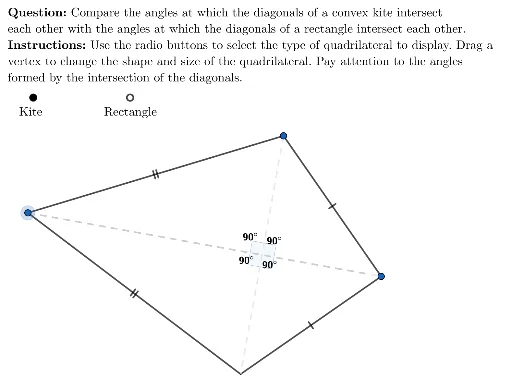
本范例演示了筝形和矩形对角线交点所形成的角。核心数学概念包括角的性质和几何作图。使用了Polygon, Flatten, Circle, RemoveUndefined, PointIn, UnitVector, Distance, Sequence, Point, Segment, UnitOrthogonalVector, Intersect等GeoGebra命令。适合初中及以上学生学习几何作图和角的相关性质。
GeoGebra 命令及参数
Polygon({(left, bottom), (left, top), (-2, top), (-2, bottom)}) → K2Region1Flatten(Sequence[Sequence[(i, j), i, left, right, 0.5], j, bottom, top, 1]) → gridSpacePolygon({(left, top), (left, bottom), (right, bottom), (right, top)}) → viewboxCircle(Kcenter, 2) → KcenterCircRemoveUndefined(Zip[If[¬IsInRegion[A, KcenterCirc], A], A, gridSpace]) → K2RegionPointIn(K2Region1) → K2UnitVector(Vector[K2, Kcenter]) → uMainAxisDistance(Kcenter, Intersect[Ray[Kcenter, Kcenter + uMainAxis], viewbox]) → K1maxLengthSequence(Kcenter + (i * uMainAxis), i, 2, K1maxLength, 0.5) → K1RegionPoint(K1Region) → K1Segment(K2, K1) → MainKiteAxisUnitOrthogonalVector(MainKiteAxis) → uCrossBarSegment(K2 + UnitVector[Vector[K2, K1]], K1 - UnitVector[Vector[K2, K1]]) → KcenterRegionDistance(Kcenter, Intersect[Ray[Kcenter, Kcenter + uCrossBar], viewbox]) → K2maxLengthSequence(Kcenter + (i * uCrossBar), i, 2, K2maxLength, 0.5) → K3RegionPointIn(viewbox) → BPolygon(C18:C21) → parallelogramLaTeX((((("\text{\textbf{Question: }" * QUESTION) * "\\\textbf{Instructions: }") * INSTRUCTIONS) * "}")) → allInstrucPointIn(viewbox) → A12PointIn(viewbox) → A13Intersect(Line[A13, v], Line[A12, u]) → A15Intersect(Line[A13, u], Line[A12, v]) → A14Segment(A12, A14) → B12Segment(A12, A15) → B14Segment(A13, A14) → B13Segment(A13, A15) → B15Segment(A12, A13) → D12Segment(A14, A15) → D13Intersect(D12, D13) → F12If(Angle[A12, F12, A14] < 180°, Angle[A12, F12, A14], Angle[A14, F12, A12]) → E12If(Angle[A15, A13, A14] ≟ 90°, Angle[A15, A13, A14], Angle[A14, A13, A15]) → C13If(Angle[A14, A12, A15] ≟ 90°, Angle[A14, A12, A15], Angle[A15, A12, A14]) → C12If(Angle[A13, A14, A12] ≟ 90°, Angle[A13, A14, A12], Angle[A12, A14, A13]) → C14If(Angle[A12, A15, A13] ≟ 90°, Angle[A12, A15, A13], Angle[A13, A15, A12]) → C15If(Angle[A14, F12, A13] < 180°, Angle[A14, F12, A13], Angle[A13, F12, A14]) → E13If(Angle[A13, F12, A15] < 180°, Angle[A13, F12, A15], Angle[A15, F12, A13]) → E14If(Angle[A15, F12, A12] < 180°, Angle[A15, F12, A12], Angle[A12, F12, A15]) → E15Element(radioButtonLocations, RECTANGLE) → rb1Element(radioButtonLocations, KITE) → rb2Element(radioButtonLocations, showObject) → highlightButtonSegment(Kcenter + (7 * UnitOrthogonalVector[MainKiteAxis]), Kcenter + UnitOrthogonalVector[MainKiteAxis]) → crossSegmentPoint(K3Region) → K3Mirror(K3, MainKiteAxis) → K4Segment(K3, K1) → Kite1Segment(K3, K2) → Kite2Segment(K4, K1) → Kite3Segment(K4, K2) → Kite4Polygon(AngleCornerPoints) → AllKiteAnglesSegment(K3, K4) → crossBarZip(Text["\textbf{\scalebox{0.8}{90°}}", A + tOffset, true, true], A, AngleCornerPoints) → AllAngleLbls