
Yin Yang Rotation
Loading the math board and drawing, please wait…
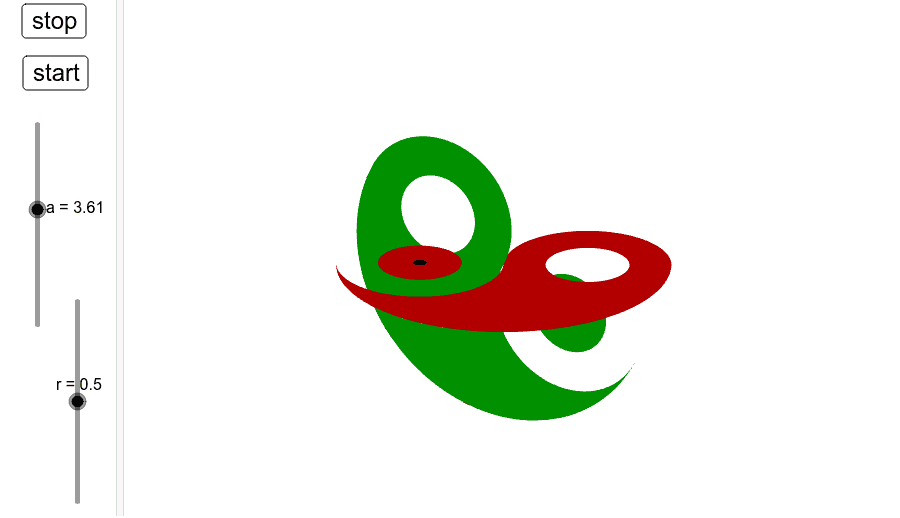
This example demonstrates the rotation of the Yin Yang symbol and its function graph transformation. It involves core mathematical concepts such as rotation, function graph, incircle, root, triangle, and binomial distribution. The construction uses commands like Surface and objects like a, q1, q2, r, c1, c2, t1, t2, Bouton1, Bouton2. Suitable for high school and above mathematics education or geometric transformation studies.
GeoGebra Commands & Parameters
Surface(((cos(v) + cos((u * v))) * cos(a)) - (sin(a) * (sin(v) + sin((u * v)))), ((cos(v) + cos((u * v))) * sin(a)) + (cos(a) * (sin(v) + sin((u * v)))), 0, u, 0, 1, v, 0, π) → q1Surface((-(((cos(v) + cos((u * v))) * cos(a)) - (sin(a) * (sin(v) + sin((u * v)))))), 0, ((cos(v) + cos((u * v))) * sin(a)) + (cos(a) * (sin(v) + sin((u * v)))), u, 0, 1, v, 0, π) → q2Surface((((v * cos(u)) + 1) * cos(a)) - ((sin(a) * v) * sin(u)), (((v * cos(u)) + 1) * sin(a)) + ((cos(a) * v) * sin(u)), 0, u, 0, (2 * π), v, 0, r) → c1Surface((-((((v * cos(u)) + 1) * cos(a)) - ((sin(a) * v) * sin(u)))), 0, (((v * cos(u)) + 1) * sin(a)) + ((cos(a) * v) * sin(u)), u, 0, (2 * π), v, 0, r) → c2Surface((((v * cos(u)) - 1) * cos(a)) - ((sin(a) * v) * sin(u)), (((v * cos(u)) - 1) * sin(a)) + ((cos(a) * v) * sin(u)), 0, u, 0, (2 * π), v, r, 1) → t1Surface((-((((v * cos(u)) - 1) * cos(a)) - ((sin(a) * v) * sin(u)))), 0, (((v * cos(u)) - 1) * sin(a)) + ((cos(a) * v) * sin(u)), u, 0, (2 * π), v, r, 1) → t2
AI Drawing Prompt Reference
Draw a rotating Yin Yang symbol demonstrating function graph transformations, incorporating core mathematical concepts like rotation, function graph, incircle, root, triangle, and binomial distribution. Create surfaces to form the Yin Yang symbol through rotation and function transformations, then use a slider to control the rotation angle, showing the dynamic changes of the Yin Yang symbol and its relationship with the function graph.
The prompt above was compiled from the original drawing commands and is for reference only.