
Writing Function Equation Using Intercepts and a Point
Loading the math board and drawing, please wait…
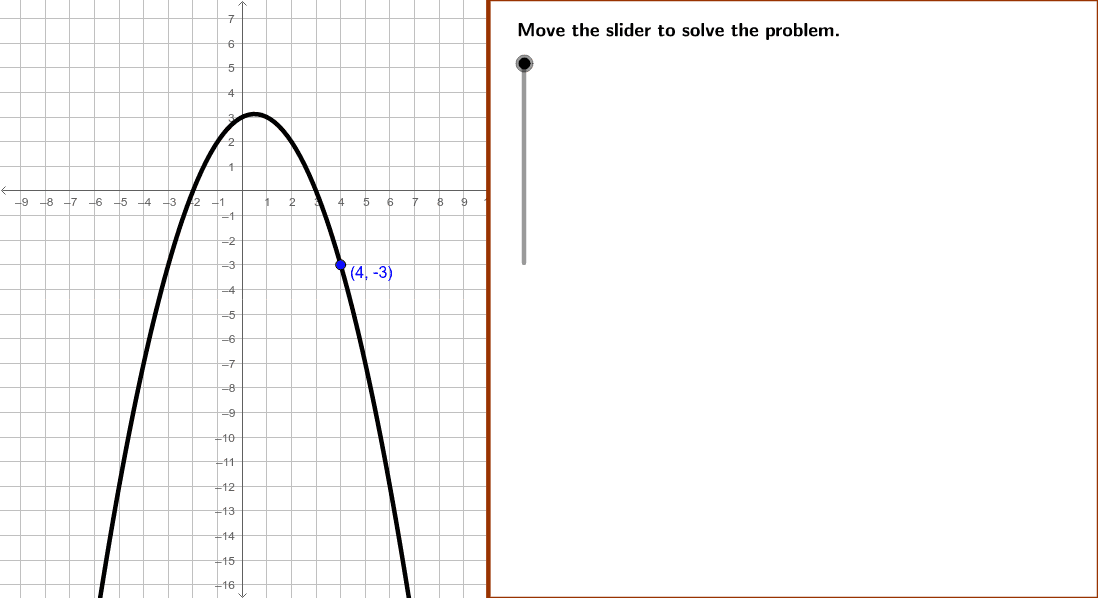
This example demonstrates how to write the standard form equation of a function using its intercepts and a point on the graph. Key math concepts include functions, coordinate geometry, quadratic functions, and standard form. GeoGebra commands like If, Polygon, Simplify, TableText and objects such as B, root1, root2, f1, B1, a, c, edge, Mask, mask1, mask2, mask4, mask3, steps2 are utilized in the construction. It is suitable for high school students learning about function graphs and equation solving, providing a practical approach to function analysis and equation derivation in mathematics education.
GeoGebra Commands & Parameters
If(x(B) ≟ root2, B + (1, 0), If[x(B) ≟ root1, B - (1, 0), B]) → B1Polygon((edge, y(Corner[1])), Corner[2], Corner[3], (edge, y(Corner[4]))) → Mask, mask1, mask2, mask4, mask3Simplify(f1) → f2TableText({{"\textit{x}=" + (LaTeX[root1]), "\textit{x}=" + (LaTeX[root2])}, {"\textit{x}" + (LaTeX[Element[plus, sgn((-root1)) + 2]]) + " " + (LaTeX[(-root1)]) + "=0", "\textit{x}" + (LaTeX[Element[plus, sgn((-root2)) + 2]]) + " " + (LaTeX[(-root2)]) + "=0"}}, "l") → Conclusions2TableText({{"\textit{f}(\textit{x})=\textit{a}" + (LaTeX[f1]), "\text{Original equation}"}, {LaTeX[y(B1)] + "=\textit{a}(" + (LaTeX[x(B1)]) + " " + (LaTeX[Element[plus, sgn((-root1)) + 2]]) + " " + (LaTeX[(-root1)]) + ")(" + (LaTeX[x(B1)]) + " " + (LaTeX[Element[plus, sgn((-root2)) + 2]]) + " " + (LaTeX[(-root2)]) + ") ", "\text{Substitute in }" + (LaTeX[B1]) + "."}, {LaTeX[y(B1)] + "=\textit{a}(" + (LaTeX[x(B1) - root1]) + ")(" + (LaTeX[x(B1) - root2]) + ")=" + (LaTeX[f1(x(B1))]) + "\textit{a}", "\text{Simplify.}"}, {" \textit{a}=" + (LaTeX[FractionText[y(B1) / f1(x(B1))]]), " "}}, "l") → Conclusions3
AI Drawing Prompt Reference
Draw the graph of a quadratic function, highlighting its x-intercepts (roots) and marking a point on the curve. Construct a quadrilateral that includes these intercepts and the point. Next to the graph, provide a table listing the coordinates of the intercepts and the standard form equation of the function. Show the step-by-step substitution and simplification to find the function's coefficient using the point's coordinates.
The prompt above was compiled from the original drawing commands and is for reference only.