
Why Positive Reals Have Two Square Roots: A Geometric Construction
Loading the math board and drawing, please wait…
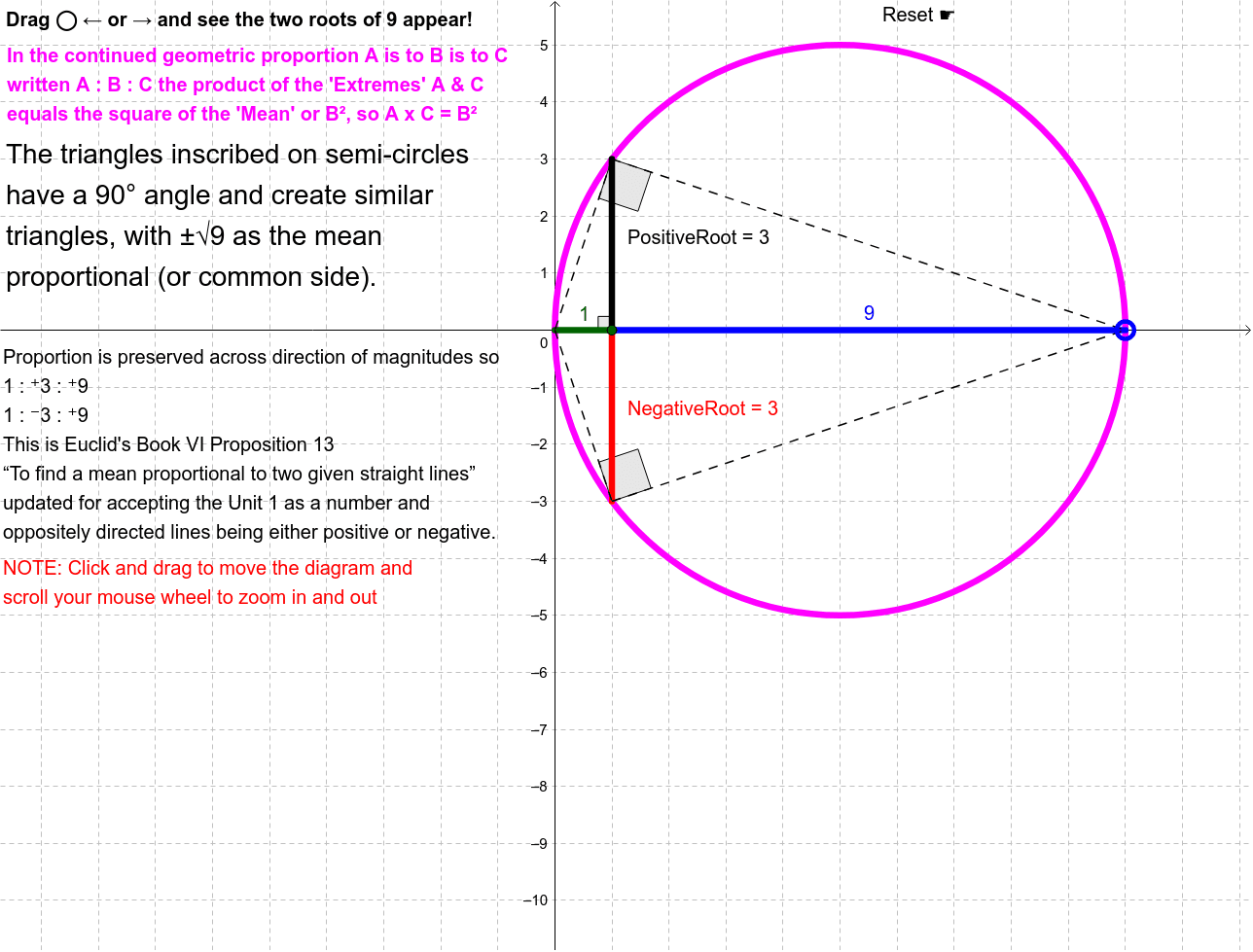
This GeoGebra example demonstrates geometrically why every positive real number has two square roots (a positive and a negative root). It addresses the common mathematical convention by providing a visual proof using line segments and semicircles. The core concepts involve square roots, symmetry on the number line, and the relationship between geometric construction and algebraic solutions. The construction uses commands such as Point, LineBisector, Segment, Semicircle, Line, Intersect, and Angle, with objects like Unity, PositiveRoot, NegativeRoot, and various auxiliary points. Suitable for middle or high school mathematics, this interactive visualization helps students grasp the dual nature of square roots and reinforces the connection between geometry and algebra.
GeoGebra Commands & Parameters
Point(xAxis) → UnityPoint(xAxis) → BLineBisector(Unity, B) → aPoint(xAxis) → GSegment(B, G) → mSemicircle(D, G) → kSemicircle(G, D) → pPoint(xAxis) → ISegment(I, D) → gSegment(I, G) → a_1Line(I, yAxis) → b_1Intersect(p, b_1, 1) → JIntersect(k, b_1, 1) → KSegment(I, K) → PositiveRootSegment(J, I) → NegativeRootSegment(K, D) → c_1Segment(D, J) → d_1Segment(K, G) → e_1Segment(J, G) → f_1Angle(D, K, G) → δAngle(G, J, D) → εAngle(K, I, D) → α