
Volumes and Surface Areas of Similar Cuboids by Dan Dale
Loading the math board and drawing, please wait…
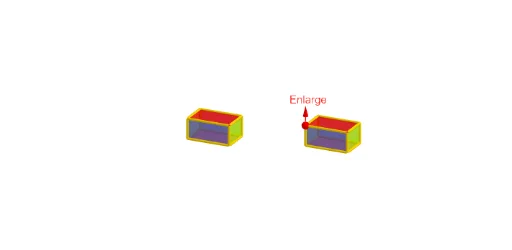
This example demonstrates the relationships between side lengths, surface areas, and volumes of similar 3D figures, specifically cuboids. Key math concepts include properties of similar figures, proportionality, and volume/surface area calculations. Constructed using GeoGebra commands like Polygon, Prism, Point, Segment, Rotate, Intersect, and Vector. Ideal for high school students studying solid geometry to understand the mathematical connections between similar solids.
GeoGebra Commands & Parameters
Polygon(A, B, C, D) → poly1, a, b, c, dPrism(poly1, E) → e, F, edgeBF, edgeCG, edgeDH, edgeEF, edgeFG, edgeGH, edgeEH, G, H, faceABFE, faceBCGF, faceCDHG, faceADHE, faceEFGH, edgeAEPoint(Segment[A' + (0, 0, h), A' + (0, 0, (2 * h))]) → E'Polygon(A', B', C', D') → poly2, a', b', c', d'Prism(poly2, E') → f, F', edgeB'I, edgeC'J, edgeD'K, edgeE'I, edgeIJ, edgeJK, edgeE'K, G', H', faceA'B'IE', faceB'C'JI, faceC'D'KJ, faceA'D'KE', faceE'IJK, edgeA'E'Segment(I, J) → gPoint(g) → KRotate(faceABFE, ((t * 90))°, a) → faceABFE'Rotate(faceBCGF, ((t * 90))°, b) → faceBCGF'Rotate(faceCDHG, ((t * 90))°, c) → faceCDHG'Rotate(faceADHE, ((t * 90))°, d) → faceADHE'Rotate(E, ((t * 90))°, a) → E'_1Rotate(F, ((t * 90))°, a) → F'_1Rotate(Rotate[faceEFGH, ((t * 90))°, a], ((t * 90))°, Segment[E'_1, F'_1]) → poly3Rotate(faceA'B'IE', ((t * 90))°, a') → faceA'B'IE''Rotate(faceB'C'JI, ((t * 90))°, b') → faceB'C'JI'Rotate(faceC'D'KJ, ((t * 90))°, c') → faceC'D'KJ'Rotate(faceA'D'KE', ((t * 90))°, d') → faceA'D'KE''Rotate(E', ((t * 90))°, a') → E''Rotate(F', ((t * 90))°, a') → F''Rotate(Rotate[faceE'IJK, ((t * 90))°, a'], ((t * 90))°, Segment[E'', F'']) → poly4Rotate(Segment[Midpoint[B', C'], Midpoint[F', G']], ((t * 90))°, b') → jRotate(Segment[Midpoint[B', F'], Midpoint[C', G']], ((t * 90))°, b') → iRotate(Segment[Midpoint[A', B'], Midpoint[E', F']], ((t * 90))°, a') → mRotate(Segment[Midpoint[A', E'], Midpoint[B', F']], ((t * 90))°, a') → nRotate(Segment[Midpoint[C', D'], Midpoint[G', H']], ((t * 90))°, c') → pRotate(Segment[Midpoint[C', G'], Midpoint[D', H']], ((t * 90))°, c') → qRotate(Segment[Midpoint[A', E'], Midpoint[D', H']], ((t * 90))°, d') → rRotate(Segment[Midpoint[A', D'], Midpoint[E', H']], ((t * 90))°, d') → sRotate(Rotate[Segment[Midpoint[E', F'], Midpoint[G', H']], ((t * 90))°, a'], ((t * 90))°, Segment[E'', F'']) → a_1Rotate(Rotate[Segment[Midpoint[E', H'], Midpoint[G', F']], ((t * 90))°, a'], ((t * 90))°, Segment[E'', F'']) → b_1Segment(Midpoint[A', B'], Midpoint[C', D']) → c_1Segment(Midpoint[A', D'], Midpoint[C', B']) → d_1Segment(Midpoint[F', C'], Midpoint[E', D']) → e_1Segment(Midpoint[F', A'], Midpoint[C', H']) → f_1Intersect(Line[E, E'], z = 0) → LSegment(L, E) → g_1Segment(L, H) → i_1Segment(L, F) → k_1Segment(L, G) → m_1Segment(H, H') → j_1Segment(G, G') → n_1Segment(E, E') → h_1Segment(F, F') → l_1Segment(L, A) → p_1Segment(A, A') → q_1Segment(L, B) → r_1Segment(B, B') → s_1Segment(L, C) → t_1Segment(C, C') → a_2Segment(L, D) → b_2Segment(D, D') → c_2Vector(E' + (0, 0, 0.3), E' + (0, 0, 1.3)) → uSegment(Midpoint[A', C'], Midpoint[E', G']) → d_2
AI Drawing Prompt Reference
Draw two similar cuboids to illustrate the relationships between their side lengths, surface areas, and volumes. Start by constructing the base and sides of the first cuboid, then form its prism. Extend the second cuboid vertically and rotate some faces and vertices of both cuboids to demonstrate similarity. Finally, connect key points and label to emphasize the mathematical concepts and proportional relationships.
The prompt above was compiled from the original drawing commands and is for reference only.