
Volume of Solid of Revolution 2
Loading the math board and drawing, please wait…
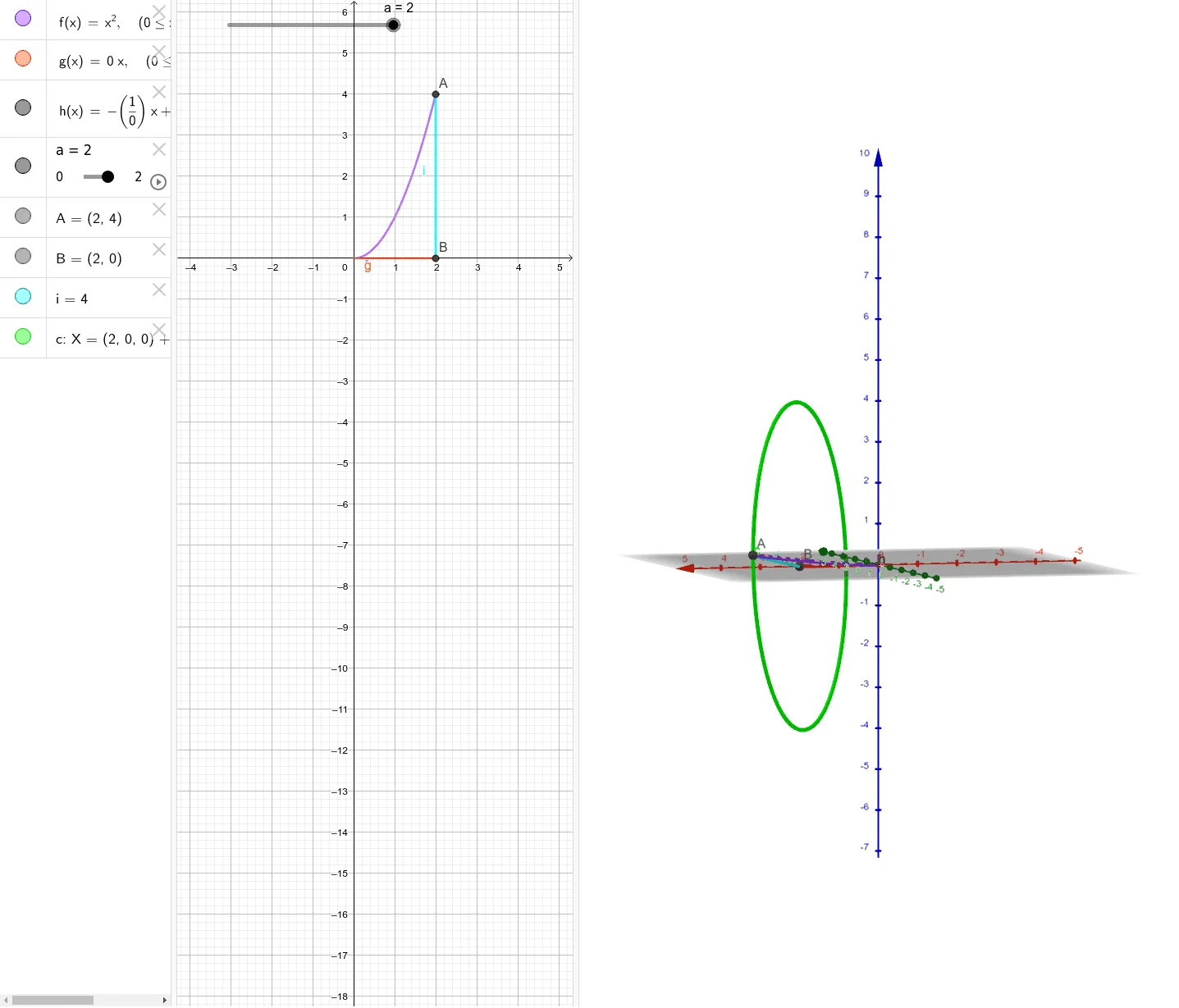
This example demonstrates how to generate a solid of revolution by rotating a planar region around an axis, and visually approximates its volume using Riemann sums. The core mathematical concept is the application of definite integrals to compute volumes of solids of revolution, specifically the disk/washer method, combined with upper and lower sum approximations. Construction details: using GeoGebra commands Segment and Circle, along with objects f, g, h, a, A, B, i, c, the example builds cross-sections and boundaries of the rotated shape. Sliders or parameters allow adjusting the rotation angle and number of subdivisions to observe how the volume approximation converges. Suitable for advanced high school or introductory college calculus students, this interactive tool helps grasp the geometric meaning of volume integrals and the idea of limiting sums.
GeoGebra Commands & Parameters
Segment(A, B) → iCircle(B, f(a), xAxis) → c
AI Drawing Prompt Reference
Draw a solid of revolution formed by rotating a planar region around an axis. The planar region is bounded by two line segments and a circular arc, with the rotation axis along the x-axis. The drawing includes the rotated solid shape, cross-sections, and boundary lines. Adjusting the rotation angle and subdivision count allows observing how the volume approximation converges.
The prompt above was compiled from the original drawing commands and is for reference only.