
Volume of Revolution by Walerij Koschkin
Loading the math board and drawing, please wait…
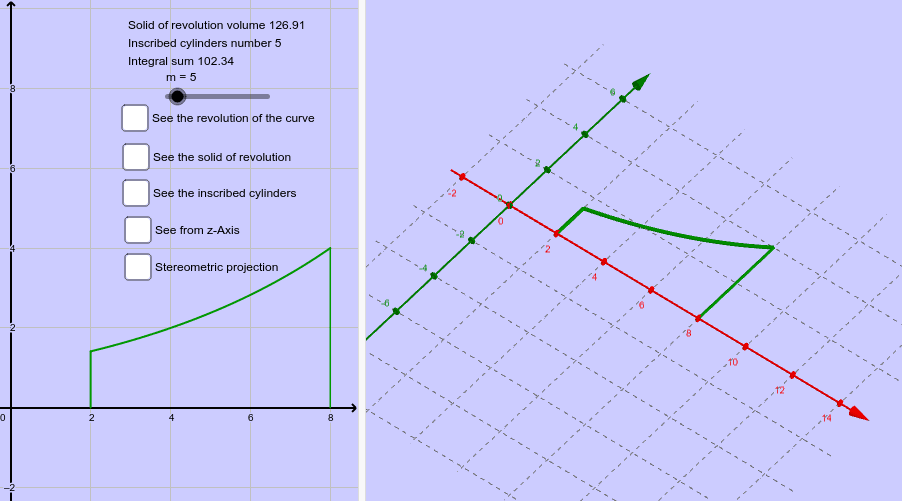
This example demonstrates the calculation of the volume of a solid of revolution. Key mathematical concepts include solids of revolution and integration. Using GeoGebra commands such as CurveCartesian, Rotate, Sequence, and Integral, the example constructs a solid of revolution and calculates its volume. Suitable for high school mathematics education and learning.
GeoGebra Commands & Parameters
CurveCartesian(t, 2^(t / 4), 0, t, 2, 8) → bRotate(b, c, xAxis) → b'Sequence(Cylinder[((9 * (n - 1) / m), 0), ((9 * n / m), 0), sqrt((9 * n / m))], n, 1, m) → list1_1Sum(list1_1) → d_1Integral(x, 0, 9) → eSegment((2, 0), (2, 2^(1 / 2))) → gSegment((8, 0), (8, 4)) → hRotate(g, c, xAxis) → g'Rotate(h, c, xAxis) → h'Sequence(Cylinder[(2 + (6 * n / m), 0), (2 + (6 * (n + 1) / m), 0), 2^((2 + (6 * n / m)) / 4)], n, 0, m - 1) → list2Sequence(Cylinder[(2 + (6 * n / 50), 0), (2 + (6 * (n + 1) / 50), 0), 2^((2 + (6 * n / 50)) / 4)], n, 0, 49) → list3Sum(list2) → S1Integral((π * 2^(x / 2)), 2, 8) → V1Vector((14, -10, 10), (6, 0, 0)) → u