
Volume of Rectangular Prisms - Measurement and Geometry
Loading the math board and drawing, please wait…
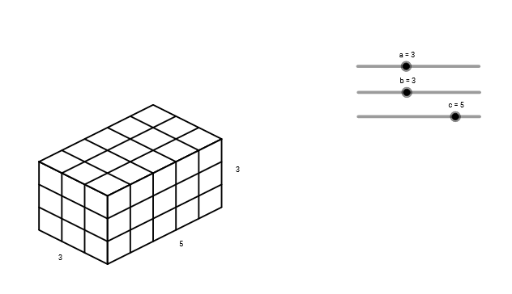
This example demonstrates the measurement of rectangular prisms' volume, involving key concepts of geometry and volume. Using GeoGebra commands like Sequence, it dynamically shows the construction process of rectangular prisms. Suitable for middle school and above students to learn geometry and volume calculation.
GeoGebra Commands & Parameters
Sequence(Segment[(n, a - n / 2), (n, ((-n)) / 2)], n, 0, b) → list1Sequence(Segment[(n + b, ((-b)) / 2 + n / 2), (n + b, ((-b)) / 2 + n / 2 + a)], n, 0, c) → list2Sequence(Segment[(0, a - n), (b, ((-b)) / 2 - n + a)], n, 0, a) → list3Sequence(Segment[(b, ((-b)) / 2 + n), (b + c, ((-b)) / 2 + n + c / 2)], n, 0, a) → list4Sequence(Segment[(n, ((-n)) / 2 + a), (n + c, c / 2 - n / 2 + a)], n, 0, b) → list5Sequence(Segment[(n, a + n / 2), (n + b, a + n / 2 - b / 2)], n, 0, c) → list6
AI Drawing Prompt Reference
Draw a rectangular prism by first creating the base rectangle, then adding four sides, and finally connecting the top face. The base rectangle's length ranges from 0 to b, and its height ranges from a minus half the length to negative b divided by 2 plus half the length. The side rectangles' lengths range from 0 to b, and their heights range from negative b divided by 2 plus half the length to negative b divided by 2 plus half the length plus half of c. The top face rectangle's length ranges from 0 to b, and its height ranges from a plus half the length to a plus half the length minus half of c.
The prompt above was compiled from the original drawing commands and is for reference only.