
Volume of Pyramid via Prisms
Loading the math board and drawing, please wait…
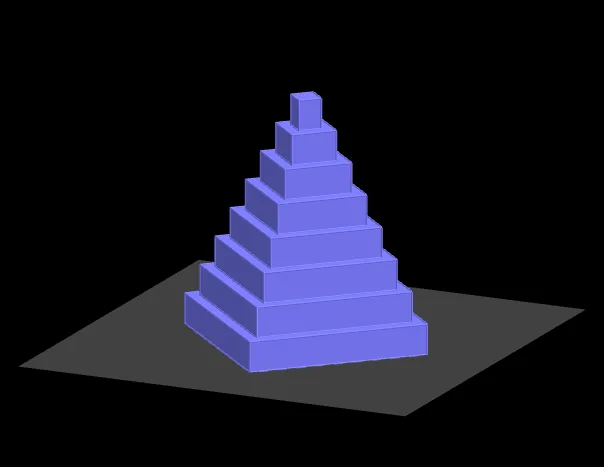
This example demonstrates how the volume of a pyramid can be derived as a limit of the sum of volumes of square prisms. It involves core concepts like volume calculation, limit theory, and geometric relationships. The construction uses GeoGebra commands such as Sequence along with objects like h, a, n, and lists (list2-list6) and texts (text1-text3) for parameter control and display. Suitable for high school mathematics education to illustrate the derivation of volume formulas.
GeoGebra Commands & Parameters
Sequence((((n - i) * a / n), 0, (i * h / n)), i, 0, n) → list2Sequence((0, ((n - i) * a / n), (i * h / n)), i, 0, n) → list1Sequence((((-(n - i)) * a / n), 0, (i * h / n)), i, 0, n) → list3Sequence((0, ((-(n - i)) * a / n), (i * h / n)), i, 0, n) → list4Sequence(Polygon[Element[list2, i], Element[list1, i], Element[list3, i], Element[list4, i]], i, 1, n) → list5Sequence(Prism[Element[list5, i], h / n], i, 1, n) → list6
AI Drawing Prompt Reference
Create a visual demonstration of deriving the volume of a pyramid by summing the volumes of square prisms. Start by drawing the base and apex of the pyramid, then divide it into n smaller square prisms along the height, with each prism's base gradually decreasing and height reducing. Finally, stack these prisms to form the pyramid's volume model, illustrating the derivation of the volume formula.
The prompt above was compiled from the original drawing commands and is for reference only.