
Volume of Intersecting Cylinders
Loading the math board and drawing, please wait…
In collections
intersection: surface-surface, curve-curve
intersection: surface-surface, curve-curve
intersection: surface-surface, curve-curve
intersection: surface-surface, curve-curve
Volumes in Calculus
Volumes in Calculus
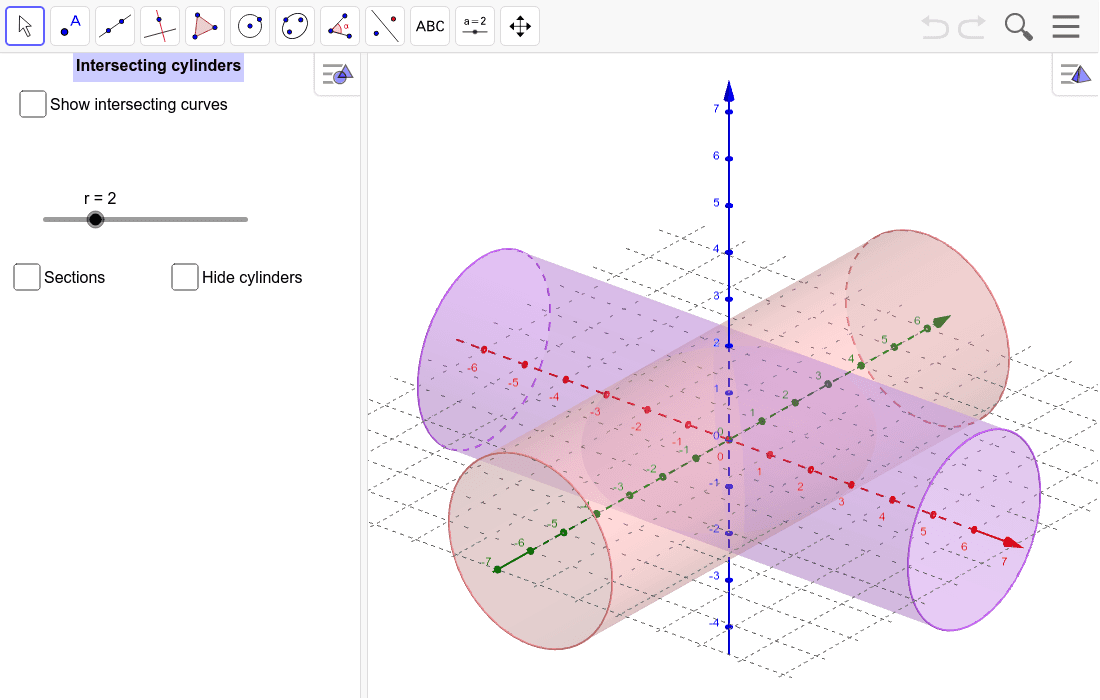
This example demonstrates the calculation of the volume of the intersection of two perpendicular cylinders, involving integral calculus, solid geometry, trigonometric functions, and volume formulas. It uses GeoGebra commands like Cylinder, IntersectPath, Point, Conic, CurveCartesian, Polygon, and Surface. Suitable for high school and above students learning complex geometric volume problems.
GeoGebra Commands & Parameters
Cylinder(((3 * r), 0, 0), (((-3) * r), 0, 0), r) → a, c, d, bCylinder((0, ((-3) * r), 0), (0, (3 * r), 0), r) → e, f, g, hIntersectPath(plane1, e) → kPoint(k) → AConic((2, 2, 0), (-2, -2, 0), (0, 0, 2), (0, 0, -2), (1.4142135623730951, 1.4142135623730951, 1.4142135623730951)) → pIntersectPath(plane2, a) → qCurveCartesian((r * cos(t)), (r * cos(t)), (r * sin(t)), t, 0, 6.28319) → crv1CurveCartesian((r * cos(t)), ((-r) * cos(t)), (r * sin(t)), t, 0, 6.28319) → crv2Polygon((ss, ss, PlaneHeight), ((-ss), ss, PlaneHeight), ((-ss), (-ss), PlaneHeight), (ss, (-ss), PlaneHeight)) → Square, i, j, l, mSurface(u, v / ((-u) ≤ v ≤ u), (-sqrt(r^(2) - u^(2))), u, (-r), r, v, (-r), r) → SecBottom1Surface(u / ((-v) ≤ u ≤ v), (-v), (-sqrt(r^(2) - v^(2))), u, (-r), r, v, (-r), r) → SecBottom2Surface((-u), v / ((-u) ≤ v ≤ u), (-sqrt(r^(2) - u^(2))), u, (-r), r, v, (-r), r) → SecBottom3Surface(u / ((-v) ≤ u ≤ v), v, (-sqrt(r^(2) - v^(2))), u, (-r), r, v, (-r), r) → SecBottom4Surface(u, v / ((-u) ≤ v ≤ u), sqrt(r^(2) - u^(2)), u, (-r), r, v, (-r), r) → SecTop1Surface(u / ((-v) ≤ u ≤ v), (-v), sqrt(r^(2) - v^(2)), u, (-r), r, v, (-r), r) → SecTop2Surface((-u), v / ((-u) ≤ v ≤ u), sqrt(r^(2) - u^(2)), u, (-r), r, v, (-r), r) → SecTop3Surface(u / ((-v) ≤ u ≤ v), v, sqrt(r^(2) - v^(2)), u, (-r), r, v, (-r), r) → SecTop4
AI Drawing Prompt Reference
Draw two perpendicular cylinders of equal radius, with their axes along the x-axis and y-axis, intersecting at the origin. Show the overlapping solid region of the two cylinders, using semi-transparent surfaces or grids to represent the upper and lower boundaries of the intersection. Add a cutting plane to reveal the cross-section shape of the overlap, and include a square cross-section inside the region. Mark the intersection curves between the cylinder surfaces and the cutting plane. Present a clear 3D geometric view emphasizing the volume of the common part of the two cylinders.
The prompt above was compiled from the original drawing commands and is for reference only.