
Volume of a Sphere Using Disks
Loading the math board and drawing, please wait…
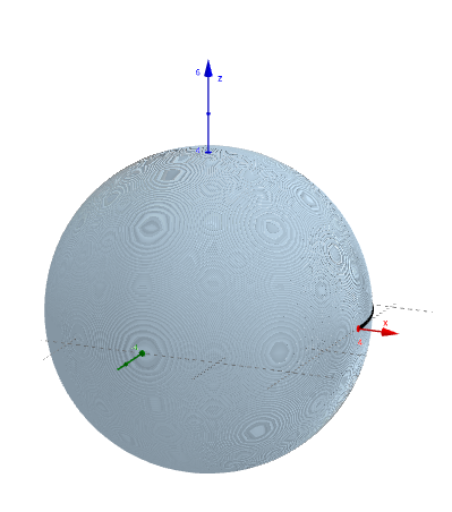
This example demonstrates how the volume of a sphere is formed using disks. It involves calculating the volume of a sphere using the disk method. GeoGebra commands such as Div and Sequence are used to dynamically show the stacking of disks, providing a clear understanding of the volume calculation. Suitable for high school mathematics, particularly in solid geometry and calculus courses.
GeoGebra Commands & Parameters
Div(b - a, dx) → nstepsSequence({QuadricSide[Cylinder[(a + (dx * k), 0), (a + (dx * (k + 1)), 0), f(a + (dx * k))]], Top[Cylinder[(a + (dx * k), 0), (a + (dx * (k + 1)), 0), f(a + (dx * k))]], Bottom[Cylinder[(a + (dx * k), 0), (a + (dx * (k + 1)), 0), f(a + (dx * k))]]}, k, a, (b - a) / dx - 1) → cylinders