
Volume of a Right Prism with Regular Polygon Base
Loading the math board and drawing, please wait…
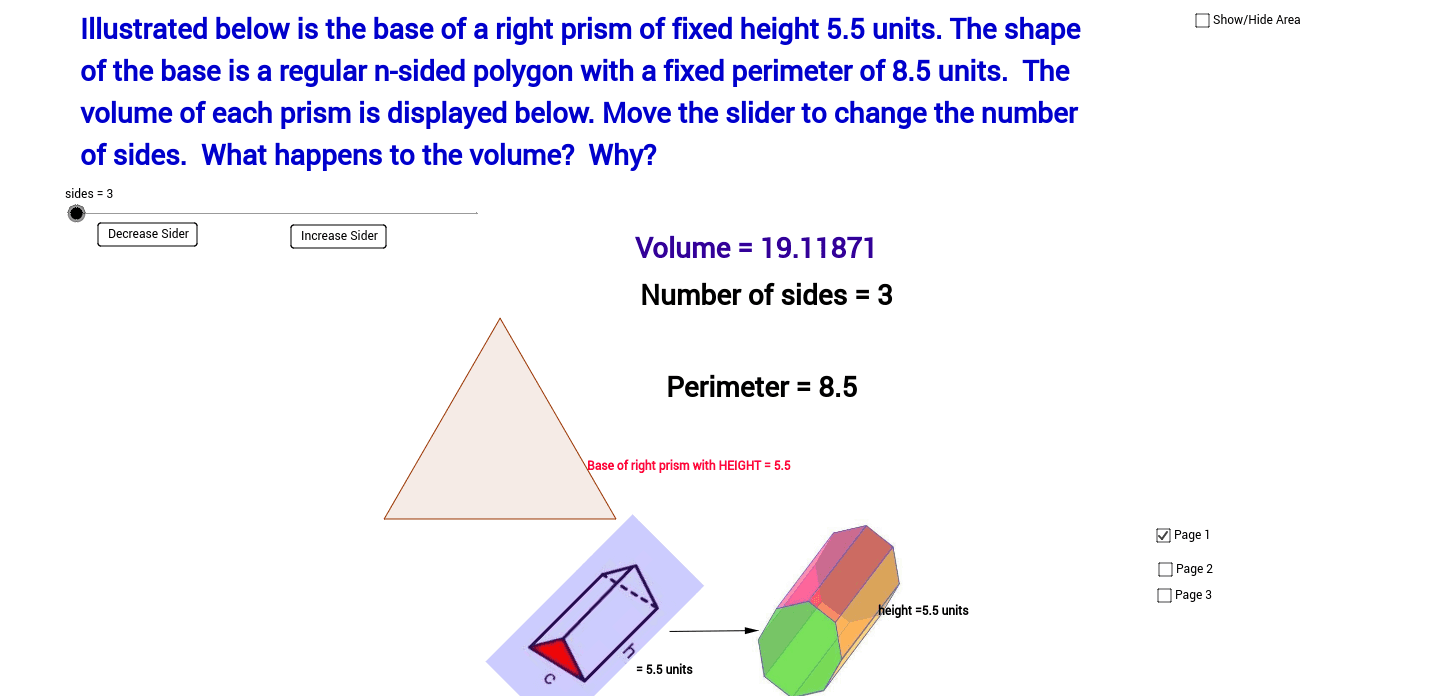
This GeoGebra example demonstrates the volume calculation of a right prism with a regular polygon base, such as an equilateral triangle, square, or n-gon, through dynamic geometric construction. Key mathematical concepts include solid geometry volume formulas, properties of regular polygons, and parametric construction techniques. The construction utilizes commands like Polygon to draw the base, Perimeter and Area for measurements, Text for labels, OrthogonalLine and Intersect to define the height, Segment and Rotate for lateral faces, and Vector and Translate for transformations. Objects include polygons, text annotations, and interactive buttons. It is suitable for high school or college geometry courses, providing an intuitive visualization for deriving and applying volume formulas.
GeoGebra Commands & Parameters
Polygon(((sides - 3) / sides, 0), (8.5 / sides + (sides - 3) / sides, 0), sides) → poly1Perimeter(poly1) → PerimeterArea(poly1) → AreaText("Perimeter = " + Perimeter) → text2Text("Area = " + Area) → text1Text("Number of sides = " + sides) → text3Text("Base of right prism with HEIGHT = 5.5") → text4OrthogonalLine(B, yAxis) → cOrthogonalLine(D, xAxis) → dIntersect(c, d) → CPolygon(A, B, C, D) → poly2, a_1, b_1, c_1, d_1Text("Area = " + (AD * h)) → text8Text("Side AB = " + h) → text9Text("Side AD = " + AD) → text10Text("If the rectangle is the base of a right prism of height 5.5 then Volume = " + (AD * h * 5.5)) → text7Text("height =5.5 units") → text11Segment(A', D') → gRotate(F, 65, A') → F'Segment(A', F') → iVector(A', D') → uTranslate(F, u) → F'_1Rotate(F'_1, 65, D') → EPolygon(A', D', E, F') → poly3, a', d', e_1, f'Segment(G, F') → jSegment(G', A') → kSegment(G, G') → lSegment(G, H') → mSegment(H', H) → nSegment(H, G') → pSegment(H', E) → qRotate(A', 327.5*°, A') → A''Intersect(e_1, k) → IIntersect(e_1, k) → JIntersect(e_1, d') → KSegment(F', I) → rSegment(I, E) → sSegment(H, D') → tText("Length = " + g_2) → text12Point(i) → LText("Width = " + a_1) → text13Text("Height = 5.5 ") → text14Point(t) → MSegment(F', E) → f_1Text(" = 5.5 units") → text15Vector(N, O) → wText("Volume = " + volume) → text16Point(yAxis) → PVector(A, P) → zPoint(xAxis) → QVector(A, Q) → bText("How do the area and volume values relate?") → text6Text("11''x8.5''") → text18Text("5.5''x8.5''") → text19Text("8.5''") → text20Text("5.5''") → text21Text("''Max-Min''") → text22
AI Drawing Prompt Reference
Draw a right prism with a regular polygon base, such as an equilateral triangle, square, or n-gon, to demonstrate volume calculation through dynamic geometric construction. Display the perimeter and area of the base, and label the number of sides. Define the prism's height and show the relationship between the lateral faces and the base. Use rotation and vector transformations to construct the lateral faces, and annotate key lengths and volume formulas, suitable for high school or college geometry courses.
The prompt above was compiled from the original drawing commands and is for reference only.