
Volume of a Rectangular Prism by Patrick Lane
Loading the math board and drawing, please wait…
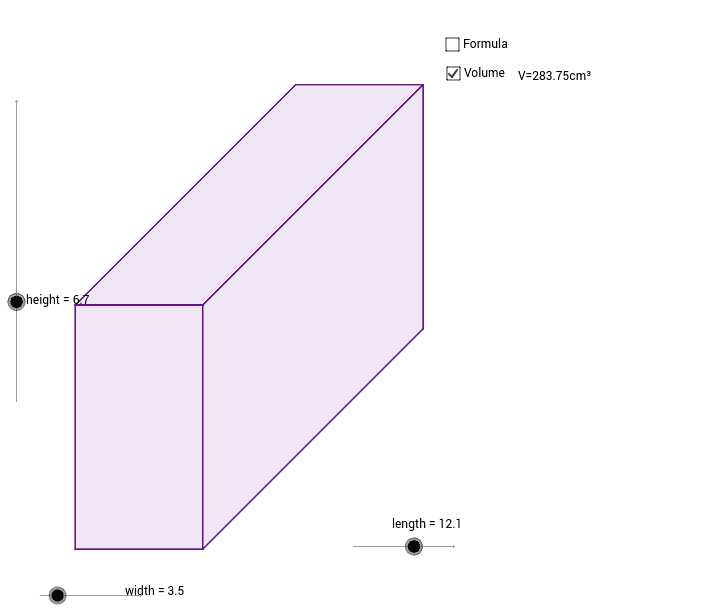
This example allows you to adjust the dimensions of a rectangular prism using sliders to observe changes in volume. Key mathematical concepts include the volume calculation of a rectangular prism. It utilizes commands like Segment, Polygon, and Text in GeoGebra, suitable for middle school and above students.
GeoGebra Commands & Parameters
Segment(A, B) → aSegment(A, C) → bSegment(B, D) → cSegment(C, D) → dSegment(B, E) → eSegment(E, F) → fSegment(F, D) → gSegment(H, F) → hSegment(G, H) → iPolygon(A, G, D, B) → poly1, a_1, g_1, d_1, b_1Polygon(B, E, F, D) → poly2, b_2, e_1, f_1, d_2Polygon(G, H, F, D) → poly3, g_2, h_1, f_2, d_3Text("V=" + height + "x" + width + "x" + length) → text2Text("V=" + (height * length * width) + "cm³") → text1
AI Drawing Prompt Reference
Draw a rectangular prism and adjust its length, width, and height to observe changes in volume. First, draw four vertices A, B, C, and D, then connect these points to form four rectangular faces, and finally display the volume formula and calculation result beside it.
The prompt above was compiled from the original drawing commands and is for reference only.