
Volume of a Pyramid by Miguel Quinonez
Loading the math board and drawing, please wait…
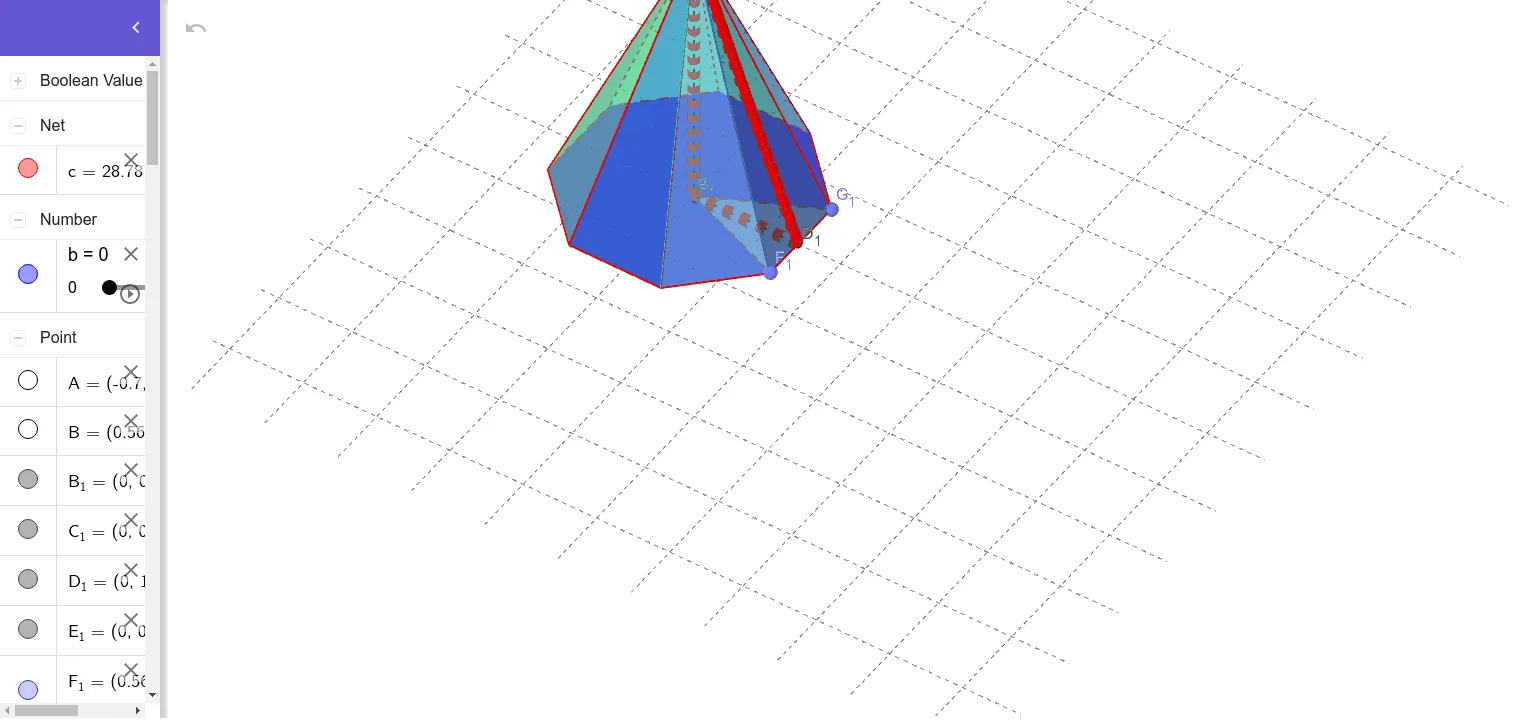
This example demonstrates how to construct and calculate the volume of a pyramid using GeoGebra. Key math concepts include volume formulas, 3D coordinates, polygon construction, and analytical geometry. The construction utilizes commands like Polygon, Point, Pyramid, Net, Intersect, and Segment. Suitable for high school solid geometry education or for math enthusiasts exploring geometric volume calculations.
GeoGebra Commands & Parameters
Polygon(A, B, 8) → poly1, f, D, E, F, G, H, g, h, i, j, k, l, m, CPoint(zAxis) → IPyramid(poly1, I) → a, faceABI, edgeBI, edgeCI, edgeDI, edgeEI, edgeFI, edgeGI, edgeHI, faceBCI, faceCDI, faceDEI, faceEFI, faceFGI, faceGHI, faceAHI, edgeAINet(a, b) → c, J, S, T, U, V, W, Z, A_1, faceJKLMNOPQ, faceJKR, faceKLS, K, faceLMT, faceMNU, faceNOV, faceOPW, facePQZ, face1, edgeJK, edgeKL, edgeLM, edgeMN, L, edgeNO, edgeOP, edgePQ, edgeJQ, edgeJR, edgeKR, edgeKS, edgeLS, edgeLT, edgeMT, M, edgeMU, edgeNU, edgeNV, edgeOV, edgeOW, edgePW, edgePZ, edgeQZ, edge2, edge1, N, O, P, Q, RIntersect(xAxis, yAxis) → B_1Intersect(edgeOV, edgePZ) → C_1Segment(B_1, C_1) → nIntersect(yAxis, edgeNO) → D_1Segment(D_1, C_1) → qSegment(D_1, B_1) → rSegment(B_1, C_1) → sSegment(D_1, B_1) → pIntersect(edgeFI, edgeGI) → E_1Segment(B_1, E_1) → tPoint(edgeNO) → F_1Point(edgeNO) → G_1Polygon(F_1, G_1, B_1) → t1, b_1, f_1, g_1Segment(E_1, B_1) → eIntersect(edgeNV, edgeOV) → H_1Segment(D_1, H_1) → h_1Segment(E_1, D_1) → i_1