
Volume of a Prism - Dynamic 3D Demonstration
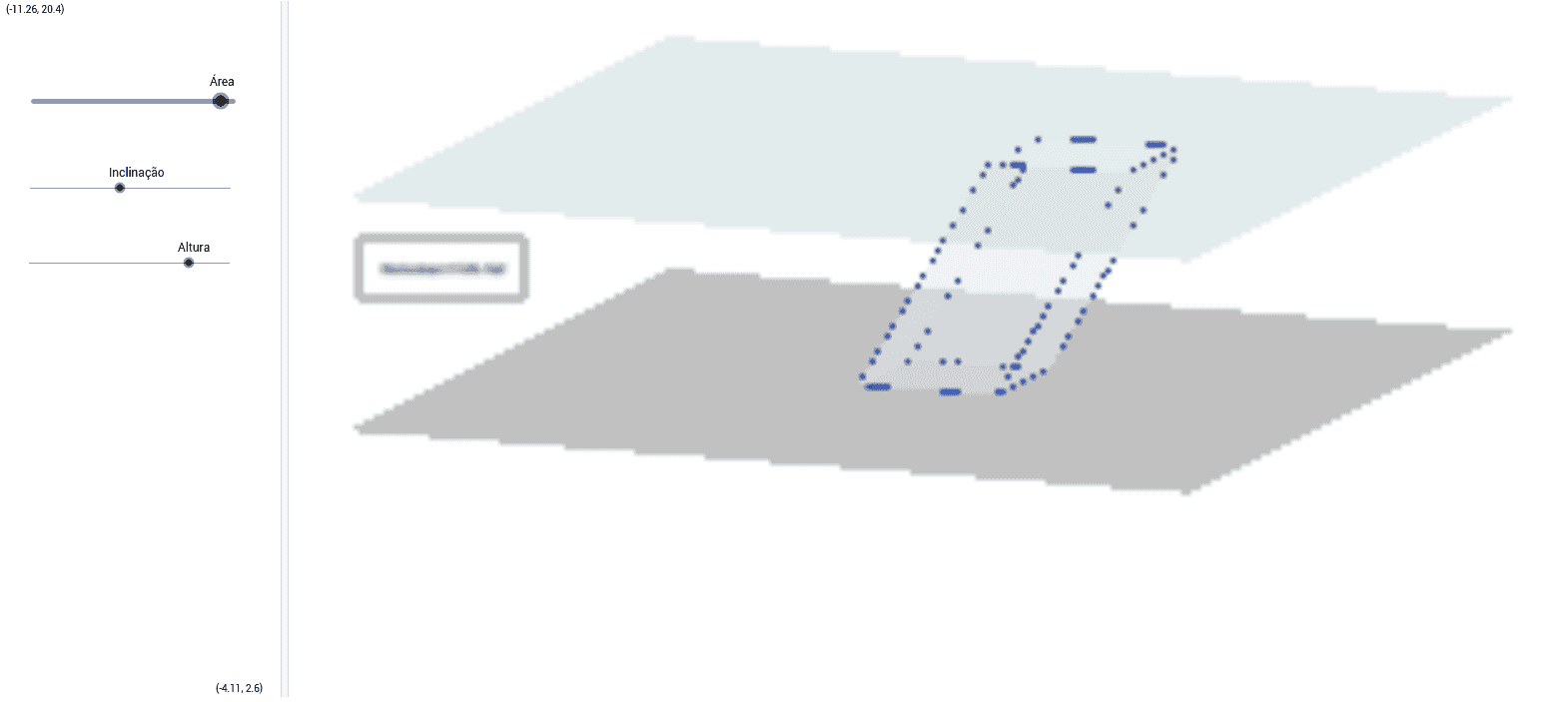
Loading the math board and drawing, please wait…
① This GeoGebra example demonstrates the construction of a prism in 3D space and dynamically computes its volume. ② Core mathematical concepts include the definition of a prism, base polygon, height, volume formula (base area × height), and spatial relationships among vertices, edges, and faces. ③ Construction highlights: uses Polygon to create the base, Point for vertices, Prism to generate the solid, Plane for auxiliary planes, and Volume to calculate the volume; objects include multiple vertices (A, B, C, D, E, F, G, H, I), edges (edgeAF, edgeCF, etc.), and faces (faceABCF, etc.), with sliders (Inclinação, Altura) adjusting tilt and height to update the volume in real time. ④ Suitable for middle/high school geometry or introductory solid geometry courses, helping students grasp the geometric meaning of the volume formula and the use of parametric dynamic modeling in 3D.
GeoGebra Commands & Parameters
Polygon(D, C, B, A) → poly1, d, c, b, a_1Point(a_1) → FPrism(A, F, C, B, E) → e, G, edgeAF, edgeCF, edgeBC, edgeAB, edgeAE, edgeFG, edgeCH, edgeBI, edgeEG, edgeGH, H, edgeHI, edgeEI, I, faceABCF, faceAEGF, faceCFGH, faceBCHI, faceABIE, faceEGHIPlane(E, G, H) → fVolume(Prism[A, F, C, B, E]) → g