
Volume Calculation and Rotation Solid Demo
Loading the math board and drawing, please wait…
In collections
Volume of Solids
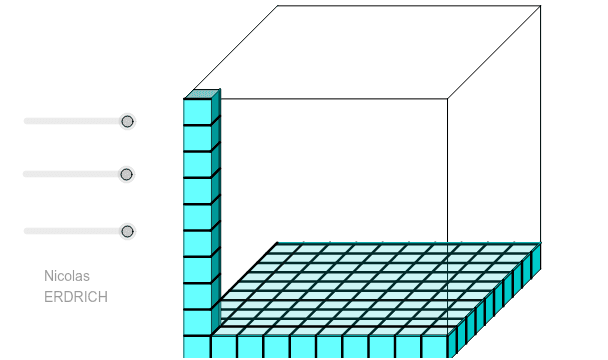
This example demonstrates the generation of a rotational solid by rotating a polygon with an incircle, visually showing the principle of volume calculation. Core concepts include rotation, symmetry, incircle, polygon properties, and volume formulas. GeoGebra commands and objects used in construction are Line, Circle, Rotate, Polygon, etc. Suitable for high school solid geometry teaching to understand the formation and calculation of rotational solid volumes.
GeoGebra Commands & Parameters
Line(A, xAxis) → aOrthogonalLine(A, a) → q_4Circle(A, 2) → rIntersect(r, q_4, 2) → EIntersect(r, a, 2) → BOrthogonalLine(E, q_4) → sOrthogonalLine(B, a) → tIntersect(s, t) → FRotate(F, 45*°, E) → S'Angle(F, E, S') → αSegment(E, S') → i_1Segment(E, F) → j_1Midpoint(j_1) → TCircle(E, T) → k_1Intersect(k_1, i_1, 1) → HSegment(E, H) → p_1Line(H, j_1) → q_1Line(F, p_1) → r_1Intersect(q_1, r_1) → VSegment(A, E) → s_1Segment(F, B) → t_1Line(B, r_1) → a_2Line(V, s_1) → b_2Intersect(a_2, b_2) → WPolygon(A, B, F, E) → poly1, p_2, r_2, s_2, q_2Polygon(B, W, V, F) → poly2, r_3, w, v, s_3Polygon(E, F, V, H) → poly3, q_3, s_4, v_1, uTranslate(A, B - A) → A'Translate(E, B - A) → E'Sequence(Sequence[Polygon[Translate[A, Vector[k * Vector[A, B] + l * Vector[A, E]]], Translate[B, Vector[k * Vector[A, B] + l * Vector[A, E]]], Translate[F, Vector[k * Vector[A, B] + l * Vector[A, E]]], Translate[E, Vector[k * Vector[A, B] + l * Vector[E, A]]]], k, 0, o], l, 0, 0) → ligneSequence(Sequence[Polygon[Translate[E, Vector[l * Vector[A, B] + m * Vector[E, H]]], Translate[F, Vector[l * Vector[A, B] + m * Vector[E, H]]], Translate[V, Vector[l * Vector[A, B] + m * Vector[E, H]]], Translate[H, Vector[l * Vector[A, B] + m * Vector[E, H]]]], l, 0, o], m, 0, q) → liste3Sequence(Polygon[Translate[B, k * (W - B) + o * (B - A)], Translate[W, k * (W - B) + o * (B - A)], Translate[V, k * (W - B) + o * (B - A)], Translate[F, k * (W - B) + o * (B - A)]], k, 0, q) → ligne2Sequence(Sequence[Polygon[Translate[A, Vector[k * Vector[B, A] - l * Vector[E, A]]], Translate[B, Vector[k * Vector[B, A] - l * Vector[E, A]]], Translate[F, Vector[k * Vector[B, A] - l * Vector[E, A]]], Translate[E, Vector[k * Vector[B, A] - l * Vector[E, A]]]], k, 0, 0], l, 0, p) → listeSequence(Sequence[Polygon[Translate[B, Vector[-l * Vector[E, A] + m * Vector[E, H]]], Translate[W, Vector[-l * Vector[E, A] + m * Vector[E, H]]], Translate[V, Vector[-l * Vector[E, A] + m * Vector[E, H]]], Translate[F, Vector[-l * Vector[E, A] + m * Vector[E, H]]]], l, 0, p], m, 0, 0) → liste2Translate(E, p * (E - A)) → E'_1Translate(F, p * (E - A)) → F'Translate(V, p * (E - A)) → V'Translate(H, p * (E - A)) → H'Polygon(E'_1, F', V', H') → Haut, e'_1, f', v', h'Translate(A, (o + 1) * (B - A)) → Sommet1Translate(A, (p + 1) * (E - A)) → Sommet2OrthogonalLine(E'_1, s_1) → bOrthogonalLine(Sommet1, p_2) → cIntersect(b, c) → Sommet3Translate(A, (q + 1) * (H - E)) → Sommet4OrthogonalLine(Sommet4, p_2) → dSegment(A, Sommet4) → eSegment(A, E'_1) → fLine(E'_1, e) → gIntersect(d, g) → CLine(Sommet3, g) → hLine(C, b) → iIntersect(h, i) → DLine(D, d) → jLine(Sommet1, h) → kIntersect(j, k) → GSegment(E'_1, Sommet3) → lSegment(Sommet3, Sommet1) → mSegment(Sommet3, D) → nSegment(D, G) → a_1Segment(D, C) → b_1Segment(C, E'_1) → c_1Segment(F', B) → d_1Segment(V', V) → e_1Segment(H', V') → f_1Segment(A, Sommet1) → g_1Point(g_1) → ISegment(I, G) → h_1Segment(F, E) → l_1Segment(F, B) → m_1Line(E, g_1) → n_1Intersect(n_1, m) → JSegment(F, J) → c_2Segment(F', V') → d_2Segment(B, W) → e_2Line(J, h_1) → f_2Intersect(a_1, f_2) → KPoint(h_1) → LSegment(L, K) → g_2Segment(J, K) → h_2Line(H, h_1) → i_2Line(K, l) → j_2Intersect(i_2, j_2) → MSegment(M, K) → k_2Intersect(i_2, e_1) → NSegment(N, M) → l_2Intersect(r_1, j_2) → OSegment(F, O) → m_2Sequence(Segment[Translate[F, -k * (A - B)], Translate[O, -k * (A - B)]], k, 0, o) → seg4Line(N, b_1) → n_2Intersect(n_2, h_2) → PSegment(N, P) → t_2Line(V, t_2) → a_3Intersect(a_3, h_2) → QLine(S', a_3) → b_3Intersect(b_3, h_2) → RSegment(V, Q) → c_3Polygon(F, V, N, M, K, J) → poly4, f_3, v_2, n_3, m_3, k_3, j_3Polygon(V, F, F', V') → poly5, v_3, f_4, f'_1, v'_1Segment(N, M) → d_3Segment(M, K) → e_3Sequence(Segment[Translate[F, -k * (A - E)], Translate[E, -k * (A - E)]], k, 0, p) → seg_1Sequence(Segment[Translate[F, k * (B - A)], Translate[B, k * (B - A)]], k, 0, o) → seg_2Sequence(Segment[Translate[F, -l * (E - H) + o * (B - A)], Translate[B, -l * (E - H) + o * (B - A)]], l, 1, q) → seg10Sequence(Segment[Translate[N, l * (H - E)], Translate[P, l * (H - E)]], l, -2, q - 3) → seg5Sequence(Segment[Translate[B, -k * (B - F)], Translate[W, -k * (B - F)]], k, 1, p) → seg_3
AI Drawing Prompt Reference
Draw a rotational solid formed by rotating a polygon with an incircle to demonstrate volume calculation. Start by drawing a baseline and a perpendicular line intersecting a circle at two points. Connect these points to form a polygon. Rotate the polygon by 45 degrees and connect key points to create new shapes, including the incircle. Use rotation and translation to generate multiple similar shapes, combining them to form the final rotational solid, visually representing the volume formation.
The prompt above was compiled from the original drawing commands and is for reference only.