
Volume by Washers
Loading the math board and drawing, please wait…
In collections
AP Calculus volume problems
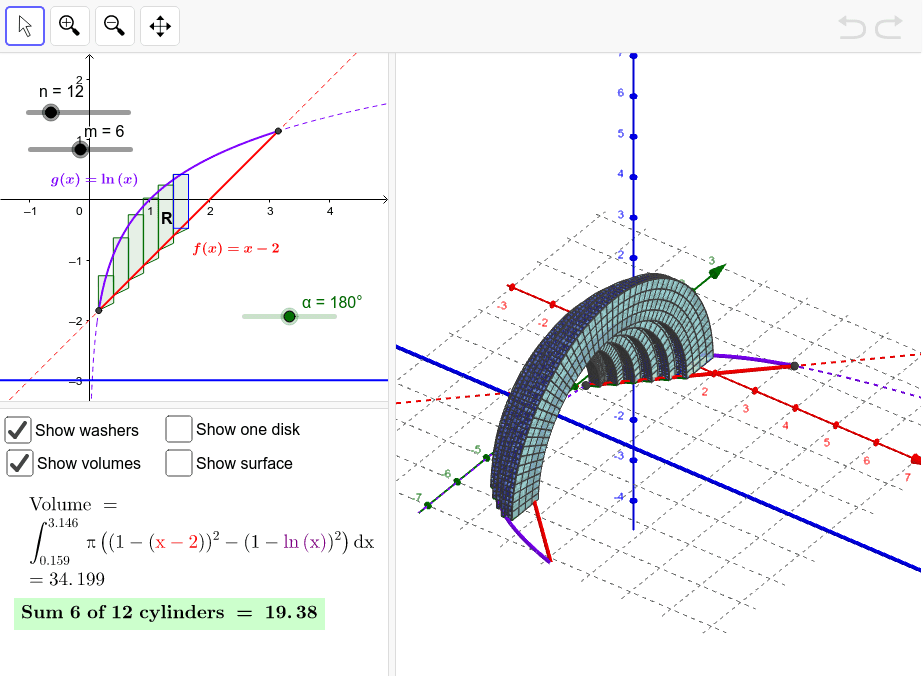
This example demonstrates the volume of a solid of revolution using the washer method, based on AP Exam 2006 Problem 1b. Key mathematical concepts include integration and volume of solids of revolution. GeoGebra commands used include Intersect, Polygon, Rotate, Integral, Sequence, Surface, RectangleSum, etc. Suitable for high school calculus courses.
GeoGebra Commands & Parameters
Intersect(f, g, 0, 4) → Left, RightPolygon((a + (DK * h), f(a + ((DK + p) * h))), (a + ((DK + 1) * h), f(a + ((DK + p) * h))), (a + ((DK + 1) * h), g(a + ((DK + p) * h))), (a + (DK * h), g(a + ((DK + p) * h)))) → Rectangle1, c, d, e, kRotate(Rectangle1, (-α), line) → Rectangle1'Integral((π * ((3 + g(x))^(2) - (3 + f(x))^(2))), a, b) → VolIntegSequence(Polygon[(a + (k * h), f(((a + k + p) * h))), (a + ((k + 1) * h), f(a + ((k + p) * h))), (a + ((k + 1) * h), g(a + ((k + p) * h))), (a + (k * h), g(a + ((k + p) * h)))], k, 0, m - 1) → RectanglesRotate(Rectangles, (-α), line) → Rectangles'Rotate(g_1, (-α), line) → iRotate(f_1, (-α), line) → jSurface(a + ((DK + 1) * h), -3 + ((3 + u) * cos(β)), ((3 + u) * sin(β)), u, f(a + ((DK + p) * h)), g(a + ((DK + p) * h)), β, 0, α) → SideRight1Surface(a + (DK * h), -3 + ((3 + u) * cos(β)), ((3 + u) * sin(β)), u, f(a + ((DK + p) * h)), g(a + ((DK + p) * h)), β, 0, α) → SideLeft1Surface(u, -3 + ((3 + g(a + ((DK + p) * h))) * cos(β)), ((3 + g(a + ((DK + p) * h))) * sin(β)), u, a + (DK * h), a + ((DK + 1) * h), β, 0, α) → Outer1Surface(u, -3 + ((3 + f(a + ((DK + p) * h))) * cos(β)), ((3 + f(a + ((DK + p) * h))) * sin(β)), u, a + (DK * h), a + ((DK + 1) * h), β, 0, α) → Inner1Surface(u, -3 + ((3 + g(u)) * cos(β)), ((3 + g(u)) * sin(β)), u, a, b, β, 0, (2 * π)) → InnerSurface(u, -3 + ((3 + f(u)) * cos(β)), ((3 + f(u)) * sin(β)), u, a, b, β, 0, (2 * π)) → OuterRectangleSum((π * ((g(x) + 3)^(2) - (f(x) + 3)^(2))), a, a + (m * h), m, p) → VCSequence(Surface[u, -3 + ((3 + f(a + ((k + p) * h))) * cos(β)), ((3 + f(a + ((k + p) * h))) * sin(β)), u, a + (k * h), a + ((k + 1) * h), β, 0, α], k, 0, m - 1) → InnersSequence(Surface[u, -3 + ((3 + g(a + ((k + p) * h))) * cos(β)), ((3 + g(a + ((k + p) * h))) * sin(β)), u, a + (k * h), a + ((k + 1) * h), β, 0, α], k, 0, m - 1) → OutersSequence(Surface[a + (k * h), -3 + ((3 + u) * cos(β)), ((3 + u) * sin(β)), u, f(a + ((k + p) * h)), g(a + ((k + p) * h)), β, 0, α], k, 0, m - 1) → SidesLeftSequence(Surface[a + ((k + 1) * h), -3 + ((3 + u) * cos(β)), ((3 + u) * sin(β)), u, f(a + ((k + p) * h)), g(a + ((k + p) * h)), β, 0, α], k, 0, m - 1) → SidesRight
AI Drawing Prompt Reference
Draw a solid of revolution around the x-axis generated by two functions f(x) and g(x) in the interval [a, b]. First, plot the graphs of the two functions, then rotate them around the x-axis to generate the outer and inner surfaces. Next, draw the side surfaces of the outer and inner rings, and finally calculate and display the volume of the solid.
The prompt above was compiled from the original drawing commands and is for reference only.