
Volume by Washer Method: AP Calculus 2010 Form B Problem 4c
Loading the math board and drawing, please wait…
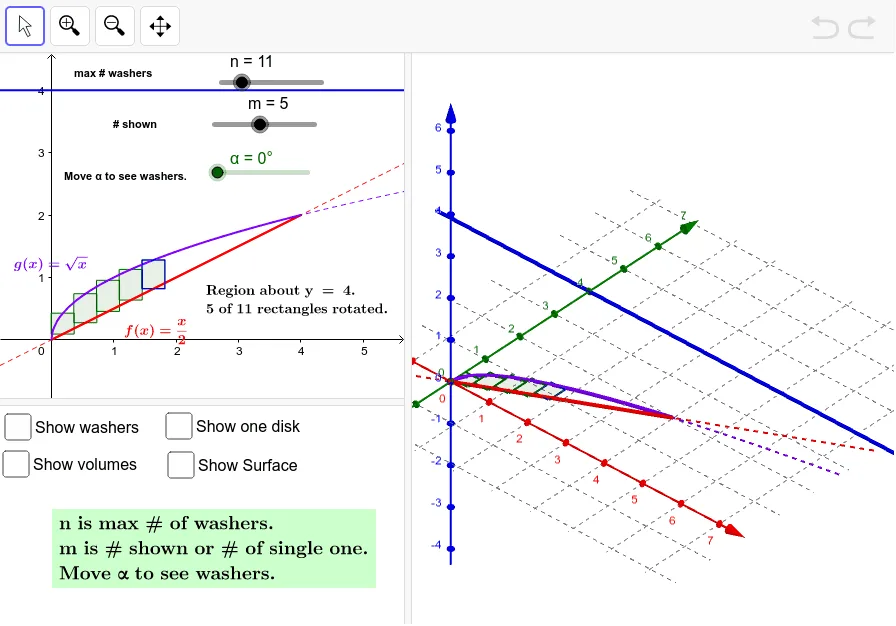
①This applet demonstrates how to compute the volume of a solid of revolution using the washer method, based on AP Calculus 2010 Form B Problem 4c. ②Core mathematical concepts include definite integrals, volumes of revolution, washer method (integrating the difference of outer and inner radii squared), function graphs, and region boundaries. ③Construction highlights: using GeoGebra commands such as Sequence, Polygon, Rotate, Integral, Surface, and RectangleSum, the applet builds function graphs g and f, the axis of rotation, washer inner/outer radii, side edges, rectangular approximations, and the volume integral expression, with sliders and dynamic rectangles to visualize the Riemann sum approach. ④This is suitable for high school seniors or early college calculus students, serving as an interactive teaching tool for understanding the geometric intuition and integral computation of volumes of revolution, and as a review aid for AP Calculus exams.
GeoGebra Commands & Parameters
Sequence(Polygon[((k * h), f(((k + p) * h))), (((k + 1) * h), f(((k + p) * h))), (((k + 1) * h), g(((k + p) * h))), ((k * h), g(((k + p) * h)))], k, 0, m - 1) → RectanglesPolygon(((DK * h), g(((DK + p) * h))), (((DK + 1) * h), g(((DK + p) * h))), (((DK + 1) * h), f(((DK + p) * h))), ((DK * h), f(((DK + p) * h)))) → Rectangle1, b, c, d, eRotate(Rectangle1, α, a) → Rectangle1'Integral((π * ((4 - f(x))^(2) - (4 - g(x))^(2))), 0, 4) → VolIntegRotate(f_1, α, a) → iRotate(g_1, α, a) → jSurface(((DK + 1) * h), 4 - ((4 - u) * cos(β)), ((4 - u) * sin(β)), u, f(((DK + p) * h)), g(((DK + p) * h)), β, 0, α) → SideRight1Surface((DK * h), 4 - ((4 - u) * cos(β)), ((4 - u) * sin(β)), u, f(((DK + p) * h)), g(((DK + p) * h)), β, 0, α) → SideLeft1Surface(u, 4 - ((4 - f(((DK + p) * h))) * cos(β)), ((4 - f(((DK + p) * h))) * sin(β)), u, (DK * h), ((DK + 1) * h), β, 0, α) → Outer1Surface(u, 4 - ((4 - g(((DK + p) * h))) * cos(β)), ((4 - g(((DK + p) * h))) * sin(β)), u, (DK * h), ((DK + 1) * h), β, 0, α) → Inner1Rotate(Rectangles, α, a) → Rectangles'Surface(u, 4 - ((4 - g(u)) * cos(β)), ((4 - g(u)) * sin(β)), u, 0, 4, β, 0, (2 * π)) → InnerSurface(u, 4 - ((4 - f(u)) * cos(β)), ((4 - f(u)) * sin(β)), u, 0, 4, β, 0, (2 * π)) → OuterSequence(Surface[u, 4 - ((4 - g(((k + p) * h))) * cos(β)), ((4 - g(((k + p) * h))) * sin(β)), u, (k * h), ((k + 1) * h), β, 0, α], k, 0, m - 1) → InnersSequence(Surface[u, 4 - ((4 - f(((k + p) * h))) * cos(β)), ((4 - f(((k + p) * h))) * sin(β)), u, (k * h), ((k + 1) * h), β, 0, α], k, 0, m - 1) → OutersSequence(Surface[(k * h), 4 - ((4 - u) * cos(β)), ((4 - u) * sin(β)), u, f(((k + p) * h)), g(((k + p) * h)), β, 0, α], k, 0, m - 1) → SidesLeftSequence(Surface[((k + 1) * h), 4 - ((4 - u) * cos(β)), ((4 - u) * sin(β)), u, f(((k + p) * h)), g(((k + p) * h)), β, 0, α], k, 0, m - 1) → SidesRightRectangleSum(A, 0, (m * h), m, p) → WS
AI Drawing Prompt Reference
Draw a diagram illustrating the volume calculation of a solid of revolution using the washer method. Include two function graphs and their axis of rotation, with rectangles approximating the volume and an integral expression displayed. Use sliders to dynamically adjust the number of rectangles, showing the Riemann sum approximation. The diagram should feature inner and outer washers, side edges, and the base, presenting the geometric shape of the solid and the integral computation.
The prompt above was compiled from the original drawing commands and is for reference only.