
Volume Between Two Hyperboloids of Two Sheets
Loading the math board and drawing, please wait…
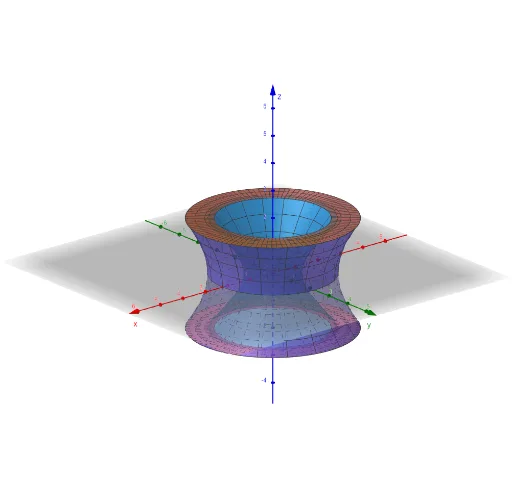
This example demonstrates the calculation of volume between two hyperboloids of two sheets. It involves core mathematical concepts such as integration, solid geometry, and hyperbolic functions. The construction uses GeoGebra's Surface command to plot the surfaces and parameters like c, d, b, a. Suitable for high school and above students to understand complex geometric volume calculations.
GeoGebra Commands & Parameters
Surface((r * cos(u)), (r * sin(u)), 2, r, 2, 3, u, 0, (2 * π)) → cSurface((r * cos(u)), (r * sin(u)), -2, r, 2, 3, u, 0, (2 * π)) → dSurface((sqrt(5 + u^(2)) * cos(v)), (sqrt(5 + u^(2)) * sin(v)), u, u, -2, 2, v, 0, (2 * π)) → bSurface((sqrt(1 + u^(2)) * cos(v)), (sqrt(1 + u^(2)) * sin(v)), u, u, -2, 2, v, 0, (2 * π)) → a
AI Drawing Prompt Reference
Draw the solid region between two hyperboloids of two sheets. Start with two horizontal disks at heights 2 and -2, with radii varying from 2 to 3, forming the top and bottom caps. Then construct two rotational hyperboloids: the inner one has horizontal cross-sections whose radii increase with height, spanning from -2 to 2; the outer one is similar but with larger radii. The two hyperboloids and the caps enclose a closed volume, illustrating the geometric setup for volume integration.
The prompt above was compiled from the original drawing commands and is for reference only.