
Volume and Surface Area of Prism
Loading the math board and drawing, please wait…
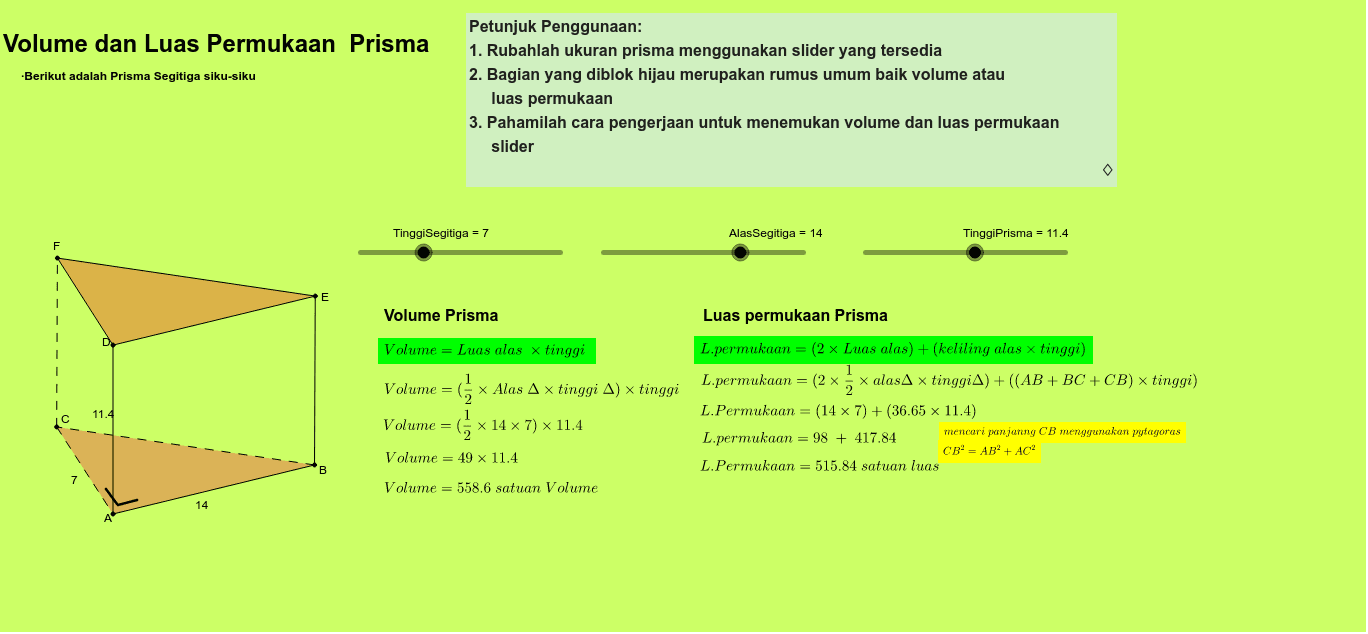
This example demonstrates how to calculate the volume and surface area of a prism. Key mathematical concepts include the geometric properties of prisms, volume formulas, and surface area formulas. Using GeoGebra commands such as Point, Segment, and Polygon, the base and sides of the prism can be dynamically constructed, allowing for the calculation of its volume and surface area. Suitable for middle and high school students studying geometry and solid geometry.
GeoGebra Commands & Parameters
Point(Circle[A, AlasSegitiga]) → BSegment(A, B) → aPoint(Circle[A, TinggiSegitiga]) → CSegment(B, C) → bSegment(C, A) → cPoint(Circle[A, TinggiPrisma]) → DPoint(Circle[B, TinggiPrisma]) → EPoint(Circle[C, TinggiPrisma]) → FSegment(D, E) → dSegment(E, F) → eSegment(F, D) → fSegment(C, F) → gSegment(B, E) → hSegment(A, D) → iPolygon(A, C, B) → poli1, b_1, a_1, c_1Polygon(D, F, E) → poli2, e_1, d_1, f_1Segment(J, K) → jSegment(L, M) → k
AI Drawing Prompt Reference
Draw a right triangular prism by first creating a right triangle as the base, then drawing perpendicular line segments from each vertex to form two parallel right triangular faces, and finally connecting these vertices to create two parallel rectangular side faces.
The prompt above was compiled from the original drawing commands and is for reference only.