
Volume and Surface Area of Cylinders and Cones
Loading the math board and drawing, please wait…
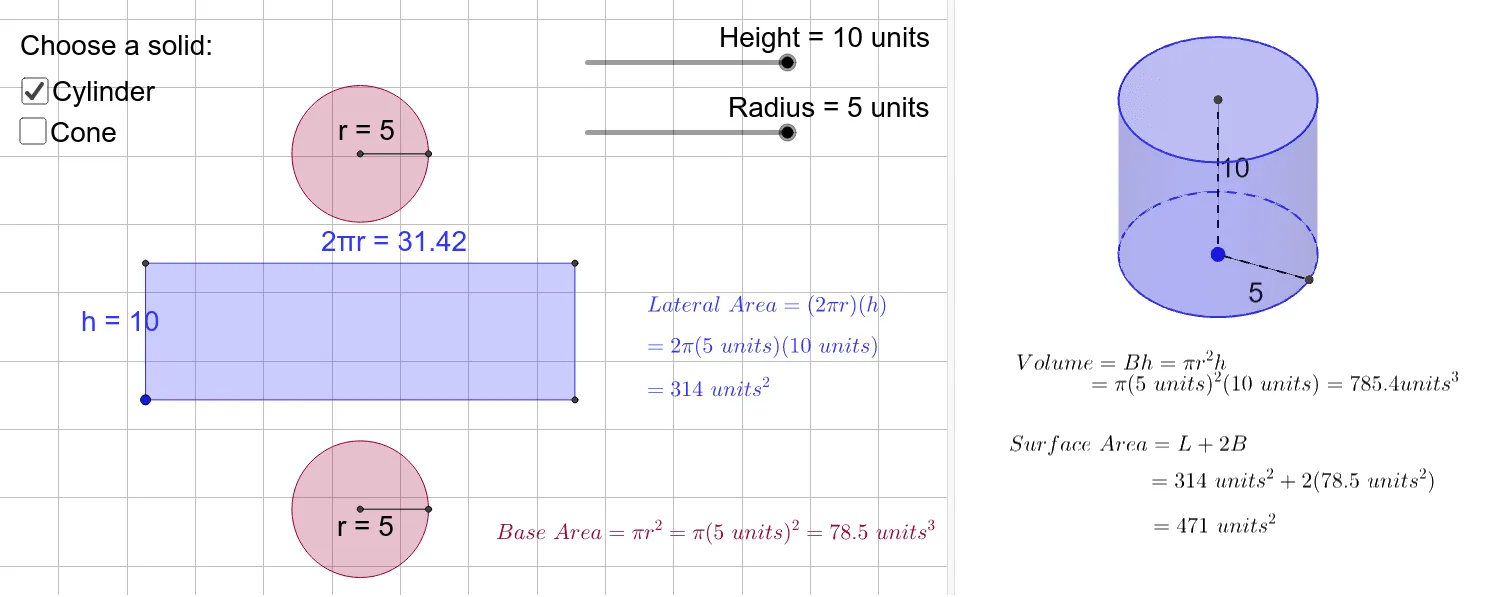
This GeoGebra interactive example dynamically demonstrates the modeling process of cylinders and cones, intuitively showing the volume calculation formulas (V=πr²h for cylinder and V=⅓πr²h for cone) and surface area methods. Construction: Use Cylinder and Cone commands to create solid models, control base radius and height via CylinderHeight and CylinderRadius sliders to observe volume changes dynamically; employ Polygon and Circle commands to draw auxiliary cross-sections, with Angle and Rotate commands showing the relationship between slant height and height. Suitable for middle school solid geometry chapters, helping students establish spatial concepts of solids of revolution and understand the derivation of volume formulas. Also applicable as material for parameter exploration math activities.
GeoGebra Commands & Parameters
Polygon(A, B, D, C) → poly1, a, b, d, cCylinder(E, F, CylinderRadius) → e, f, g, hSegment(E, G) → iSegment(E, F) → jCircle(H, J) → kCircle(I, K) → pSegment(H, J) → lSegment(I, K) → mCone(E, F, CylinderRadius) → n, q, oRotate(O, ((360 * CylinderRadius / SlantLength))°, H) → O'Angle(O, H, O') → αCircleSector(H, O, O') → rSegment(H, O') → f_1
AI Drawing Prompt Reference
Create a geometric model demonstrating the volume and surface area relationships of cylinders and cones. Start by drawing a rectangular polygon as an auxiliary cross-section reference, then create a cylinder and a cone sharing the same axis, with their base radius and height controlled by sliders. Draw two parallel circular cross-sections on the sides of the figures and connect the radius line segments. Additionally, construct the slant height line on the cone surface through rotation to show the angle relationship between slant height and height, drawing a circular sector to visually present the right triangle formed by slant height, base radius, and cone height. The diagram should clearly illustrate the geometric derivation of the cylinder volume formula V=πr²h and cone volume formula V=⅓πr²h.
The prompt above was compiled from the original drawing commands and is for reference only.