
Visualizing the Sum of Interior Angles of Polygons
Loading the math board and drawing, please wait…
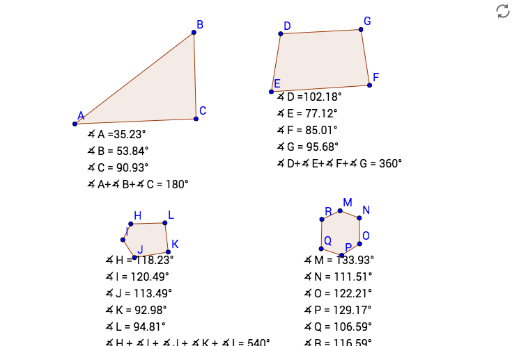
This GeoGebra example dynamically demonstrates the sum of interior angles for polygons, showing how the total angle measure changes as the number of sides increases from triangles to hexagons. The core mathematical concept is the polygon interior angle sum formula (n-2)×180°, along with the geometric reasoning of triangulating a polygon to derive this formula. Construction highlights: multiple polygons (poly1 to poly4) are created using the Polygon command, interior angles are labeled with the Angle command, and the Sum command computes the total angle measure. Objects include vertices A through R and edges a through r, building a sequence of polygons from triangle to hexagon. This resource is ideal for middle and high school geometry classes, helping students grasp the theorem and its derivation, and can also support exploration of the relationship between side count and angle sum.
GeoGebra Commands & Parameters
Polygon(A, B, C) → poly1, c, a, bPolygon(D, E, F, G) → poly2, d, e, f, gPolygon(H, I, J, K, L) → poly3, h, i, j, k, lPolygon(M, N, O, P, Q, R) → poly4, m, n, o, p, q, rAngle(C, A, B) → αAngle(A, B, C) → βAngle(B, C, A) → γSum({Angle[C, A, B], Angle[A, B, C], Angle[B, C, A]}) → δAngle(E, D, G) → εAngle(F, E, D) → ζAngle(G, F, E) → ηAngle(D, G, F) → θSum({Angle[E, D, G], Angle[F, E, D], Angle[G, F, E], Angle[D, G, F]}) → ιAngle(I, H, L) → κAngle(J, I, H) → λAngle(K, J, I) → μAngle(L, K, J) → νAngle(H, L, K) → ξSum({Angle[I, H, L], Angle[J, I, H], Angle[K, J, I], Angle[L, K, J], Angle[H, L, K]}) → οAngle(R, M, N) → ρAngle(Q, R, M) → σAngle(P, Q, R) → τAngle(O, P, Q) → υAngle(P, O, N) → ϕAngle(N, O, P) → χAngle(M, N, O) → ψSum({Angle[R, M, N], Angle[M, N, O], Angle[N, O, P], Angle[O, P, Q], Angle[P, Q, R], Angle[Q, R, M]}) → ω