
Visualizing the Angle Between Two Planes
Loading the math board and drawing, please wait…
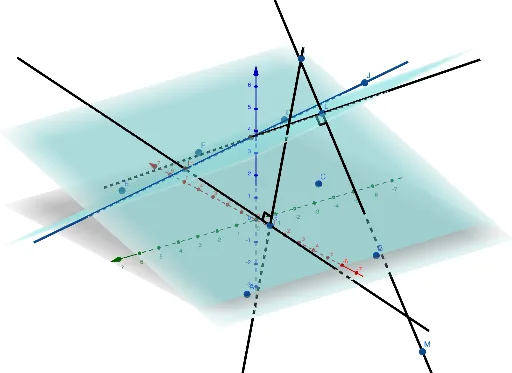
This GeoGebra example visualizes the dihedral angle between two intersecting planes in 3D space, showing how the angle is measured in a plane perpendicular to their line of intersection. The core mathematical concepts include spatial plane equations, normal vectors, the definition of the dihedral angle as the angle between two lines each perpendicular to the intersection line within the respective planes, and angle measurement in three dimensions. The construction uses GeoGebra commands such as Plane to define two planes p and q, IntersectPath to obtain their intersection line, Point and PointIn to place points on the planes, OrthogonalLine to construct lines perpendicular to the intersection, and Intersect and Angle to measure the angle α between the planes. Additional objects like lines, points, and parametric curves support dynamic visualization from multiple viewpoints. This resource is suitable for high school solid geometry or university analytic geometry courses, helping students grasp the concept of dihedral angles and spatial angle measurement through interactive exploration.
GeoGebra Commands & Parameters
Plane(A, B, C) → pPlane(D, E, F) → qIntersectPath(p, q) → hPoint(h) → JPoint(h) → KPointIn(p) → GOrthogonalLine(G, p) → fOrthogonalLine(G, h, space) → gIntersect(h, g) → HPoint(f) → IAngle(H, G, I) → αPointIn(q) → LOrthogonalLine(L, h, space) → iOrthogonalLine(L, q) → jPoint(j) → MIntersect(h, i) → NAngle(N, L, M) → β
AI Drawing Prompt Reference
In 3D space, draw two intersecting planes defined by two sets of three non-collinear points, with their intersection line visible. Place two points on the intersection line. In one plane, choose a point, then construct a line through it perpendicular to the intersection line)Skip, and another line through it perpendicular to the plane; these two lines meet at a point on the intersection line. Take a point on the second perpendicular line)Skip, and measure the angle formed by that point,Skip the intersection point,Skip and the first chosen point in the plane. Repeat similarly in the other plane: choose a point,Skip construct perpendiculars to the intersection line and the plane,Skip and measure the corresponding angle to show the dihedral angles are equal.
The prompt above was compiled from the original drawing commands and is for reference only.