
Visualizing Surface Area of a Sphere
Loading the math board and drawing, please wait…
In collections
Surface Area
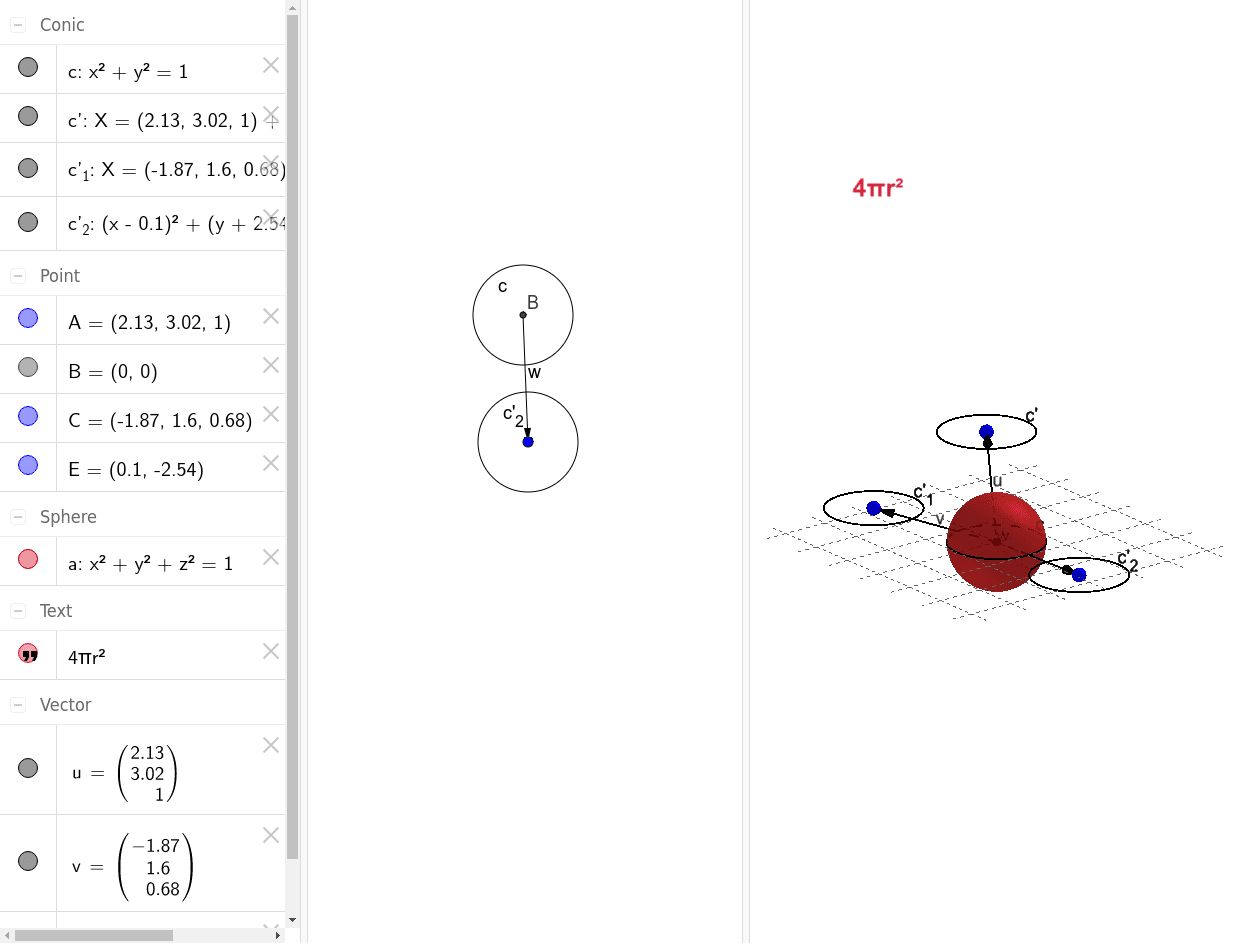
①This GeoGebra example dynamically demonstrates the surface area of a sphere, allowing learners to explore how the area relates to the sphere's radius. ②Core mathematical concepts include sphere geometry, surface area, circles, vectors, and translations, bridging solid geometry and coordinate geometry. ③Construction highlights: from the summary, commands such as Intersect, Circle, Sphere, Vector, and Translate are used, along with objects like B, c, a, A, u, c', C, v, c'_1, E, w, c'_2, and a text label text1 for annotations. ④Suitable for high school or early college students studying solid geometry, and useful for teachers as a dynamic classroom demonstration to visualize the geometric meaning behind the surface area formula.
GeoGebra Commands & Parameters
Intersect(xAxis, yAxis) → BCircle(B, 1) → cSphere(B, 1) → aVector(B, A) → uTranslate(c, u) → c'Vector(B, C) → vTranslate(c, v) → c'_1Vector(B, E) → wTranslate(c, w) → c'_2
AI Drawing Prompt Reference
Draw a sphere with radius 1 centered at the origin. Choose three points on the sphere in different directions, and draw vectors from the center to each point. Also draw a circle of radius 1 centered at the origin in the horizontal plane. Translate this circle along each of the three vectors, producing three congruent circles at different positions on or around the sphere. The final image shows the sphere together with these translated circles, illustrating how the surface area relates to the radius.
The prompt above was compiled from the original drawing commands and is for reference only.