
Visualizing Equality of Fractions with Geometric Construction
Loading the math board and drawing, please wait…
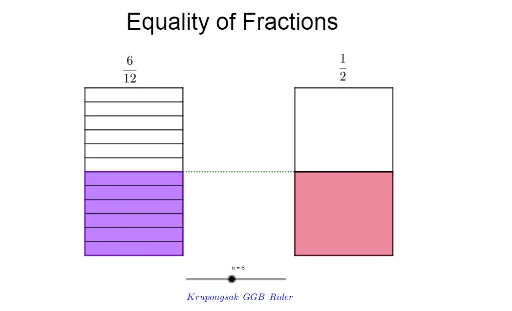
① This GeoGebra example demonstrates the equality of fractions (e.g., a/b = c/d) through a geometric construction involving a kite-shaped figure and translations, showing that equal fractions correspond to equal ratios of lengths or areas. ② Core mathematical concepts include fraction equality, proportionality, geometric mean, real numbers, and step functions, which help represent discrete values in the construction. ③ The construction uses commands such as Segment, Vector, Translate, Polygon, and FractionText, with objects including points A, B, C, D, E, F, G, H, I, J and their translated copies (e.g., D', A', i', etc.), creating multiple similar shapes via repeated translations and displaying the ratios as fraction text. ④ This is suitable for middle school to high school students learning fractions, ratios, and geometric transformations, and for teachers to demonstrate the visual link between algebraic fraction equality and geometric proportion.
GeoGebra Commands & Parameters
Segment(A, B) → fSegment(B, C) → gSegment(C, D) → hSegment(D, A) → iVector(E, F) → uTranslate(D, u) → D'Translate(A, u) → A'Segment(D', A') → i'Translate(D', u) → D''Translate(A', u) → A''Segment(D'', A'') → i''Translate(D'', u) → D'''Translate(A'', u) → A'''Segment(D''', A''') → i'''Translate(D''', u) → GTranslate(A''', u) → HSegment(G, H) → jTranslate(G, u) → G'Translate(H, u) → H'Segment(G', H') → j'Translate(G', u) → G''Translate(H', u) → H''Segment(G'', H'') → j''Translate(G'', u) → G'''Translate(H'', u) → H'''Segment(G''', H''') → j'''Translate(G''', u) → ITranslate(H''', u) → JSegment(I, J) → kTranslate(I, u) → I'Translate(J, u) → J'Segment(I', J') → k'Translate(I', u) → I''Translate(J', u) → J''Segment(I'', J'') → k''Translate(I'', u) → I'''Translate(J'', u) → J'''Segment(I''', J''') → k'''Translate(A, v) → A'_1Vector(A, A'_1) → wTranslate(D, v) → D'_1Vector(D, D'_1) → aPolygon(A, D, D'_1, A'_1) → q1, a_1, d, d'_1, a'_1Vector(K, L) → bTranslate(A, b) → A'_2Translate(D, b) → D'_2Translate(D'_1, b) → MTranslate(A'_1, b) → NTranslate(A, b) → A'_3Translate(D, b) → D'_3Translate(D'_1, b) → OTranslate(A'_1, b) → PPolygon(A'_3, D'_3, O, P) → q1', a'_3, d'_3, o_1, pTranslate(A, b) → A'_4Translate(B, b) → B'Segment(A'_4, B') → f'Translate(B, b) → B'_1Translate(C, b) → C'Segment(B'_1, C') → g'Translate(C, b) → C'_1Translate(D, b) → D'_4Segment(C'_1, D'_4) → h'Translate(D, b) → D'_5Translate(A, b) → A'_5Segment(D'_5, A'_5) → i'_1Translate(D', b) → D''_1Translate(A', b) → A''_1Segment(D''_1, A''_1) → i''_1Translate(D'', b) → D'''_1Translate(A'', b) → A'''_1Segment(D'''_1, A'''_1) → i'''_1Translate(D''', b) → QTranslate(A''', b) → RSegment(Q, R) → lTranslate(G, b) → G'_1Translate(H, b) → H'_1Segment(G'_1, H'_1) → j'_1Translate(G', b) → G''_1Translate(H', b) → H''_1Segment(G''_1, H''_1) → j''_1Translate(G'', b) → G'''_1Translate(H'', b) → H'''_1Segment(G'''_1, H'''_1) → j'''_1Translate(G''', b) → STranslate(H''', b) → TSegment(S, T) → mTranslate(I, b) → I'_1Translate(J, b) → J'_1Segment(I'_1, J'_1) → k'_1Translate(I', b) → I''_1Translate(J', b) → J''_1Segment(I''_1, J''_1) → k''_1Translate(I'', b) → I'''_1Translate(J'', b) → J'''_1Segment(I'''_1, J'''_1) → k'''_1Translate(I''', b) → UTranslate(J''', b) → VSegment(U, V) → qSegment(A'''_1, D'''_1) → rSegment(H'_1, G'_1) → sSegment(H'''_1, G'''_1) → tSegment(J'_1, I'_1) → eSegment(J'''_1, I'''_1) → f_1Segment(R, Q) → g_1Segment(H'''_1, G'''_1) → h_1Segment(J''_1, I''_1) → i_1Segment(J'_1, I'_1) → j_1Segment(H'''_1, G'''_1) → k_1Segment(H'_1, G'_1) → l_1Segment(A'''_1, D'''_1) → m_1Segment(H'_1, G'_1) → n_1Segment(H'''_1, G'''_1) → p_1Segment(J'_1, I'_1) → q_1Segment(J'''_1, I'''_1) → r_1FractionText(c) → text2Segment(D'_1, N) → s_1