
Visual Proof of Pythagoras' Theorem by ajmck2013
Loading the math board and drawing, please wait…
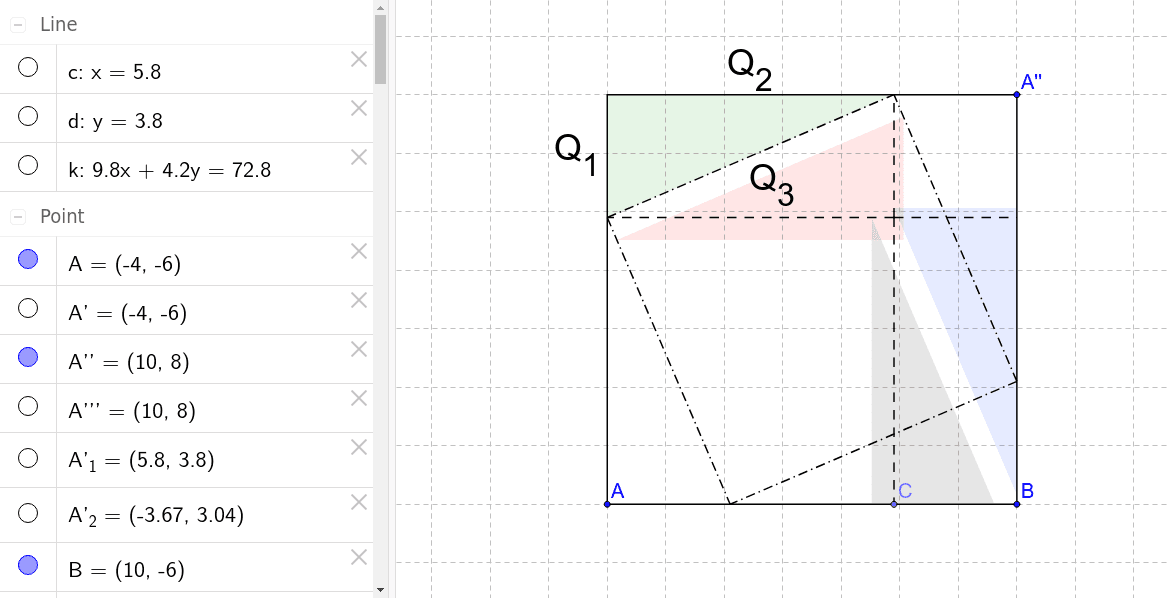
This example visually demonstrates Pythagoras' Theorem using geometric shapes. It involves the relationship between the sides of a right-angled triangle. By constructing the three sides of a right-angled triangle and using operations like rotation and translation, it shows that the square of the hypotenuse is equal to the sum of the squares of the other two sides. Commands used include Segment, Point, Rotate, Line, Intersect, Polygon, Vector, Translate. Suitable for middle school and above students learning geometric proofs.
GeoGebra Commands & Parameters
Segment(A, B) → aPoint(a) → CRotate(A, 270*°, C) → A'_1Rotate(A'_1, 270*°, A'_1) → DSegment(D, B) → qRotate(B, 90*°, A) → B'Rotate(B', 90*°, B') → B''Rotate(A, 90*°, A) → A'Rotate(A', 90*°, B') → A''Rotate(B'', 90*°, A'') → B'''Rotate(A'', 90*°, A'') → A'''Segment(A''', B''') → a'''Rotate(C, 270*°, C) → C'Rotate(C', 270*°, A'_1) → C''Line(C'', A'_1) → dIntersect(d, a''') → FSegment(F, A'') → pSegment(A', B') → a'Segment(A'', B'') → a''Segment(A, C) → bSegment(A'_1, C') → b'Segment(D, C'') → b''Line(C, A'_1) → cIntersect(c, a'') → EPolygon(C'', B', E) → poly1, e, c'', b'_1Point(b) → HVector(C, H) → uTranslate(A'_1, u) → ITranslate(C', u) → C''_1Segment(I, C''_1) → b''_1Segment(A'_1, F) → fPoint(p) → GVector(F, G) → vTranslate(A'_1, v) → JTranslate(F, v) → F'Segment(J, F') → f'Vector(A'_1, G) → wTranslate(A'_1, w) → KTranslate(C', w) → C''_2Segment(K, C''_2) → b''_2Vector(A'_1, H) → zTranslate(A'_1, z) → LTranslate(F, z) → F'_1Segment(L, F'_1) → f'_1Polygon(I, H, F'_1) → poly2, f'_2, i, hPolygon(J, C''_2, G) → poly3, g, j, c''_2Line(A'_1, B) → kPoint(q) → MVector(C, M) → lTranslate(A, l) → A'_2Translate(C, l) → C'_1Segment(A'_2, C'_1) → b'_2Segment(A'_1, E) → mVector(A'_1, M) → nTranslate(A'_1, n) → NTranslate(E, n) → E'Segment(N, E') → m'Polygon(A'_2, M, E') → poly4, e', a'_2, m_1Segment(A'_1, E) → rSegment(A'_1, F) → sSegment(A'_1, C'') → tSegment(A'_1, C) → a_1Segment(C'', E) → b_1Rotate(C'', 90*°, E) → C'''Rotate(E, 90*°, E) → E'_1Segment(C''', E'_1) → c_1Rotate(C''', 90*°, C''') → ORotate(E'_1, 90*°, C''') → PSegment(O, P) → d_1Rotate(O, 90*°, P) → O'Rotate(P, 90*°, P) → P'Segment(O', P') → e_1
AI Drawing Prompt Reference
Draw a right-angled triangle and label its three sides. Then, rotate each side around its respective vertex to form three squares. Demonstrate the relationship between the areas of these squares to prove the Pythagorean theorem. Start by drawing the triangle, then rotate the two legs around the right angle to create new points. Connect these points to form three squares, and use rotations and translations to visually show that the area of the square on the hypotenuse equals the sum of the areas of the squares on the other two sides.
The prompt above was compiled from the original drawing commands and is for reference only.