
Vibrating String Guitar Cross-section
Loading the math board and drawing, please wait…
In collections
MATH1052-edX
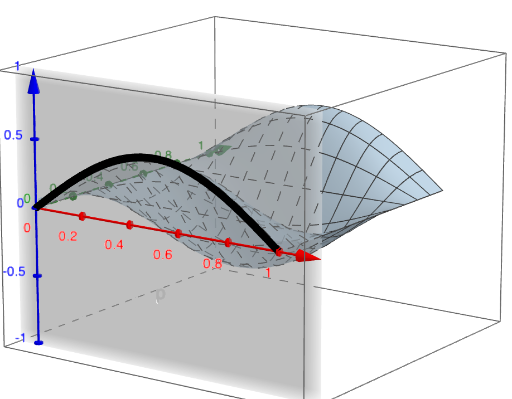
This example demonstrates the 3D waveform cross-section formed by a vibrating guitar string. It involves core math concepts like functions, bar charts, translation, secant lines, congruence, and ellipses. The construction uses GeoGebra commands such as Surface, OrthogonalPlane, and Translate. Suitable for high school and above students to learn about the geometric shape and mathematical representation of vibrating strings.
GeoGebra Commands & Parameters
Surface(u, v, f(u, v), u, 0, 1, v, 0, 1) → aOrthogonalPlane((0, t), yAxis) → pTranslate(Rotate[If[0 ≤ x ≤ 1, f(x, t)], pi / 2, xAxis], Vector[(0, 0), (0, t)]) → cross
AI Drawing Prompt Reference
Draw the cross-sectional vibration waveform of a guitar string. First, create a 3D surface to represent the vibration waveform of the string, with the range from 0 to 1. Then, create an orthogonal plane p to the y-axis. Finally, translate the rotated string cross-section along the y-axis to form a series of cross-sections, showing the vibration process of the string.
The prompt above was compiled from the original drawing commands and is for reference only.