
Verifying Triangle Area Invariance by Transposing a Vertex to the Origin
Loading the math board and drawing, please wait…
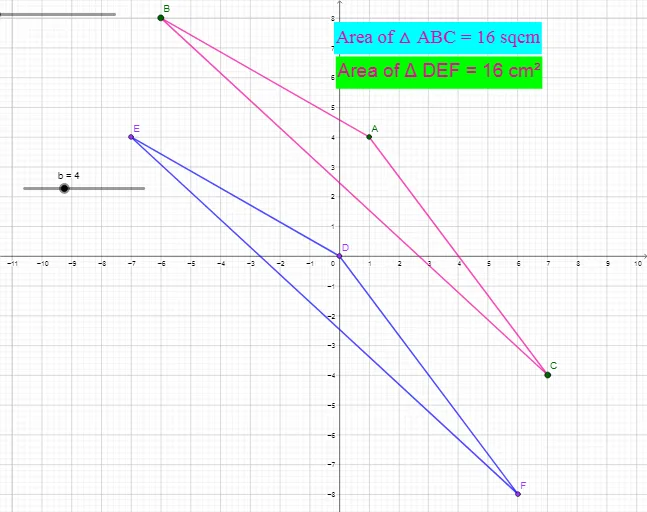
This GeoGebra example demonstrates that the area of a triangle remains the same when one vertex is transposed (shifted) to the coordinate origin, while the other vertices are shifted accordingly. It highlights the geometry-and-coordinates idea that area is an invariant under the appropriate coordinate transformation. The main math concepts are coordinate geometry, area computation using segments/point positions, vector-style relative placement (via point differences relative to the origin), and the invariance of area under translation. Construction-wise, the model uses GeoGebra commands such as Segment and Area to build the triangle’s edges and to compute its area, with objects like a, b, A, B, C, c, D, E, F, i, j, k, and d representing the original and translated points. Text labels (text1, text2) are used to display or compare the resulting area values before and after the transformation. Suitable for middle/high school geometry through early university analytic geometry lessons, especially for teaching transformations, coordinate methods, and geometric invariants.
GeoGebra Commands & Parameters
Segment(A, B) → fSegment(B, C) → gSegment(A, C) → hArea(A, B, C) → cSegment(D, E) → iSegment(E, F) → jSegment(F, D) → kArea(D, E, F) → d
AI Drawing Prompt Reference
Draw triangle ABC by connecting points A, B, and C to form sides f, g, and h, then calculate and display its area c. Move point A to the origin, and move points B and C accordingly to form a new triangle DEF. Connect points D, E, and F to form sides i, j, and k, then calculate and display its area d.
The prompt above was compiled from the original drawing commands and is for reference only.