
Verify Inverse Functions f(x)=±√(x+3) and g(x)=x²-3
Loading the math board and drawing, please wait…
In collections
CCGPS AA Unit 6 Lesson 7
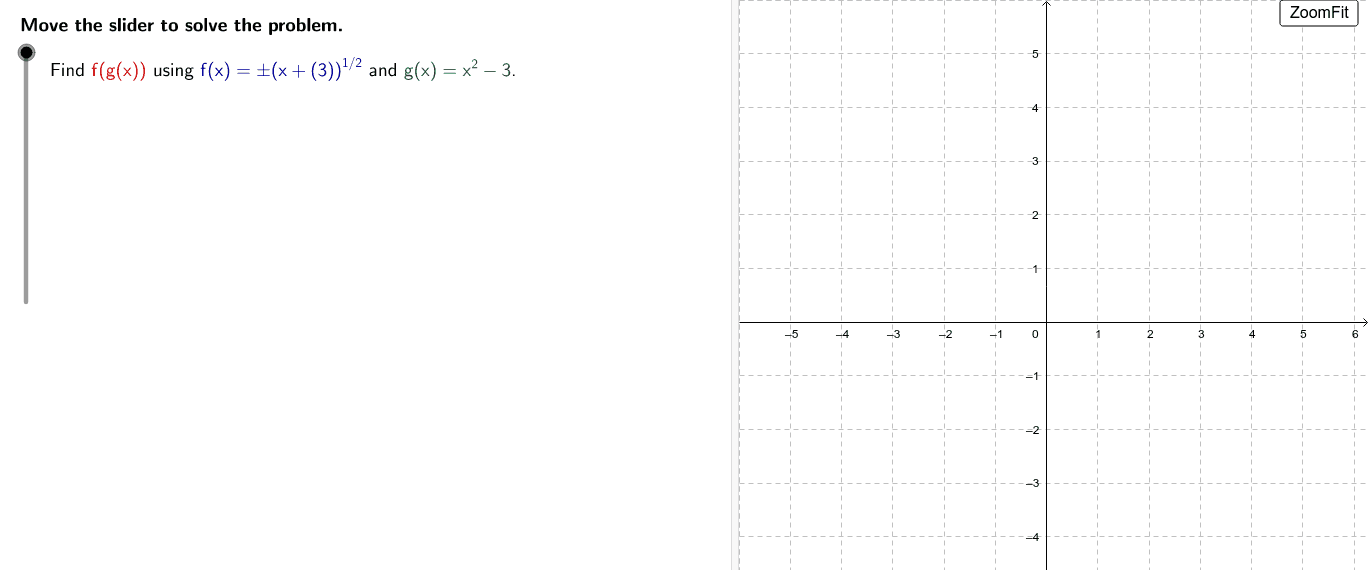
① This example demonstrates how to verify that two functions are inverses by evaluating the compositions f(g(x)) and g(f(x)) both algebraically and graphically. ② Core mathematical concepts include function composition, the definition of inverse functions, domain‑range correspondence, and the handling of the positive and negative branches of the square‑root function. ③ Construction highlights: the applet uses GeoGebra commands LaTeX, Corner, If, Simplify, Max together with objects such as stepMax, stepper, steps, counter, text0, Original, Randomize, ZoomFit, button1, A, B, txmin, txmax, tymin, tymax, Problem, a, b, c, f, evenodd, f2, g, d, text4, text6, text8, text9, text10, text21, text23, text24, list1, maxzeros, range, xmax, xmin, ymax, ymin, text3 to create a step‑by‑step interactive verification. ④ Suitable for high‑school “Functions and Derivatives” units or college‑prep courses as a teaching demo or self‑study resource for inverse‑function verification.
GeoGebra Commands & Parameters
LaTeX(steps) → counterLaTeX("\text{Move the slider to solve the problem.}") → text0Corner(1) → ACorner(3) → BLaTeX("\text{}") → ProblemIf(IsInteger[c / 2], LaTeX["\pm"], "") → evenoddSimplify(Polynomial[x^(c) - b] / a) → gLaTeX((((((((("\textcolor{#000099}{f(x)=" * evenodd) * "(") * Simplify[(a * x)]) * "+(") * b) * "))^{1/") * c) * "}}")) → text4LaTeX((((((((("\textcolor{#CC0000}{f(g(x))=" * evenodd) * "((") * Simplify[(a * g(x))]) * ")+(") * b) * "))^{1/") * c) * "}}")) → text6LaTeX((((((("\textcolor{#CC0000}{f(g(x))=" * evenodd) * "\left(x^") * c) * "\right)^{1/") * c) * "}}")) → text8LaTeX("\text{Simplify the powers.}") → text9LaTeX("\textcolor{#CC0000}{f(g(x))=x}") → text10LaTeX("\textcolor{#CC0000}{g(f(x))=x}") → text21LaTeX("\text{State a conclusion about whether }\textcolor{#006633}{g(x)}\text{ is the inverse}\cr\text{of }\textcolor{#000099}{f(x)}\text{ based on the results for }\textcolor{#CC0000}{f(g(x))}\text{ and }\textcolor{#CC0000}{g(f(x))}.") → text23LaTeX("\text{We have determined that }\textcolor{#CC0000}{f(g(x)) = x}\text{ and }\cr\textcolor{#CC0000}{g(f(x)) = x}\text{. By substitution, }\textcolor{#CC0000}{f(g(x)) = g(f(x))};\cr\text{therefore, }\textcolor{#006633}{g(x)}\text{ is the inverse of }\textcolor{#000099}{f(x)}.") → text24Max(Zip[abs(x(a)), a, list1]) → maxzerosLaTeX("\text{Original function }\textcolor{#000099}{f(x)}") → text3LaTeX((("\text{Substitute }\textcolor{#006633}{" * g) * "}\text{ for }\textcolor{#000099}{x}\text{ and name the }\cr\text{new function }\textcolor{#CC0000}{f(g(x))}.")) → text5LaTeX((("\text{The notation }\textcolor{#CC0000}{f(g(x))}\text{ means that the input for }\textcolor{#000099}{f(x)}\text{ is equal to the output of }\textcolor{#006633}{g(x)}\text{.}\cr\text{In other words, to find }\textcolor{#CC0000}{f(g(x))}\text{, replace }\textcolor{#000099}{x}\text{ in the value of the function }\textcolor{#000099}{f(x)}\cr\text{with the value of the function }\textcolor{#006633}{g(x)}\text{. Therefore, replace }\textcolor{#000099}{x}\text{ with }\textcolor{#006633}{" * g) * "}\text{ and then}\cr\text{solve the resulting composition of functions.}")) → text2LaTeX((((((((((("\text{Find }\textcolor{#CC0000}{f(g(x))}\text{ using }\textcolor{#000099}{f(x)=" * evenodd) * "(") * Simplify[(a * x)]) * "+(") * b) * "))^{1/") * c) * "}}\text{ and }\textcolor{#006633}{g(x) = ") * g) * "}.")) → text1LaTeX("\text{Original function }\textcolor{#006633}{g(x)}") → text14LaTeX("\text{Use the buttons below to return to the original problem or}\cr\text{randomly generate a similar practice problem.}") → RandomizationTextLaTeX("\text{Simplify.}") → text20LaTeX((((((((((("\text{Find }\textcolor{#CC0000}{g(f(x))}\text{ using }\textcolor{#000099}{f(x)=" * evenodd) * "(") * Simplify[(a * x)]) * "+(") * b) * "))^{1/") * c) * "}}\text{ and }\textcolor{#006633}{g(x) = ") * g) * "}.")) → text12LaTeX((((((((("\text{The notation }\textcolor{#CC0000}{g(f(x))}\text{ means that the input for }\textcolor{#006633}{g(x)}\text{ is equal to the output of }\textcolor{#000099}{f(x)}\text{.}\cr\text{In other words, to find }\textcolor{#CC0000}{g(f(x))}\text{, replace }\textcolor{#006633}{x}\text{ in the value of the function }\textcolor{#006633}{g(x)}\cr\text{with the value of the function }\textcolor{#000099}{f(x)}\text{. Therefore, replace }\textcolor{#006633}{x}\text{ with }\textcolor{#000099}{" * evenodd) * "(") * Simplify[(a * x)]) * "+(") * b) * "))^{1/") * c) * "}}\cr\text{and then solve the resulting composition of }\text{functions.}")) → text13LaTeX((("\textcolor{#006633}{g(x)=" * g) * "}")) → text15LaTeX((((((((((((((("\textcolor{#CC0000}{g(f(x))=\frac{\left(" * evenodd) * "((") * Simplify[(a * x)]) * ")+(") * b) * "))^{1/") * c) * "}\right)^{") * c) * "}-(") * b) * ")}{") * a) * "}}")) → text17LaTeX((((((((("\text{Substitute }\textcolor{#000099}{" * evenodd) * "(") * Simplify[(a * x)]) * "+(") * b) * "))^{1/") * c) * "}}\text{ for }\textcolor{#006633}{x}\text{ and }\cr\text{name the new function }\textcolor{#CC0000}{g(f(x))}.")) → text16LaTeX((((((((("\textcolor{#CC0000}{g(f(x))=\frac{\left((" * Simplify[(a * x)]) * ")+(") * b) * ")\right)-") * b) * "}{") * a) * "}}")) → text19LaTeX("\text{Simplify the powers.}") → text18LaTeX((((((((((("\text{}\textcolor{#CC0000}{g(f(x))=x}\text{ when }\textcolor{#000099}{f(x)= " * evenodd) * "(") * Simplify[(a * x)]) * "+(") * b) * "))^{1/") * c) * "}}\text{ and }\textcolor{#006633}{g(x)=") * g) * "}.")) → text22LaTeX((((((((((("\text{}\textcolor{#CC0000}{f(g(x))=x}\text{ when }\textcolor{#000099}{f(x)= " * evenodd) * "(") * Simplify[(a * x)]) * "+(") * b) * "))^{1/") * c) * "}}\text{ and }\textcolor{#006633}{g(x)=") * g) * "}.")) → text11LaTeX("\text{Simplify.}") → text7
AI Drawing Prompt Reference
Draw the graphs of functions f(x) = ±√(x+3) and g(x) = x²-3, and verify if they are inverse functions of each other. First, draw the positive and negative branches of f(x). Then, draw g(x). Next, calculate f(g(x)) and g(f(x)), simplify the expressions, and check if the results are equal to x to verify if they are inverse functions.
The prompt above was compiled from the original drawing commands and is for reference only.