
Vector Calculus - Surfaces - Surface Limits
Loading the math board and drawing, please wait…
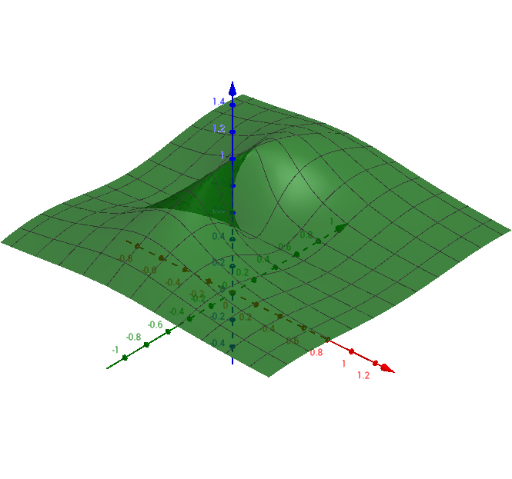
This example demonstrates the concept of surface limits in vector calculus, visually showing the behavior of functions at different points. Core math concepts include surfaces, logarithmic functions, variance, Pythagorean theorem, linear equations, and limit operations. It uses GeoGebra commands/objects like f, h, g, b, C, D, d, a for constructing function graphs and limit analysis. Suitable for university mathematics students or those deepening their understanding of calculus and vector calculus.
GeoGebra Commands & Parameters
f(x, y) = (x^(2) + sin(y)^(2)) / ((2 * x^(2)) + y^(2))h(x, y) = (((3 * x^(2)) * y)) / (x^(2) + y^(2))g(x, y) = ((x^(2) * y)) / (x^(4) + y^(2))Numeric b(0.06)z = bz = (-b)Numeric d(0.1)a(x, y) = x^(2) + y^(2) < d
AI Drawing Prompt Reference
Create an image featuring three function graphs to illustrate their behavior at different points. One graph approaches zero near the origin, while the other two show distinct trends. Include a circle with a radius smaller than a specified value, filled with color to highlight the behavior of the functions within that region.
The prompt above was compiled from the original drawing commands and is for reference only.