
Vector Addition via Analytic Geometry: Translation Construction
Loading the math board and drawing, please wait…
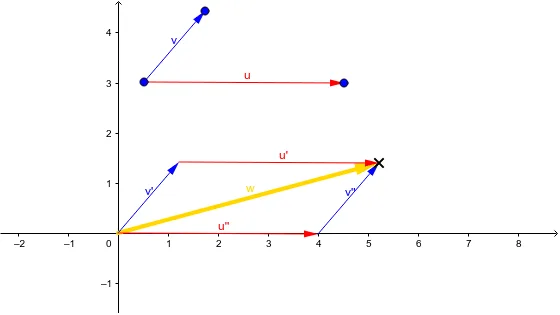
This example visually demonstrates vector addition using geometric translation: it constructs how adding vectors corresponds to connecting tails to heads and to forming the parallelogram relationship, while keeping the construction consistent with analytic-geometry viewpoints. Key concepts include vector addition, translation-based interpretation of vectors, and coordinate/position-vector reasoning. Construction-wise, it uses GeoGebra commands Vector and Translate to create vectors (u, v, w and related variants) and their defining points (A, B, O, O′, O″, etc.). Translate is used to shift a vector so its tail matches the appropriate point, producing translated endpoints (such as u′, v′, u″, v″ and additional points like D) that confirm the resulting sum geometrically. Suitable for high school through early university lessons on vectors, analytic geometry, and geometric construction; also good for classroom demonstrations and self-study.
GeoGebra Commands & Parameters
Vector(A, B) → uVector(A, C) → vTranslate(O, v) → O'_1Vector(O, O'_1) → v'Translate(O'_1, u) → DVector(O'_1, D) → u'Translate(O, u') → O'Vector(O, O') → u''Translate(O', v') → O''Vector(O', O'') → v''
AI Drawing Prompt Reference
Draw a vector addition demonstration using analytic geometry, showing how vector addition corresponds to geometric translation. Start by drawing two vectors, then translate one so its tail meets the head of the other, connecting the endpoints to form a parallelogram and drawing the diagonal to represent the vector sum. Translate vectors again and connect points to verify the geometric relationship of the sum, illustrating the concept of vector addition through translation and coordinate reasoning.
The prompt above was compiled from the original drawing commands and is for reference only.