
Vector Addition: Parallelogram and Triangle Law
Loading the math board and drawing, please wait…
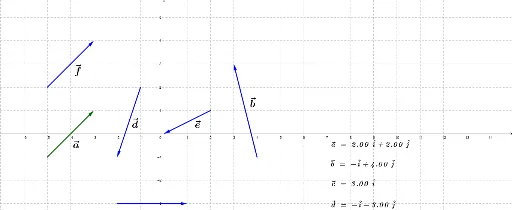
① This GeoGebra example dynamically demonstrates the addition of two vectors, visually illustrating both the parallelogram law and the triangle law of vector addition. ② Core mathematical concepts include geometric representation of vectors, vector addition, parallelogram law, triangle law, and algebraic computation of vector components. ③ Construction highlights: The Vector command is used to create vectors a and b, with Point defining start point A and end point B; LaTeX text labels annotate vector symbols; multiple auxiliary points (e.g., A_1, B_1) and auxiliary vectors (c, d, e, f) are constructed to form the parallelogram and its diagonal, while sliders or parameters (aa, bb) control vector magnitude and direction for dynamic adjustment. ④ Suitable for high school or early college students learning vector operations, and for teachers demonstrating the geometric meaning of vector addition in class, helping students intuitively grasp the commutative and associative properties of vector addition.
GeoGebra Commands & Parameters
Vector(A, B) → aVector(A_1, B_1) → bVector(A_2, B_2) → fVector(A_3, B_3) → eVector(A_4, B_4) → dVector(A_5, B_5) → cVector(A, R) → wPoint(a) → CPoint(b) → DPoint(c) → EPoint(d) → FPoint(e) → GPoint(f) → HVector(A_6, B_6) → a_1Point(a_1) → C_1LaTeX(If[ya ≟ 1 ∧ xa ≠ 0, testo5 + testo8, If[ya ≟ 1 ∧ xa ≟ 0, testo8, If[ya ≟ -1, testo7 + testo8, If[ya > 0 ∧ xa ≠ 0, testo5 + testo4, If[ya > 0 ∧ xa ≟ 0, testo4, If[ya < 0, testo7 + testo4, If[ya ≟ 0, testo49]]]]]]]) → testo13LaTeX(If[xa ≟ 1, testo9, If[xa ≟ -1, testo7 + testo9, If[xa > 0, testo3, If[xa < 0, testo7 + testo3, If[xa ≟ 0, testo49]]]]]) → testo10LaTeX(testo2 + testo10 + testo13) → testo14LaTeX(If[xb ≟ 1, testo9, If[xb ≟ -1, testo7 + testo9, If[xb > 0, testo19, If[xb < 0, testo7 + testo19, If[xb ≟ 0, testo49]]]]]) → testo29LaTeX(If[xc ≟ 1, testo9, If[xc ≟ -1, testo7 + testo9, If[xc > 0, testo21, If[xc < 0, testo7 + testo21, If[xc ≟ 0, testo49]]]]]) → testo30LaTeX(If[xd ≟ 1, testo9, If[xd ≟ -1, testo7 + testo9, If[xd > 0, testo23, If[xd < 0, testo7 + testo23, If[xd ≟ 0, testo49]]]]]) → testo31LaTeX(If[xe ≟ 1, testo9, If[xe ≟ -1, testo7 + testo9, If[xe > 0, testo25, If[xe < 0, testo7 + testo25, If[xe ≟ 0, testo49]]]]]) → testo32LaTeX(If[xf ≟ 1, testo9, If[xf ≟ -1, testo7 + testo9, If[xf > 0, testo27, If[xf < 0, testo7 + testo27, If[xf ≟ 0, testo49]]]]]) → testo33LaTeX(If[yb ≟ 1 ∧ xb ≠ 0, testo5 + testo8, If[yb ≟ 1 ∧ xb ≟ 0, testo8, If[yb ≟ -1, testo7 + testo8, If[yb > 0 ∧ xb ≠ 0, testo5 + testo20, If[yb > 0 ∧ xb ≟ 0, testo20, If[yb < 0, testo7 + testo20, If[yb ≟ 0, testo49]]]]]]]) → testo34LaTeX(If[yc ≟ 1 ∧ xc ≠ 0, testo5 + testo8, If[yc ≟ 1 ∧ xc ≟ 0, testo8, If[yc ≟ -1, testo7 + testo8, If[yc > 0 ∧ xc ≠ 0, testo5 + testo22, If[yc > 0 ∧ xc ≟ 0, testo22, If[yc < 0, testo7 + testo22, If[yc ≟ 0, testo49]]]]]]]) → testo35LaTeX(If[yd ≟ 1 ∧ xd ≠ 0, testo5 + testo8, If[yd ≟ 1 ∧ xd ≟ 0, testo8, If[yd ≟ -1, testo7 + testo8, If[yd > 0 ∧ xd ≠ 0, testo5 + testo24, If[yd > 0 ∧ xd ≟ 0, testo24, If[yd < 0, testo7 + testo24, If[yd ≟ 0, testo49]]]]]]]) → testo36LaTeX(If[ye ≟ 1 ∧ xe ≠ 0, testo5 + testo8, If[ye ≟ 1 ∧ xe ≟ 0, testo8, If[ye ≟ -1, testo7 + testo8, If[ye > 0 ∧ xe ≠ 0, testo5 + testo26, If[ye > 0 ∧ xe ≟ 0, testo26, If[ye < 0, testo7 + testo26, If[ye ≟ 0, testo49]]]]]]]) → testo37LaTeX(If[yf ≟ 1 ∧ xf ≠ 0, testo5 + testo8, If[yf ≟ 1 ∧ xf ≟ 0, testo8, If[yf ≟ -1, testo7 + testo8, If[yf > 0 ∧ xf ≠ 0, testo5 + testo28, If[yf > 0 ∧ xf ≟ 0, testo28, If[yf < 0, testo7 + testo28, If[yf ≟ 0, testo49]]]]]]]) → testo38LaTeX(testo12 + testo29 + testo34) → testo39LaTeX(testo15 + testo30 + testo35) → testo40LaTeX(testo16 + testo31 + testo36) → testo41LaTeX(testo17 + testo32 + testo37) → testo42LaTeX(testo18 + testo33 + testo38) → testo43LaTeX(If[xw ≟ 1, testo9, If[xw ≟ -1, testo7 + testo9, If[xw > 0, testo44, If[xw < 0, testo7 + testo44, If[xw ≟ 0, testo49]]]]]) → testo46LaTeX(If[yw ≟ 1 ∧ xw ≠ 0, testo5 + testo8, If[yw ≟ 1 ∧ xw ≟ 0, testo8, If[yw ≟ -1, testo7 + testo8, If[yw > 0 ∧ xw ≠ 0, testo5 + testo45, If[yw > 0 ∧ xw ≟ 0, testo45, If[yw < 0, testo7 + testo45, If[yw ≟ 0, testo49]]]]]]]) → testo47LaTeX(testo11 + testo46 + testo47) → testo48
AI Drawing Prompt Reference
Create a diagram illustrating vector addition using both the parallelogram and triangle laws. Start with two vectors originating from a common point, shown in distinct colors. For the triangle law, translate one vector so its tail meets the head of the other, forming a closed triangle. For the parallelogram law, construct a parallelogram with the two vectors as adjacent sides, and draw the diagonal from the common origin, which represents the sum. Label all vectors with arrows and algebraic expressions, and include sliders to adjust vector magnitudes and directions dynamically.
The prompt above was compiled from the original drawing commands and is for reference only.