
Vector Addition: Geometric Sum of u, v, and w
Loading the math board and drawing, please wait…
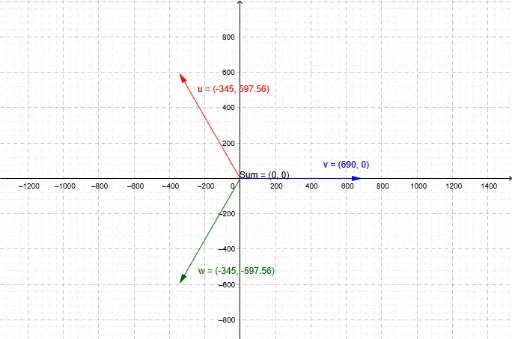
① This GeoGebra example demonstrates the addition of two vectors u and v, producing the resultant vector w, and visually illustrates the triangle law or parallelogram law of vector addition. ② The core mathematical concept is vector addition, including the head-to-tail geometric interpretation, component-wise addition of coordinates, and properties such as commutativity and associativity. ③ Construction highlights: vector objects u, v, and w are created; w is defined as the sum of u and v by adding their corresponding components; dragging the endpoints of u or v dynamically updates w, allowing exploration of how the sum changes. ④ Suitable for high school or early college mathematics, particularly for introductory vector lessons, coordinate geometry, or as a visual aid in physics for force or displacement composition.
GeoGebra Commands & Parameters
(-345, 597.56)(690, 0)(-345, -597.56)u + v + w
AI Drawing Prompt Reference
Draw two vectors starting from the origin with lengths and directions (-345, 597.56) and (690, 0), then draw a third vector from the end of the first vector with length and direction (-345, -597.56), connecting these vectors head-to-tail to form a closed triangle, illustrating the triangle law of vector addition.
The prompt above was compiled from the original drawing commands and is for reference only.