
Vector Addition by Components
Loading the math board and drawing, please wait…
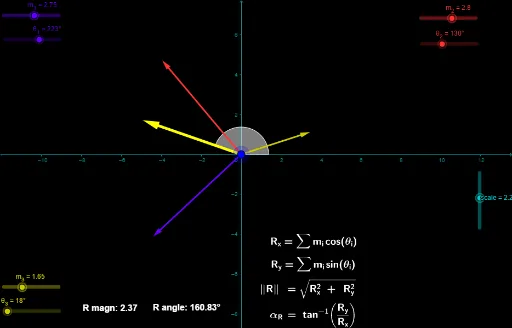
This example demonstrates vector addition by components. Key mathematical concepts include vector decomposition and synthesis. Using GeoGebra commands such as Angle and Vector, it visually illustrates the geometric and algebraic representations of vectors. Suitable for high school and above students learning vector operations.
GeoGebra Commands & Parameters
Angle((R_x, R_y)) → αVector((0, 0), (((scale * m_1) * cos(θ_1)), ((scale * m_1) * sin(θ_1)))) → uVector((0, 0), (((scale * m_2) * cos(θ_2)), ((scale * m_2) * sin(θ_2)))) → vVector((0, 0), (((scale * m_3) * cos(θ_3)), ((scale * m_3) * sin(θ_3)))) → wVector((0, 0), ((scale * R_x), (scale * R_y))) → z
AI Drawing Prompt Reference
Draw two vectors u and v, with u forming an angle θ1 with the x-axis and a length of m1, and v forming an angle θ2 with the x-axis and a length of m2. Then, add these two vectors to get vector w and draw it. Finally, draw vector z, which is the resultant of vectors u, v, and w, with its length and direction determined by its endpoint coordinates.
The prompt above was compiled from the original drawing commands and is for reference only.