
Vector Addition and Subtraction Exercises
Loading the math board and drawing, please wait…
In collections
Complex Numbers as Vectors
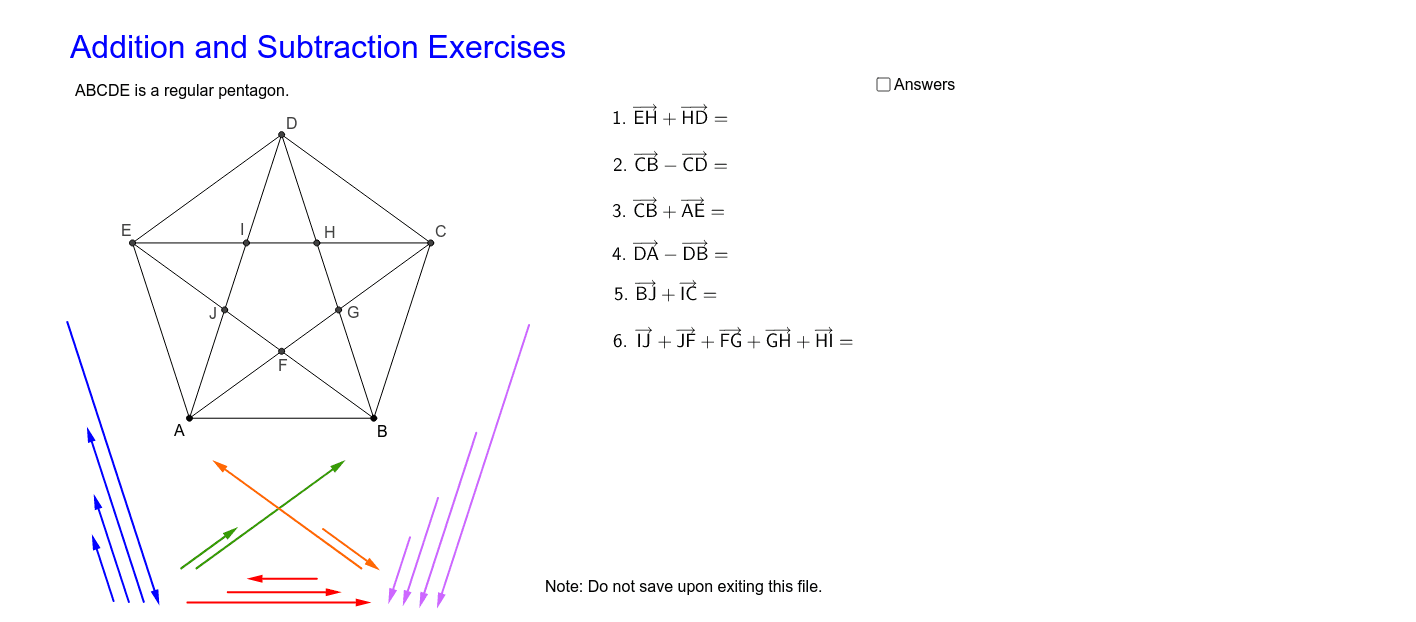
This example demonstrates interactive exercises on vector addition and subtraction, highlighting geometric transformations and coordinate geometry. It constructs vectors, polygons, and intersections using commands like Polygon, Segment, Intersect, Vector, and Translate in GeoGebra, suitable for high school mathematics instruction or student exploration of vector properties.
GeoGebra Commands & Parameters
Polygon(A, B, 5) → poly1, a, b, c, d, e, C_2, D_1, E_1Segment(E_1, A) → fSegment(A, B) → gSegment(B, C_2) → hSegment(C_2, D_1) → iSegment(D_1, E_1) → jSegment(E_1, C_2) → kSegment(D_1, B) → lSegment(D_1, A) → mSegment(C_2, A) → nSegment(E_1, B) → pIntersect(n, p) → FIntersect(l, n) → GIntersect(k, l) → HIntersect(k, m) → IIntersect(m, p) → JVector(E_1, D_1) → uVector(E_1, H) → vVector(H, D_1) → wTranslate(K, u) → K'Vector(K, K') → zTranslate(L, w) → L'Vector(L, L') → qTranslate(M, v) → M'Vector(M, M') → rVector(C_2, B) → sVector(C_2, D_1) → tTranslate(O, s) → O'Vector(O, O') → u_1Translate(N, t) → N'Vector(N, N') → v_1Vector(D_1, B) → w_1Translate(P, w_1) → P'Vector(P, P') → z_1Vector(A, E_1) → a_1Translate(Q, a_1) → Q'Vector(Q, Q') → b_1Vector(H, C_2) → c_1Translate(R, c_1) → R'Vector(R, R') → d_1Vector(D_1, A) → e_1Translate(S, e_1) → S'Vector(S, S') → f_1Vector(D_1, I) → g_1Translate(T, g_1) → T'Vector(T, T') → h_1Vector(I, J) → i_1Vector(J, F) → j_1Vector(F, G) → k_1Vector(G, H) → l_1Vector(H, I) → m_1Translate(U, i_1) → U'Vector(U, U') → n_1Translate(V, j_1) → V'Vector(V, V') → p_1Translate(W, k_1) → W'Vector(W, W') → q_1Translate(Z, l_1) → Z'Vector(Z, Z') → r_1Translate(A_1, m_1) → B_1Vector(A_1, B_1) → s_1Segment(A_2, B_2) → g_2Intersect(i, j) → DIntersect(h, i) → CIntersect(f, j) → EVector(D, A) → t_1Vector(A, D) → u_2Translate(G_1, t_1) → H_1
AI Drawing Prompt Reference
Draw a pentagon and connect each vertex to the intersection points of the diagonals, forming several triangles. Then, draw vectors from the center of the pentagon representing vector addition and subtraction. Finally, translate and draw the opposite vectors to illustrate geometric transformations of the vectors.
The prompt above was compiled from the original drawing commands and is for reference only.