
Vecten Problem: Geometric Exploration with Squares and Triangles
Loading the math board and drawing, please wait…
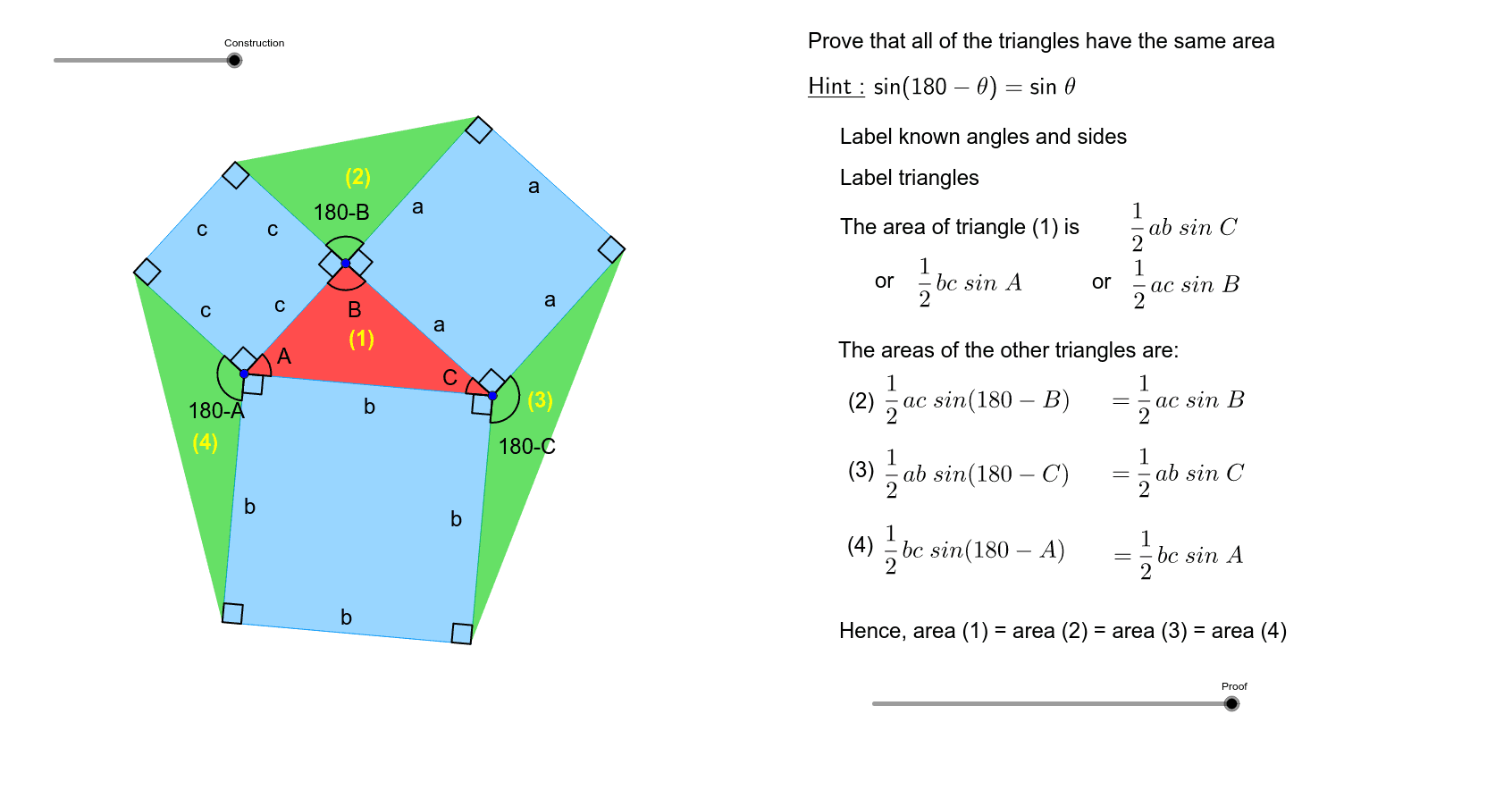
① This GeoGebra example demonstrates the Vecten configuration, where squares are constructed on the sides of a triangle, and explores the area relationships among the resulting shapes, with a full solution attached. ② Core mathematical concepts include triangle area, sine rule, square properties, trigonometry, and 2D vectors, with extensions to prisms and conic sections. ③ Construction highlights: using GeoGebra's Polygon command to create triangle poly1 and squares poly2 through poly7 on each side, Angle command to mark key angles, and points A, B, C with derived points D, E, F, G, H, I to build auxiliary lines; the command list includes polygons, angles, and side lengths. ④ Suitable for GCSE/IGCSE extension or high school geometry, this example trains students in area calculation, trigonometric identities, and integrated geometric construction.
GeoGebra Commands & Parameters
Polygon(A, B, C) → poly1, c, a, bPolygon(A, B, 4) → poly2, d, e, f, g, D, EPolygon(B, C, 4) → poly3, h, i, j, k, F, GPolygon(C, A, 4) → poly4, l, m, n_1, p, H, IPolygon(D, G, B) → poly5, b_1, d_1, g_1Polygon(E, A, H) → poly6, h_1, e_1, a_1Polygon(I, C, F) → poly7, f_1, i_1, c_1Angle(A, B, C) → αAngle(B, C, A) → βAngle(C, A, B) → γAngle(E, A, H) → δAngle(B, A, E) → εAngle(D, B, A) → ζAngle(A, E, D) → ηAngle(E, D, B) → θAngle(C, B, G) → ιAngle(G, F, C) → κAngle(F, C, B) → λAngle(B, G, F) → μAngle(H, A, C) → νAngle(A, C, I) → ξAngle(C, I, H) → οAngle(I, H, A) → ρAngle(I, C, F) → σAngle(G, B, D) → τ