
Variety of Perimeters with Fixed Area
Loading the math board and drawing, please wait…
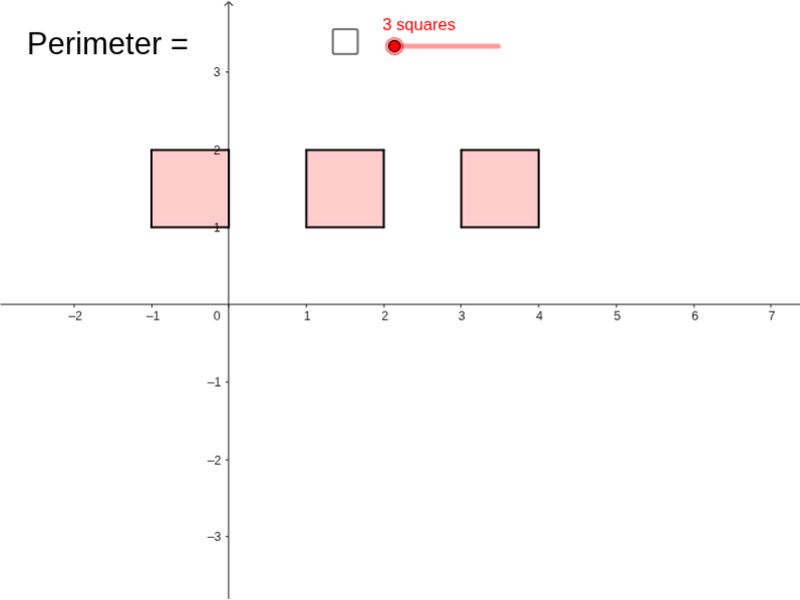
This GeoGebra interactive example demonstrates the fascinating variety of perimeters that plane figures can have when their area is kept strictly constant, visually illustrating the non-one-to-one correspondence between area and perimeter. The core mathematical concepts involved include the geometry of plane shapes, the calculation of perimeters and areas, vertex coordinate transformations, and the foundational ideas behind the isoperimetric inequality. To construct this dynamic model, key GeoGebra commands such as `If` (for conditional logic and parameter control), `Polygon` (to draw the varying shapes), and `Text` (for dynamic labeling) are utilized, manipulating a series of objects like $D_1, A_1, B_9, n$ to generate a family of polygons with constant area but varying boundary lengths. This tool is highly suitable for secondary school mathematics (middle to high school level), particularly for inquiry-based geometry lessons, math lab experiments, and visual teaching curricula aimed at helping students overcome the common misconception that equal areas must have equal perimeters.
GeoGebra Commands & Parameters
If(n ≥ 1, true, false) → o_1If(n ≥ 9, true, false) → o_9If(n ≥ 2, true, false) → o_2If(n ≥ 5, true, false) → o_5If(n ≥ 6, true, false) → o_6If(n ≥ 7, true, false) → o_7If(n ≥ 8, true, false) → o_8If(n ≥ 4, true, false) → o_4If(n ≥ 3, true, false) → o_3Polygon(A_1, B_1, C_1, D_1) → poly1_1, poly1a_1, poly1b_1, poly1c_1, poly1d_1Polygon(A_2, B_2, C_2, D_2) → poly1_2, poly1a_2, poly1b_2, poly1c_2, poly1d_2Polygon(A_3, B_3, C_3, D_3) → poly1_3, poly1a_3, poly1b_3, poly1c_3, poly1d_3Polygon(A_4, B_4, C_4, D_4) → poly1_4, poly1a_4, poly1b_4, poly1c_4, poly1d_4Polygon(A_5, B_5, C_5, D_5) → poly1_5, poly1a_5, poly1b_5, poly1c_5, poly1d_5Polygon(A_6, B_6, C_6, D_6) → poly1_6, poly1a_6, poly1b_6, poly1c_6, poly1d_6Polygon(A_7, B_7, C_7, D_7) → poly1_7, poly1a_7, poly1b_7, poly1c_7, poly1d_7Polygon(A_8, B_8, C_8, D_8) → poly1_8, poly1a_8, poly1b_8, poly1c_8, poly1d_8Polygon(A_9, B_9, C_9, D_9) → poly1_9, poly1a_9, poly1b_9, poly1c_9, poly1d_9Text("Perimeter 2") → A3Text("Perimeter 1") → A2Text("Perimeter 3") → A4Text("Perimeter 4") → A5Text("Perimeter 5") → A6Text("Perimeter 6") → A7Text("Perimeter 7") → A8Text("Perimeter 8") → A9Text("Perimeter 9") → A10Text("Perimeter 10") → A11
AI Drawing Prompt Reference
Please draw a set of polygons with the same area but different perimeters, displayed on a plane. The vertex coordinates of these polygons will vary based on a parameter n, which ranges from 1 to 9. Each polygon has four vertices, and the perimeter of each polygon changes as n increases. Please label the corresponding perimeter value next to each polygon to visually demonstrate the non-one-to-one correspondence between area and perimeter.
The prompt above was compiled from the original drawing commands and is for reference only.