
Variable Cube 2
Loading the math board and drawing, please wait…
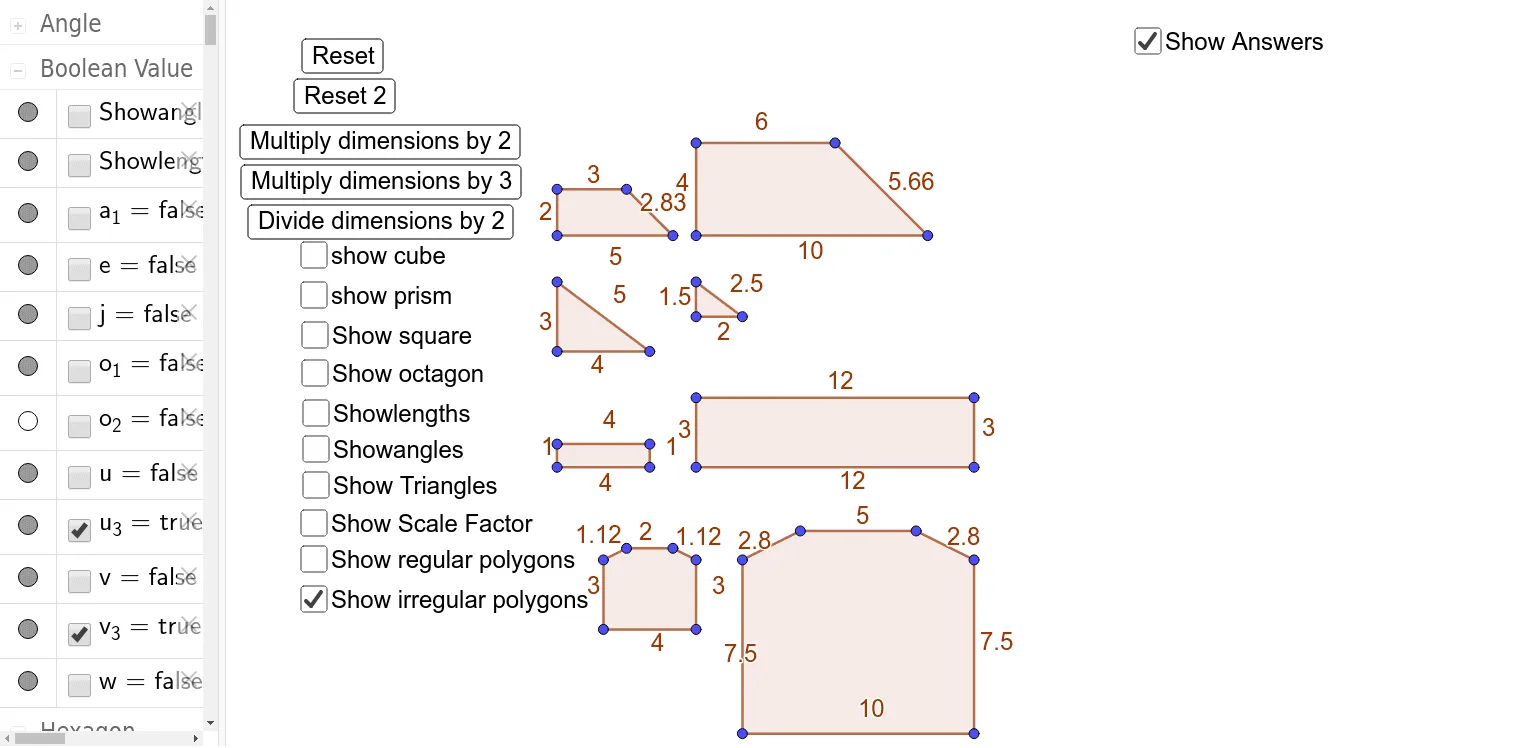
This example demonstrates the geometric construction of a variable cube. Key mathematical concepts include solid geometry, prisms, and pyramids. Using GeoGebra commands such as Polygon, Prism, and Angle, the size of the cube can be dynamically adjusted. Suitable for high school students and teachers for teaching geometric construction and solid geometry.
GeoGebra Commands & Parameters
Polygon(A, B, C, D) → q1, a, b, c, dPrism(q1, n) → f, I, edgeAI, edgeBJ, edgeCK, edgeDL, edgeIJ, edgeJK, edgeKL, edgeIL, J, K, L, faceABJI, faceBCKJ, faceCDLK, faceADLI, faceIJKLPolygon(E, F, G, H, M, N, O, P) → poly1, e_1, f_1, g, h, m, n_1, o, pPrism(poly1, 0) → i, Q, faceFGSR, faceGHTS, faceHMUT, faceMNVU, faceNOWV, faceOPZW, faceEPZQ, faceQRSTUVWZ, edgeEQ, edgeFR, R, edgeGS, edgeHT, edgeMU, edgeNV, edgeOW, edgePZ, edgeQR, edgeRS, edgeST, edgeTU, S_2, edgeUV, edgeVW, edgeWZ, edgeQZ, T, U, V, W, Z, faceEFRQPrism(faceQRSTUVWZ, k) → l, I_1, face12, face13, face14, face15, face16, face17, face11, face18, edge17, edge18, J_1, edge19, edge20, edge21, edge22, edge23, edge24, edge25, edge27, edge28, edge29, K_1, edge30, edge31, edge32, edge26, L_1, M_1, N_1, O_1, P_1, face10Polygon(A_1, B_1, 4) → poly2, q, r, s, t, C_1, D_1Polygon(E_1, F_1, 8) → poly3, g_1, H_1, Q_1, R_1, S_1, T_1, h_1, i_1, j_1, k_1, l_1, m_1, p_1, G_1Polygon(U_1, V_1, W_1, Z_1, A_2) → poly4, u_1, v_1, w_1, z_1, a_2Polygon(S, B_2, C_2, D_2, E_2) → poly5, s_1, b_2, c_2, d_2, e_2Angle(E_2, D_2, C_2) → αAngle(C_2, B_2, S) → βAngle(D_2, C_2, B_2) → γAngle(A_2, Z_1, W_1) → δAngle(W_1, V_1, U_1) → εAngle(Z_1, W_1, V_1) → ζPolygon(F_2, G_2, H_2) → t1, h_2, f_2, g_2Polygon(I_2, J_2, K_2) → t2, k_2, i_2, j_2Polygon(L_2, M_2, 6) → poly6, q_1, Q_2, r_1, t_1, b_1, c_1, d_1, N_2, O_2, P_2Polygon(L_3, M_3, 6) → poly6_1, q_2, Q_3, r_2, t_2, b_3, c_3, d_3, N_3, O_3, P_3Polygon(R_2, T_2, 3) → poly7, l_2, m_2, n_2, U_2Polygon(V_2, W_2, 3) → poly8, p_2, s_2, f_3, Z_2Polygon(A_3, B_3, 5) → poly9, g_3, h_3, i_3, j_3, k_3, C_3, D_3, E_3Polygon(F_3, G_3, 5) → poly10, l_3, m_3, n_3, p_3, q_3, H_3, I_3, J_3Polygon(K_3, R_3, 4) → poly11, r_3, s_3, t_3, a_3, S_3, T_3Polygon(U_3, V_3, 4) → poly12, e_3, f_4, g_4, h_4, W_3, Z_3Polygon(A_4, B_4, C_4, D_4) → q2, a_4, b_4, c_4, d_4Polygon(E_4, F_4, G_4, H_4) → q3, e_4, f_5, g_5, h_5Polygon(I_4, J_4, K_4) → t3, k_4, i_4, j_4Polygon(L_4, M_4, N_4) → t4, n_4, l_4, m_4Polygon(O_4, P_4, Q_4, R_4) → q4, o_4, p_4, q_4, r_4Polygon(S_4, T_4, U_4, V_4) → q5, s_4, t_4, u_4, v_4Polygon(W_4, Z_4, A_5, B_5, C_5, D_5) → poly13, w_4, z_4, a_5, b_5, c_5, d_5Polygon(E_5, F_5, G_5, H_5, I_5, J_5) → poly14, e_5, f_6, g_6, h_6, i_5, j_5