
Upside-Down Pyramid: Rate & Accumulation
Loading the math board and drawing, please wait…
In collections
Rate & Accumulation Yr 4 Much&Fast
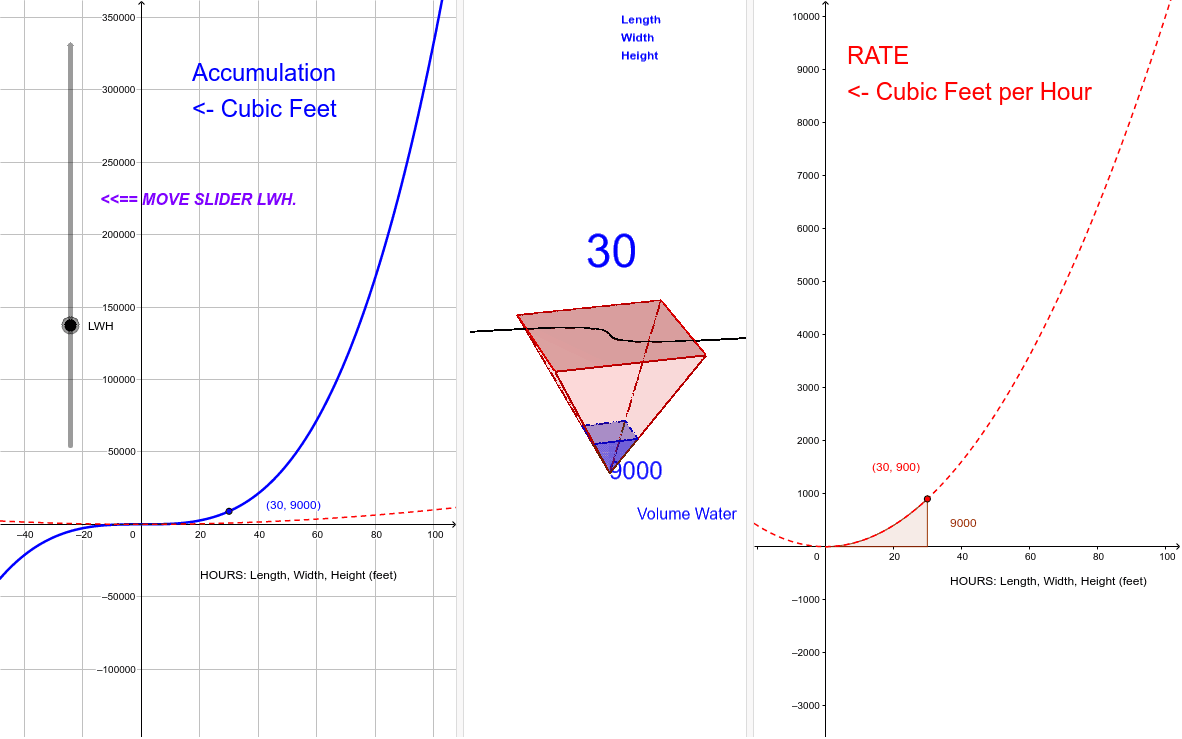
This example demonstrates the rate and accumulation process of an upside-down pyramid. Key mathematical concepts include derivatives, volume, and exponential functions. Using GeoGebra commands such as Polygon, Pyramid, Text, CurveCartesian, and Integral, an upside-down pyramid model is constructed. Suitable for high school mathematics education, particularly in calculus and solid geometry courses.
GeoGebra Commands & Parameters
Polygon(H, G, E, F) → poly1, h, g, e, fPyramid(poly1, -10) → a, J, faceGHJ, faceEGJ, faceEFJ, faceFHJ, edgeHJ, edgeGJ, edgeEJ, edgeFJPolygon(N, M, K, L) → poly2, n, m, k, lPyramid(poly2, (-2 * LWH)) → b, O, face1, face2, face3, face4, edge1, edge2, edge3, edge4Text(WaterLWH) → text1Text(Vol) → text3CurveCartesian((u, V(u)), u, -10, 10) → cIntegral(V', 0, WaterLWH) → d
AI Drawing Prompt Reference
Draw an upside-down pyramid model to demonstrate its volume and accumulation process, featuring a base polygon and a top point, constructed using polygon and pyramid commands, with labels for volume and an accumulation curve showing the range from -10 to 10, and an integral representing the accumulation.
The prompt above was compiled from the original drawing commands and is for reference only.