
Universal Abacus
Loading the math board and drawing, please wait…
In collections
Arithmetic Operations (preGED)
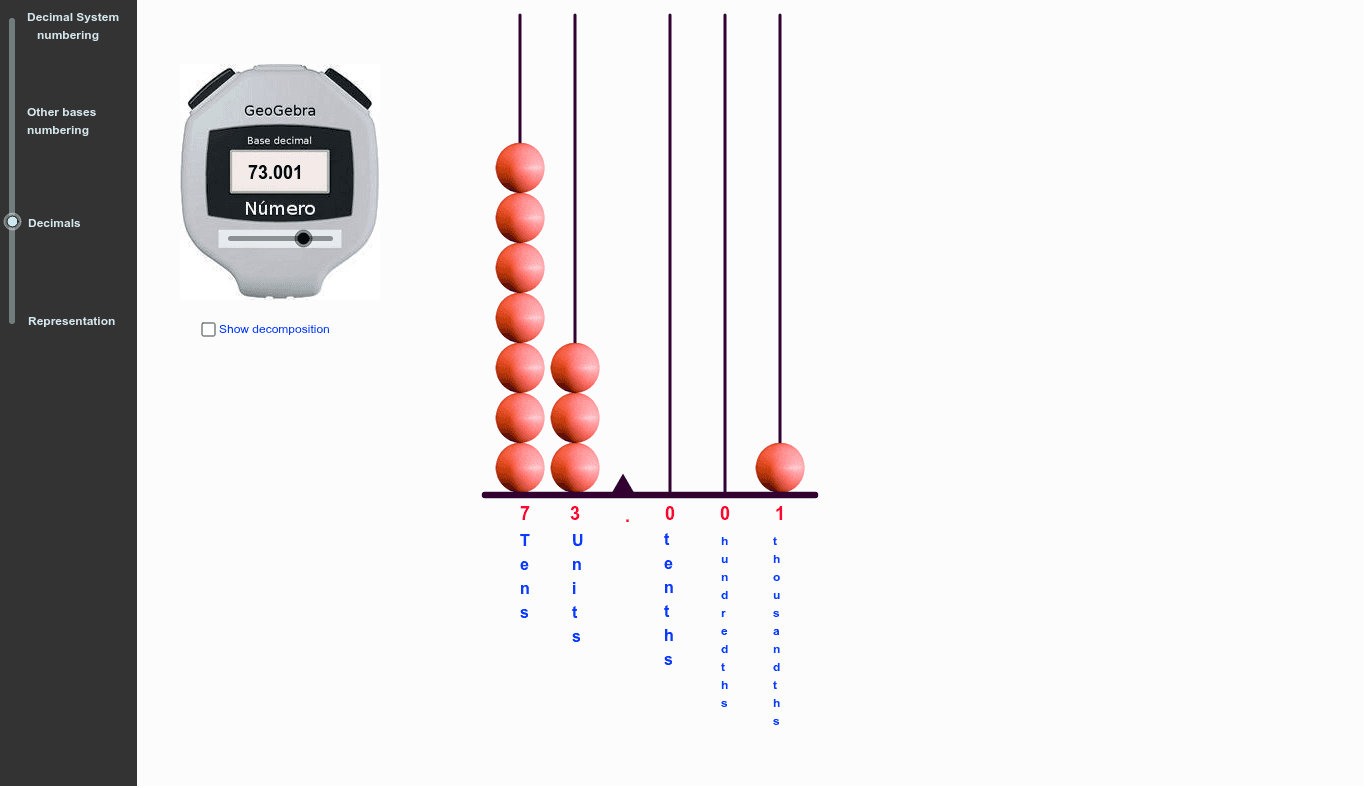
This example demonstrates a versatile abacus capable of operating in various bases from binary to hexadecimal. It involves core mathematical concepts like base conversion, modular arithmetic, and geometric constructions. The construction utilizes GeoGebra commands and objects such as If, Mod, Segment, Sequence, and Point. It is suitable for high school students and math enthusiasts for teaching base conversion and algorithm visualization.
GeoGebra Commands & Parameters
If(z ≟ 3, num, num1) → nuMod(num, base) → d1Mod(Div[num, base], base) → d2Mod(Div[Div[num, base], base], base) → d3Mod(Div[Div[Div[num, base], base], base], base) → d4Mod(Div[Div[Div[Div[num, base], base], base], base], base) → d5Mod(Div[Div[Div[Div[Div[num, base], base], base], base], base], base) → d6Mod(Div[Div[Div[Div[Div[Div[num, base], base], base], base], base], base], base) → d7Mod(Div[Div[Div[Div[Div[Div[Div[num, base], base], base], base], base], base], base], base) → d8Mod(Div[Div[Div[Div[Div[Div[Div[Div[num, base], base], base], base], base], base], base], base], base) → d9Mod(Div[Div[Div[Div[Div[Div[Div[Div[Div[num, base], base], base], base], base], base], base], base], base], base) → d10Segment((3.5, -3.6), (14.5, -3.6)) → aSegment((5.4, -3.6), (11.4, -3.6)) → bSegment((5.4, -3.6), (12, -3.6)) → cSequence(Segment[(5 + (1.1 * t), (-3.6)), (5 + (1.1 * t), (-3.5) + 9.5)], t, 1, 2) → L25Sequence(Segment[(5.8 + (1.1 * t), (-3.6)), (5.8 + (1.1 * t), (-3.5) + 9.5)], t, 3, 5) → L26Sequence(Sequence[(4.5 + t, s), t, 0, 10], s, -4, 4, 4) → L31Sequence(Segment[(4.3, s), (14.7, s)], s, -4, 4, 4) → L32Sequence({(4.5, s), (14.5, s)}, s, -4, 4, 4) → L33Segment((4.2, -3.7), (14.8, -3.7)) → dPoint(d) → BSegment((4.2, 0.3), (14.8, 0.3)) → eSegment((4.2, 4.3), (14.8, 4.3)) → fPoint(e) → CPoint(f) → DSequence(Sequence[Translate[cuenta, Vector[(11.7 - (1.1 * t), s - 4.05)]], s, 1, Element[L11, t]], t, 1, 7) → lista1Sequence(Sequence[Translate[cuenta, Vector[(11.6 - (1.1 * t), s - 4.05)]], s, 1, Element[L11, t]], t, 4, 5) → lista3Sequence(Sequence[Translate[cuenta, Vector[(12.4 - (1.1 * t), s - 4.05)]], s, 1, Element[L11, t]], t, 1, 3) → lista4Sequence(Sequence[Translate[cuentap, Vector[(15 - (1.1 * t), (0.6 * s) - 3.85)]], s, 1, Element[L01, t]], t, 1, 10) → lista2Sequence(Segment[(5.1 + (1.1 * t), (-3.6)), (5.1 + (1.1 * t), (-3.5) + 9.5)], t, 1, 5) → L12Sequence(Segment[(2.9 + (1.1 * t), (-3.6)), (2.9 + (1.1 * t), (-3.5) + Min[base, 10] - 0.5)], t, 1, 10) → L02
AI Drawing Prompt Reference
This is a geometric illustration of converting a multi-digit decimal number from binary to hexadecimal. The figure includes colored blocks representing digits, which are moved and rotated to show the conversion process. There are line segments and points that represent conversion steps, along with a central point to mark the final result. The construction order starts with basic digit blocks and gradually adds and moves them to visualize each step of the conversion.
The prompt above was compiled from the original drawing commands and is for reference only.