
Unitary Fractions: The Rectangle Model
Loading the math board and drawing, please wait…
In collections
Fraction worksheets
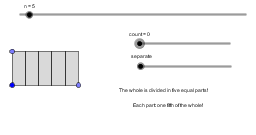
This example demonstrates how to use the rectangle model to understand unitary fractions. Unitary fractions are fractions with a numerator of 1, and the rectangle model visually shows the relationship between their area and the whole. Core mathematical concepts include fractions, area, geometric intuition, and integral ideas. Construction highlights the use of GeoGebra commands Ray, Point, OrthogonalLine, Intersect, Distance, Sequence; objects include separate, n, ang, O, nome, partes, count, angr, A, B, C, f, g, D, E, h, i, F, base, altura, lista1, lista2, lista3, texto1. Suitable for middle school and above students learning about fractions and integral concepts, or for mathematical teaching demonstrations.
GeoGebra Commands & Parameters
Ray(A, B) → fRay(A, C) → gPoint(f) → DPoint(g) → EOrthogonalLine(D, f) → hOrthogonalLine(E, g) → iIntersect(h, i) → FDistance(A, D) → baseDistance(A, E) → alturaSequence(Polygon[(x(A) + ((i - 1) * base / n) + ((i - 1) * separate), y(A)), (x(A) + (i * base / n) + ((i - 1) * separate), y(A)), (x(A) + (i * base / n) + ((i - 1) * separate), y(A) + altura), (x(A) + ((i - 1) * base / n) + ((i - 1) * separate), y(A) + altura)], i, 1, n) → lista1Sequence(Polygon[(x(A) + ((i - 1) * base / n) + ((i - 1) * separate), y(A)), (x(A) + (i * base / n) + ((i - 1) * separate), y(A)), (x(A) + (i * base / n) + ((i - 1) * separate), y(A) + altura), (x(A) + ((i - 1) * base / n) + ((i - 1) * separate), y(A) + altura)], i, 1, count) → lista2Sequence(Polygon[(x(A) + ((i - 1) * base / n) + ((i - 1) * separate), y(A)), (x(A) + (i * base / n) + ((i - 1) * separate), y(A)), (x(A) + (i * base / n) + ((i - 1) * separate), y(A) + altura), (x(A) + ((i - 1) * base / n) + ((i - 1) * separate), y(A) + altura)], i, 1, count) → lista3
AI Drawing Prompt Reference
Draw a rectangle and divide it into multiple small rectangles to represent unit fractions, showing the relationship between each fraction's area and the whole. Start by drawing two rays that intersect to form one corner of the rectangle, then draw two perpendicular line segments to find their intersection point. Next, divide the rectangle into smaller parts, each representing a unit fraction, and draw these parts sequentially to visually demonstrate the area relationship of unit fractions.
The prompt above was compiled from the original drawing commands and is for reference only.