
Sum of Exterior Angles of a Regular Polygon
Loading the math board and drawing, please wait…
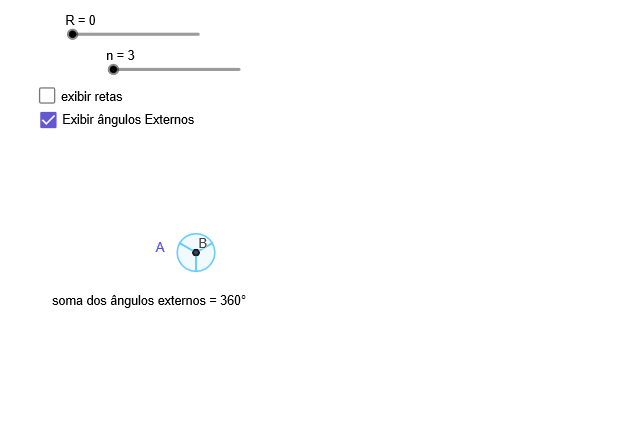
This example demonstrates how to calculate and visualize the sum of exterior angles of a polygon. It involves core math concepts like exterior angles, interior angles, and angle sums. Construction highlights include using GeoGebra commands like Sequence, Polygon, Length, and Sum, with objects A, R, B, n, l1, pol1, a, l2, l3, l4, b, c, s, texto1. Suitable for middle school and above students to understand and verify the theorem on the sum of exterior angles of polygons.
GeoGebra Commands & Parameters
Sequence(Rotate[B, ((2 * pi) * i / n), A], i, 0, n) → l1Polygon(l1) → pol1Length(l1) → aSequence(Element[l1, i], i, 1, n) → l2Sequence(Line[Element[l2, i], Element[l2, Mod[i, n] + 1]], i, 1, n) → l3Sequence(Angle[Element[l3, i], Element[l3, Mod[i, n] + 1]], i, 1, n) → l4Sum(l4) → s
AI Drawing Prompt Reference
Draw a regular polygon with n sides, where each side has equal length. The sum of the exterior angles of the polygon is equal to 2π. Draw the exterior angles of the polygon, including the measure of each angle. Calculate the sum of these angles.
The prompt above was compiled from the original drawing commands and is for reference only.