
Pythagorean Theorem Proof via Areas
Loading the math board and drawing, please wait…
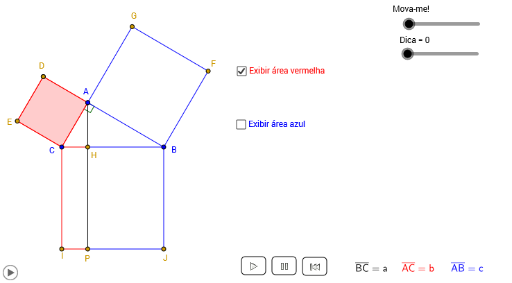
This example demonstrates the Pythagorean Theorem through areas. It involves key mathematical concepts such as geometric area calculation and properties of triangles. Using GeoGebra commands like Ray, Point, Midpoint, Semicircle, Segment, Angle, and Polygon, a clear diagram is constructed to illustrate the theorem's proof. Suitable for middle school and above students learning geometric proofs.
GeoGebra Commands & Parameters
Ray(A, XA) → aPoint(a) → BMidpoint(A, B) → OSemicircle(A, B) → cPoint(c) → CSegment(A, B) → bSegment(B, C) → dSegment(C, A) → eAngle(A, C, B) → αPolygon(A, C, 4) → poly1, a_1, d_1, f, g, D, EPolygon(C, B, 4) → poly2, d_2, b_1, h, i, F, GPolygon(B, A, 4) → poly3, b_2, a_2, j, k, H_1, ISegment(C, D) → lSegment(D, E) → mSegment(E, A) → nSegment(A, H_1) → pSegment(H_1, I) → qSegment(I, B) → rSegment(B, F) → sSegment(F, G) → t_1Segment(G, C) → c_1Line(A, B) → e_1OrthogonalLine(C, e_1) → f_1Intersect(e_1, f_1) → HIntersect(f_1, q) → D_1Min(1, Max[t, 0]) → ct1Segment(C, D_1) → g_1Polygon(E, A, PC, PD) → poly4, e_2, a_3, pc, pdMin(Max[t - 1, 0], 1) → ct2Rotate(WD, (-θ), A) → ZD'Rotate(B, (-θ), A) → WRotate(B, (-θ), A) → B'Rotate(E, (-θ), A) → E'Polygon(A, B', ZD', E') → poly5, a_4, b', zd', e'Rotate(WD, -1.5707963267948966, A) → WD'Min(Max[t - 2, 0], 1) → ct3Polygon(W, J, K, A) → poly6, b'_1, j_1, k_1, a_5Polygon(L, B, F, M) → poly7, l_1, b_3, f_2, m_1Rotate(N, θ, B) → N'_1Rotate(F, θ, B) → F'Rotate(A, θ, B) → A'Polygon(A', B, F', N'_1) → poly8, a', b_4, f', n'Rotate(N, 1.5707963267948966, B) → N'Polygon(P, Q, I, B) → poly9, p_1, q_1, i_1, b_5Segment(H_1, D_1) → h_1Segment(A, H) → n_1Segment(H, B) → r_1Segment(D_1, H) → s_1Segment(H, C) → c_2Segment(D_1, I) → g_2If(Dica ≥ 1, true, false) → showHint1Point(h_2) → SSegment(E, WD) → j_2Segment(F, N) → k_2If(Dica ≥ 2, true, false) → showHint2If(Dica ≥ 3, true, false) → showHint3
AI Drawing Prompt Reference
Draw a right triangle ABC with AB as the hypotenuse and BC and AC as the legs. Construct a semicircle with AB as the diameter, and connect the midpoints O of BC and AC. Draw two semicircles with B and C as centers and BC and AC as radii, and connect the points to form several quadrilaterals and triangles, illustrating the area proof of the Pythagorean theorem.
The prompt above was compiled from the original drawing commands and is for reference only.